
ORIGINAL ARTICLE
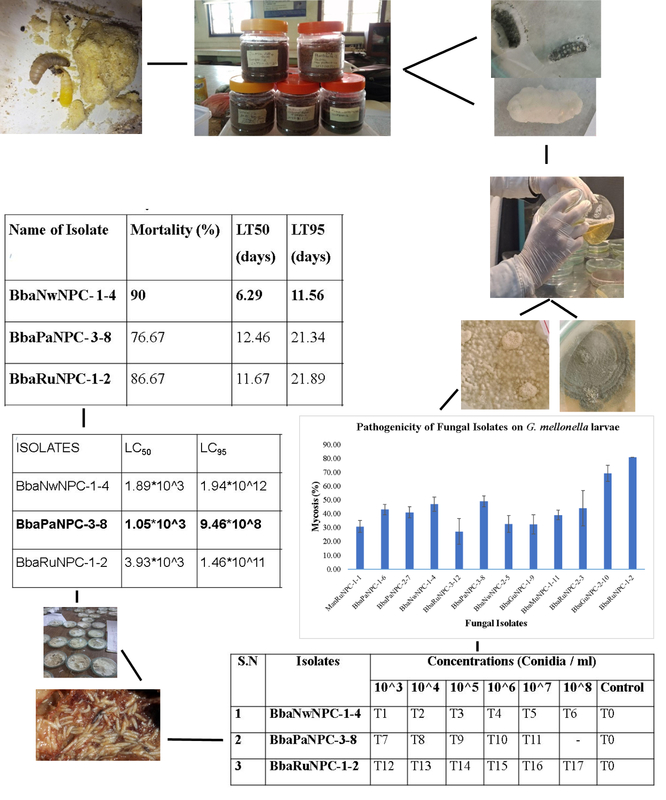
Assessment of Insecticidal Potential of Indigenous Beauveria bassiana Isolates Against Oriental Fruit Fly (Bactrocera dorsalis) In Laboratory Conditions.
1
Department of Agriculture Entomology and Plant Protection, Institute of Agriculture and Animal Science, Paklihawa, 32914, Bhairahawa, Nepal
A - Research concept and design; B - Collection and/or assembly of data; C - Data analysis and interpretation; D - Writing the article; E - Critical revision of the article; F - Final approval of article
Submission date: 2025-10-04
Acceptance date: 2026-01-29
Online publication date: 2026-02-13
Corresponding author
Samir Gnawali
Department of Agriculture Entomology and Plant Protection, Institute of Agriculture and Animal Science, Paklihawa, 32914, Bhairahawa, Nepal
Department of Agriculture Entomology and Plant Protection, Institute of Agriculture and Animal Science, Paklihawa, 32914, Bhairahawa, Nepal
HIGHLIGHTS
- • Local isolates of entomopathogenic fungi were obtained via Galleria bait method
- They were assessed against Galleria mellonella and Bactrocera dorsalis
- • Isolate BbaNwNPC-1-4 was most effective with 90% mortality and LT50 of 6.29 days
- • Isolates BbaRuNPC-1-2 (86.67%) with LT50 12.46 days followed
- • All the strains assessed were found to be pathogenic
KEYWORDS
TOPICS
ABSTRACT
The indiscriminate use of chemical pesticides to control insect pests has caused various ecological and human health hazards. This study evaluated the potential of indigenous isolates of entomopathogenic fungi (EPFs) as an eco-friendly insecticidal alternative against fruit flies (Bactrocera dorsalis). Eleven isolates of Beauveria bassiana and a single isolate of Metarhizium anisopliae were obtained from soil samples from different areas using the Galleria-bait technique. Pathogenicity tests against Galleria mellonella larvae (at 1×10⁵ conidia·ml⁻¹) identified three most effective isolates (BbaRuNPC-1-2, BbaPaNPC-3-8, and BbaNwNPC-1-4) for virulence testing against B. dorsalis larvae in vitro through contact application.
Probit regression studies showed that the isolate BbaNwNPC-1-4 was the most effective, causing 90% mortality with a lethal time (LT50) value of 6.29 days and a lethal concentration (LC50) of 1.89*103 conidia.ml-1 followed by BbaRuNPC-1-2 (86.67%) and BbaPaNPC-3-8 (76.67%) with LT50 values of 11.67 and 12.46 days, respectively. The isolate BbaPaNPC-3-8 had the lowest LC50 value of 1.05*103 conidia.ml-1 making it 1.18 times and 3.74 times more lethal than the isolates BbaNwNPC-1-4 and BbaRuNPC-1-2 with values 1.89*103 and 3.93*103 conidia . ml-1, respectively.
These findings indicate that B. bassiana isolates, particularly BbaNwNPC-1-4 for rapid mortality and BbaPaNPC-3-8 for concentration efficiency, could offer promising biological control alternatives for management of B. dorsalis in integrated pest management programs.
CONFLICT OF INTEREST
The authors have declared that no conflict of interests exist.
| eISSN: | 1899-007X |
| ISSN: | 1427-4345 |

We process personal data collected when visiting the website. The function of obtaining information about users and their behavior is carried out by voluntarily entered information in forms and saving cookies in end devices. Data, including cookies, are used to provide services, improve the user experience and to analyze the traffic in accordance with the Privacy policy. Data are also collected and processed by Google Analytics tool (more).
You can change cookies settings in your browser. Restricted use of cookies in the browser configuration may affect some functionalities of the website.
You can change cookies settings in your browser. Restricted use of cookies in the browser configuration may affect some functionalities of the website.