
ORIGINAL ARTICLE
Enhancing sunflower growth and defense against Sclerotinia sclerotiorum stress with cyanogenic bacterial endophytes

1
Department of Microbiology, College of Basic Sciences and Humanities, Punjab Agricultural University, Ludhiana, India
2
Department of Soil Science, College of Agriculture, Punjab Agricultural University, Ludhiana, India
3
Oilseed Section, Department of Plant Breeding and Genetics, College of Agriculture, Punjab Agricultural University, Ludhiana, India
These authors had equal contribution to this work
A - Research concept and design; B - Collection and/or assembly of data; C - Data analysis and interpretation; D - Writing the article; E - Critical revision of the article; F - Final approval of article
Submission date: 2025-10-31
Acceptance date: 2026-01-19
Online pre-proof publication date: 2026-02-04
Corresponding author
Pratibha Vyas
Department of Microbiology, College of Basic Sciences and Humanities, Punjab Agricultural University, Ludhiana, India
Department of Microbiology, College of Basic Sciences and Humanities, Punjab Agricultural University, Ludhiana, India
HIGHLIGHTS
- Endophytes reduced Sclerotinia sclerotiorum growth and disease severity in plants
- Bacterial endophytes were able to produce various volatile organic compounds
- Sphingobacterium solani as a biocontrol agent is reported here for the first time
- Significant improvement in plant growth, total phenol and nutrients in plants
KEYWORDS
TOPICS
ABSTRACT
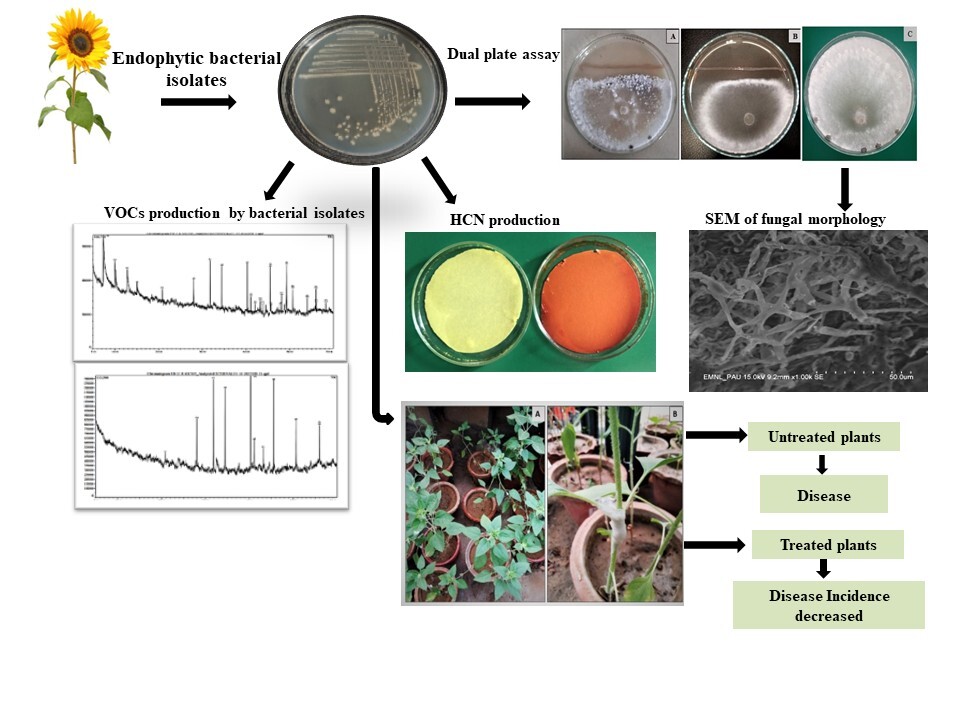
The present study was designed to check the ability of cyanogenic antagonistic bacterial endophytes to produce volatile organic compounds and enhance growth of sunflower under Sclerotinia sclerotiorum stress. Forty endophytic bacteria were isolated and screened for antagonism against Sclerotinia sclerotiorum. Out of 40 endophytes, two isolates SEB1 and SEB21exhibited fungal growth inhibition of 30.0 and 36.6%, respectively, in dual plate assay and 78.7 and 82%, respectively, in liquid media. Scanning electron microscopy showed rupturing, breakage and shrinkage of the fungal hyphae in the presence of the antagonistic bacterial strains. In addition, the bacterial strains also exhibited phosphate solubilization, and production of hydrogen cyanide, siderophores, auxins, ammonia, lipase and cellulases. The isolates were identified as Sphingobacterium solani SEB1 and Pseudomonas sp. SEB21 by 16S rRNA gene sequencing. GCMS analysis confirmed the presence of dimethyl-sulfone, phenol, 3-hexadecene, 2,4-ditertbutylphenol, 1-docosene, 1-octadecene, 2,4-dimethylphenylimino-4-nitrophenyl, nonylcyclopropane 1-nonadecene, octacosane, n-octadecanol, isopropyl myristate, 3-hexadecene, 7,9-di-tert-butyl-1-oxosiro-4,5-deca-6,9-diene, 3,5-bis (1,1-dimethylethyl)-phenol, isopropyl myristate, 7,9-ditert-butyl-1-oxospiro (4,5) deca-6,9-diene-2,8-dione, 1-tricosene and octacosanol as major volatile organic compounds produced by the bacterial strains. SEM analysis showed colonization of plant tissues by both the bacterial strains validating their endophytic nature. The bacterial treatments showed disease control up to 88.9% and significantly improved vigor index, plant growth, total phenol and chlorophyll content over the uninoculated control in sunflower grown under greenhouse conditions. The treatment SsSEB1+PspSEB21 in the presence of the fungal pathogen showed 1.41%, 0.47% and 6.8% N, P and K content in plants, respectively, which was the highest among all the treatments. Further field-level evaluations are recommended to validate the effectiveness of Sphingobacterium solani SEB1 and Pseudomonas sp. SEB21 as biological control agents. Sphingobacterium solani as a biocontrol agent and a plant growth-promoting endophyte is reported here for the first time.
RESPONSIBLE EDITOR
Beata Wielkopolan
CONFLICT OF INTEREST
The authors have declared that no conflict of interests exist.
Share
RELATED ARTICLE
| eISSN: | 1899-007X |
| ISSN: | 1427-4345 |

We process personal data collected when visiting the website. The function of obtaining information about users and their behavior is carried out by voluntarily entered information in forms and saving cookies in end devices. Data, including cookies, are used to provide services, improve the user experience and to analyze the traffic in accordance with the Privacy policy. Data are also collected and processed by Google Analytics tool (more).
You can change cookies settings in your browser. Restricted use of cookies in the browser configuration may affect some functionalities of the website.
You can change cookies settings in your browser. Restricted use of cookies in the browser configuration may affect some functionalities of the website.