
ORIGINAL ARTICLE
Assessment of some herbicide effects on the weed control and agronomic traits of Camelina sativa under irrigation and rainfed conditions
1
Department of Agronomy and Plant Breeding, Faculty of Agriculture, University of Maragheh, Maragheh, Iran, Maragheh, Iran
A - Research concept and design; B - Collection and/or assembly of data; C - Data analysis and interpretation; D - Writing the article; E - Critical revision of the article; F - Final approval of article
Submission date: 2024-11-16
Acceptance date: 2025-04-08
Online publication date: 2026-04-27
Corresponding author
Naser Sabaghnia
Department of Agronomy and Plant Breeding, Faculty of Agriculture, University of Maragheh, Maragheh, Iran, Maragheh, Iran
Department of Agronomy and Plant Breeding, Faculty of Agriculture, University of Maragheh, Maragheh, Iran, Maragheh, Iran
Journal of Plant Protection Research 2026;66(2):263-272
HIGHLIGHTS
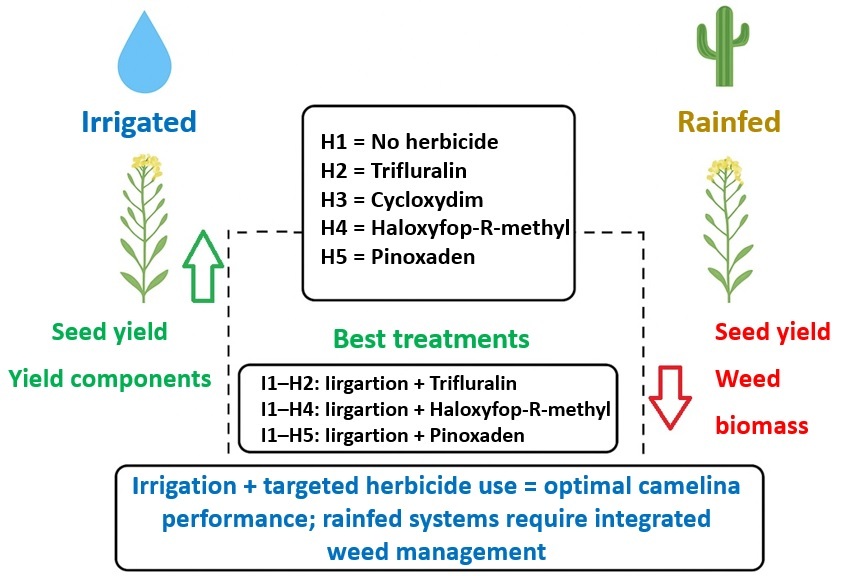
- cycloxydim, haloxyfop-p-methyl, and pinoxaden were useful under irrigated condition
- All above herbicides and trifluralin were useful under rainfed condition
- The availability of water strongly affected the effectiveness of herbicides
- Climate smart agriculture practices are needed in drought prone regions
KEYWORDS
TOPICS
ABSTRACT
Climatic fluctuations in semi-arid areas are modifying the dynamics of weeds in field crops
production. This trial was aimed to research the application of various herbicides on the
growth characteristics of camelina under irrigation and rainfed conditions in Maragheh,
Iran. Analyzing the data via treatment by a trait biplot model based on principal component
(PCA) indicated that the PCA1 and PCA2 explained 74 and 17% of the observed
variability, “respectively”. Most traits were grouped under the I1-H3 (irrigated + cycloxydim)
section while the number of siliques per plant was positioned with I1-H5 (irrigated
+ pinoxaden), and I1-H1 (irrigated + without herbicide) produced a high harvest index
as well as density and biomass of weeds. The seed yield, biological yield, thousand-seed
weight, seed number per silique, canopy diameter, chlorophyll content, plant height, and
the number of siliques per plant were correlated similar to association of weed density
with biomass. Herbicides H3, H4 (haloxyfop-R-methyl), and H5 were positively correlated
under irrigated conditions, while H2 (trifluralin), H3, H4, and H5 were positively associated
under rainfed circumstances. The number of siliques per plant, seeds per silique, and
seed yield demonstrated high discriminative ability as well as greater typical ability. Treatments
H2, H4 and H5 under irrigation conditions were identified as ideal or distinguishing
treatments. The response of treatments for seed yield indicated that H3, H4 and H5 under
full-irrigated conditions were the most effective in terms of yield performance. Overall,
this study underscored that the availability of water strongly affected the effectiveness of
herbicides, thus, it seems necessary to use climate smart agricultural practices in drought
prone regions such as supplemental irrigation to improve the effectiveness of acetyl CoA
carboxylase inhibitor herbicides.
ACKNOWLEDGEMENTS
We appreciate the kind favors of Dr. W. Yan (Agriculture
and Agri-Food Canada) for GGEbiplot application.
RESPONSIBLE EDITOR
Agnieszka Synowiec
CONFLICT OF INTEREST
The authors have declared that no conflict of interests exist.
REFERENCES (23)
1.
Alizade S., Keshtkar E., Mokhtasi-Bidgoli A., Sasanfar H., Streibig J.C. 2020. Effect of water deficit stress on benzoylprop-ethyl performance and physiological traits of winter wild oat (Avena sterilis subsp. ludoviciana). Crop Protection 137: 105292. DOI: https://doi.org/10.1016/j.crop....
2.
Alizade S., Keshtkar E., Mokhtassi‐Bidgoli A., Sasanfar H., Streibig J.C. 2021. Effect of drought stress on herbicide performance and photosynthetic activity of Avena sterilis subsp. ludoviciana (winter wild oat) and Hordeum spontaneum (wild barley). Weed Research 61 (4): 288–297. DOI: https://doi.org/10.1111/wre.12....
3.
Cierjacks A., Pommeranz M., Schulz K., Almeida-Cortez J. 2016. Is crop yield related to weed species diversity and biomass in coconut and banana fields of northeastern Brazil?. Agriculture, Ecosystems and Environment 220: 17–183. DOI: https://doi.org/10.1016/j.agee....
4.
Fallah F., Kahrizi D., Rezaeizad A., Zebarjadi A., Zarei L., Doğan H.Ü.L.Y.A. 2023. Assessment of genetic variability and genetic parameters of morphological and agro-physiological traits in Camelina sativa (L.). Turkish Journal of Agriculture and Forestry 47 (2): 242–251. DOI: https://doi.org/10.55730/1300-....
5.
Fattahi M., Janmohammadi M., Abasi A., Sabaghnia N. 2023. The effects of farmyard manure and nitrogen fertilizer on the performance of safflower. Agrotechniques in Industrial Crops 3 (4): 162–169. DOI: https://doi.org/10.22126/ATIC.....
6.
Gherekhloo J., Oveisi M., Zand E., De Prado R. 2016. A review of herbicide resistance in Iran. Weed Science 64 (4): 551–561. DOI: https://doi.org/10.1614/WS-D-1....
7.
Ghidoli M., Pesenti M., Colombo F., Nocito F.F., Pilu R., Araniti F. 2023. Camelina sativa (L.) crantz as a promising cover crop species with allelopathic potential. Agronomy 13 (8): 2187. DOI: https://doi.org/10.3390/agrono....
8.
Janmohammadi M., Kouchakkhani H., Sabaghnia N. 2024. The effect of supplemental irrigation and exogenous application of glycine betaine on chickpea performance in the semi-arid region. Journal of Agriculture Faculty of Ege University 61 (2): 189–199. DOI: https://doi.org/10.20289/zfder....
9.
Jiang Y., Caldwell C.D. 2016. Effect of nitrogen fertilization on camelina seed yield, yield components, and downy mildew infection. Canadian Journal of Plant Science 96 (1): 17–26. DOI: https://doi.org/10.1139/cjps-2....
10.
Jha P., Stougaard, R.N. 2013. Camelina (Camelina sativa) tolerance to selected preemergence herbicides. Weed Technology 27 (4): 712–717. DOI: https://doi.org/10.1614/WT-D-1....
11.
Jursík M., Hamouzová K., Hajšlová J. 2021. Dynamics of the degradation of acetyl-coA carboxylase herbicides in vegetables. Foods 10 (2): 405. DOI: https://doi.org/10.3390/foods1....
12.
Kahrizi D., Rostami H., Akbarabadi A., Razi Z., Fallah F. 2018. Report on the introduction of cultivars. Seed and Plant Certification and Registration 6: 24–27.
13.
Kulasekaran Ramesh K.R., Amar Matloob A.M., Farhena Aslam F.A., Florentine S.K., Chauhan, B.S. 2017. Weeds in a changing climate: vulnerabilities, consequences, and implications for future weed management. Frontiers in Plant Science 8: 95. DOI: https://doi.org/10.3389/fpls.2....
14.
Leclère M., Jeuffroy M.H., Butier A., Chatain C., Loyce, C. 2019. Controlling weeds in camelina with innovative herbicide-free crop management routes across various environments. Industrial Crops and Products 140: 111605. DOI: https://doi.org/10.1016/j.indc....
15.
Monadjemi S., Ter Halle A., Richard C. 2014. Accelerated dissipation of the herbicide cycloxydim on wax films in the presence of the fungicide chlorothalonil and under the action of solar light. Journal of Agricultural and Food Chemistry 62 (21): 4846–4851. DOI: https://doi.org/10.1021/jf5007....
16.
Peerzada A.M., Williams A., O’Donnell C., Adkins S. 2021. Effect of soil moisture regimes on the glyphosate sensitivity and morpho-physiological traits of windmill grass (Chloris truncata R. Br.), common sowthistle (Sonchus oleraceus L.), and flaxleaf fleabane [Conyza bonariensis (L.) Cronq.]. Plants 10 (11): 2345. DOI: https://doi.org/10.3390/plants....
17.
Sabaghnia N., Janmohammadi, M. 2016. Biplot analysis of silicon dioxide on early growth of sunflower. Plant Breeding and Seed Science 73 (1): 87. DOI: https://doi.org/10.1515/plass-....
18.
Sobiech Ł., Grzanka M., Kurasiak-Popowska D., Radzikowska D. 2020. Phytotoxic effect of herbicides on various camelina [Camelina sativa (L.) Crantz] genotypes and plant chlorophyll fluorescence. Agriculture 10 (5): 185. DOI: https://doi.org/10.3390/agricu....
19.
Sydor M., Kurasiak-Popowska D., Stuper-Szablewska K., Rogoziński T. 2022. Camelina sativa. Status quo and future perspectives. Industrial Crops and Products 187: 115531. DOI: https://doi.org/10.1016/j.indc....
20.
Xi N., Li Y., Xia, X. 2022. A review of pesticide phototransformation on the leaf surface: Models, mechanism, and influencing factors. Chemosphere 308: 136260. DOI: https://doi.org/10.1016/j.chem....
21.
Yan W. 2024. Two types of biplots to integrate multi‐trial and multi‐trait information for genotype selection. Crop Science 64 (3): 1608–1618. DOI: https://doi.org/10.1002/csc2.2....
22.
Yanniccari M., Gigón R., Larsen A. 2020. Cytochrome P450 herbicide metabolism as the main mechanism of cross-resistance to ACCase-and ALS-inhibitors in Lolium spp. populations from Argentina: a molecular approach in characterization and detection. Frontiers in Plant Science 11: 600301. DOI: https://doi.org/10.3389/fpls.2....
23.
Yari S., Sabaghnia N., Pasandi M., Janmohammadi M. 2018. Assessment of genotype × trait interaction of rye genotypes for some morphologic traits through GGE biplot methodology. Annales Universitatis Mariae Curie-Sklodowska, sectio C–Biologia 72:37–45. DOI: http://dx.doi.org/10.17951/c.2....
Share
RELATED ARTICLE
| eISSN: | 1899-007X |
| ISSN: | 1427-4345 |

We process personal data collected when visiting the website. The function of obtaining information about users and their behavior is carried out by voluntarily entered information in forms and saving cookies in end devices. Data, including cookies, are used to provide services, improve the user experience and to analyze the traffic in accordance with the Privacy policy. Data are also collected and processed by Google Analytics tool (more).
You can change cookies settings in your browser. Restricted use of cookies in the browser configuration may affect some functionalities of the website.
You can change cookies settings in your browser. Restricted use of cookies in the browser configuration may affect some functionalities of the website.