
ORIGINAL ARTICLE
Nanoparticle-Mediated Defense and Antiviral Protection in Roselle Against Hibiscus chlorotic ringspot virus (HCRSV)

1
Virus and Phytoplasma Research Department, Plant Pathology Research Institute, Agricultural Research Center, Cairo University Street, 11269, Giza, Egypt
2
Nanotechnology and Advanced Materials Central Lab., Regional Center for Food and Feed, Agricultural Research Center, Cairo University Street, 12619, Giza, Egypt
A - Research concept and design; B - Collection and/or assembly of data; C - Data analysis and interpretation; D - Writing the article; E - Critical revision of the article; F - Final approval of article
Submission date: 2025-10-24
Acceptance date: 2026-01-13
Online publication date: 2026-01-23
Corresponding author
Hayam Samy Abdelkader
Virus and Phytoplasma Research Department, Plant Pathology Research Institute, Agricultural Research Center, Cairo University Street, 11269, Giza, Egypt
Virus and Phytoplasma Research Department, Plant Pathology Research Institute, Agricultural Research Center, Cairo University Street, 11269, Giza, Egypt
HIGHLIGHTS
- CS–Ag NCs showed the strongest curative efficacy (~91.7%) with no phytotoxicity
- Nanoparticles enhanced antioxidant enzymes (PAL, POX, CAT) and boosted yield
- CS–Ag NCs upregulated sulfur-redox genes (SO, APK) and primed defense signaling
- Findings establish a safe, dose-dependent framework for nano-based viral control
- CS–Ag and CuO nanoparticles suppress HCRSV in roselle
KEYWORDS
copper oxide nanoparticlesHCRSVchitosan–silver nanocompositesdefense-related genesantiviral nanotechnology
TOPICS
ABSTRACT
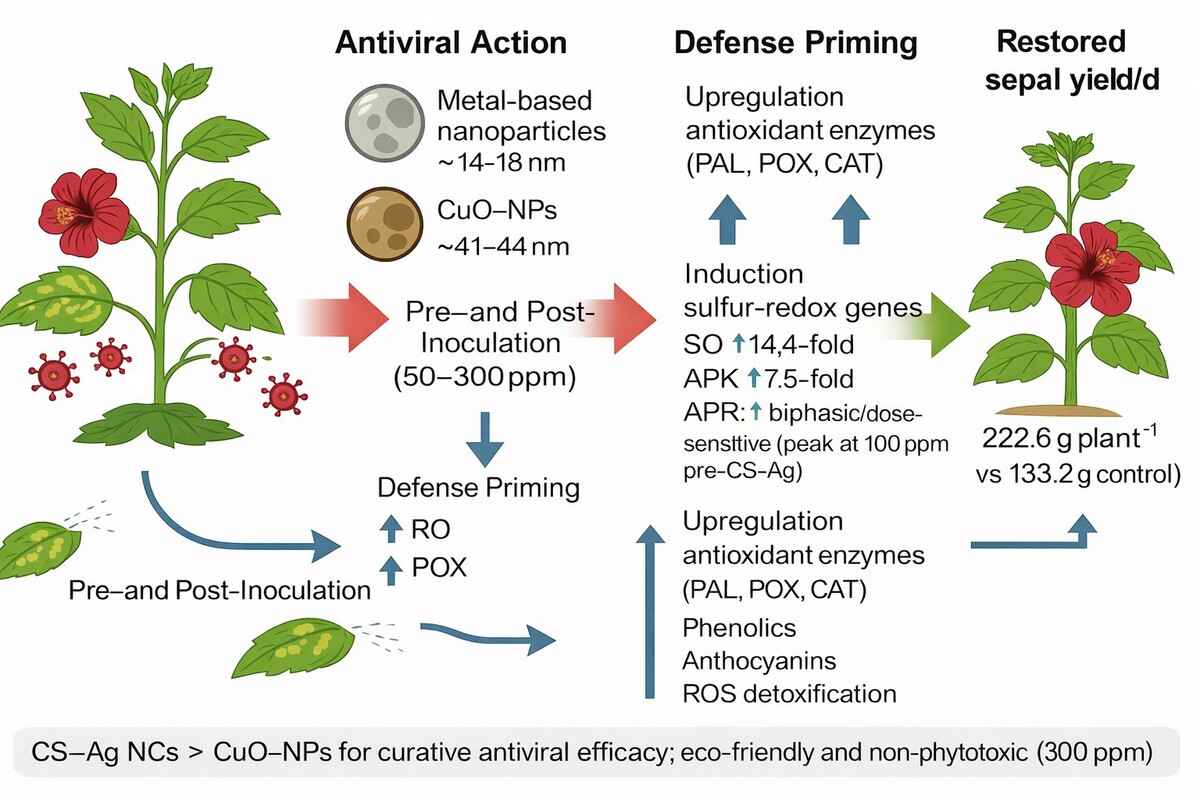
Hibiscus sabdariffa (roselle) is highly susceptible to Hibiscus chlorotic ringspot virus (HCRSV), for which effective control strategies remain limited. This study assessed the antiviral and defense-priming potential of foliar-applied chitosan–silver nanocomposites (CS-Ag NCs) and copper oxide nanoparticles (CuO-NPs) at concentrations of 50–300 ppm, applied either before or after virus inoculation. The nanomaterials were synthesized and physicochemically characterized using HR-TEM, DLS/ζ-potential, and XRD analyses. Both CS-Ag NCs and CuO-NPs significantly reduced HCRSV infection incidence in a dose-dependent manner, with the strongest curative effects observed at 300 ppm post-inoculation (CS-Ag ≈ 91.7% and CuO ≈ 85%), without visible phytotoxic effects under greenhouse conditions. CS-Ag NC treatment markedly enhanced host defense capacity, as reflected by increased activities of antioxidant and phenylpropanoid-related enzymes (PAL, POX, and CAT), elevated phenolic and anthocyanin contents, and improved sepal yield (222.6 g plant⁻¹ compared to 133.2 g plant⁻¹ in infected controls). Gene-expression profiling (2⁻ΔΔCt) revealed strong CS-Ag-mediated induction of sulfur redox–associated genes, particularly sulfite oxidase (SO) and APS kinase (APK), indicating reinforcement of redox homeostasis and reactive oxygen species detoxification pathways. In contrast, adenylylsulfate reductase (APR) exhibited a biphasic, dose-dependent transcriptional response, suggesting that sulfur assimilation is finely regulated and sensitive to both nanomaterial type and stress intensity. Collectively, these findings indicate that CS-Ag NCs predominantly act as defense-priming agents that enhance sulfur-linked antioxidant signaling, whereas CuO-NPs confer antiviral protection in a more dose- and stress-dependent manner. This study provides mechanistic insight into nano-enabled antiviral defense in roselle and identifies practical dose–timing windows for disease management, while underscoring the need for field-level validation and environmental safety assessment prior to large-scale application.
CONFLICT OF INTEREST
The authors have declared that no conflict of interests exist.
| eISSN: | 1899-007X |
| ISSN: | 1427-4345 |

We process personal data collected when visiting the website. The function of obtaining information about users and their behavior is carried out by voluntarily entered information in forms and saving cookies in end devices. Data, including cookies, are used to provide services, improve the user experience and to analyze the traffic in accordance with the Privacy policy. Data are also collected and processed by Google Analytics tool (more).
You can change cookies settings in your browser. Restricted use of cookies in the browser configuration may affect some functionalities of the website.
You can change cookies settings in your browser. Restricted use of cookies in the browser configuration may affect some functionalities of the website.