ORIGINAL ARTICLE
Assessing honeybee vulnerability to residue-level acetamiprid and thermal stress under different nutritional conditions
1
Institute of Apiculture, Research Institute for Animal Production, Doktor J. Gašperíka, 03301, Liptovský Hrádok, Slovak Republic
2
Department of Plant Protection, Faculty of Agriculture, Damanhour University, Damanhour, 22516, Damanhour, Egypt
A - Research concept and design; B - Collection and/or assembly of data; C - Data analysis and interpretation; D - Writing the article; E - Critical revision of the article; F - Final approval of article
Submission date: 2025-12-10
Acceptance date: 2026-01-14
Online publication date: 2026-01-23
Corresponding author
Hossam Abou-Shaara
Department of Plant Protection, Faculty of Agriculture, Damanhour University, Damanhour, 22516, Damanhour, Egypt
Department of Plant Protection, Faculty of Agriculture, Damanhour University, Damanhour, 22516, Damanhour, Egypt
HIGHLIGHTS
- Acetamiprid increased bee mortality across diets
- Nurse bees showed lower mortality and higher food intake than foragers
- Honey-based diets offered better protection than protein diets
- Honey—especially buckwheat—enhanced resilience to acetamiprid and heat stress
KEYWORDS
TOPICS
ABSTRACT
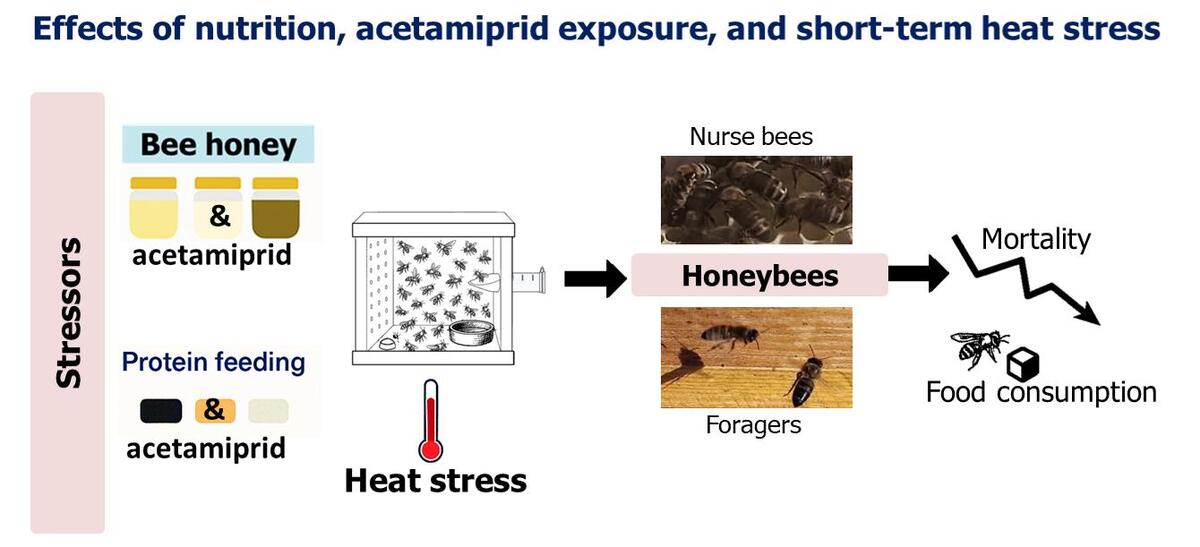
Honeybees, which serve as vital pollinators, are often exposed to agrochemicals as non-target organisms. Among these substances, the widely used insecticide acetamiprid is of particular concern, as it is frequently detected in bee products. Honeybees are also routinely subjected to multiple stressors simultaneously, including pesticide exposure and heat stress—the latter becoming increasingly problematic under ongoing climate change. Nutrition adds an additional layer of complexity to honeybee resilience, shaping how individuals respond to these concurrent stressors. In this study, the survival of nurse and forager honeybees was evaluated under two abiotic stressors—acetamiprid exposure at a residue level (52.78 µg kg⁻¹) and short-term heat stress (45°C for 2.5 h)—while providing bees with different dietary treatments: three types of honey and three commercial protein diets. Mortality of nurse bees was significantly higher in all acetamiprid-exposed groups than in the pesticide-free control, with honey-based diets providing better protection than protein-based diets. Regarding forager bees, mortality differed significantly between treatments, with buckwheat honey showing the lowest rates compared to protein diets and sugar candy. Age was a determining factor, as foragers exhibited higher mortality and lower consumption than nurses across treatments. Honey—particularly buckwheat —provided the most favorable outcomes, combining high consumption with reduced mortality under the study conditions. This study advances understanding of how nutrition can mitigate the impacts of multiple stressors on honey bees.
CONFLICT OF INTEREST
The authors have declared that no conflict of interests exist.
Share
RELATED ARTICLE
| eISSN: | 1899-007X |
| ISSN: | 1427-4345 |

We process personal data collected when visiting the website. The function of obtaining information about users and their behavior is carried out by voluntarily entered information in forms and saving cookies in end devices. Data, including cookies, are used to provide services, improve the user experience and to analyze the traffic in accordance with the Privacy policy. Data are also collected and processed by Google Analytics tool (more).
You can change cookies settings in your browser. Restricted use of cookies in the browser configuration may affect some functionalities of the website.
You can change cookies settings in your browser. Restricted use of cookies in the browser configuration may affect some functionalities of the website.