
ORIGINAL ARTICLE
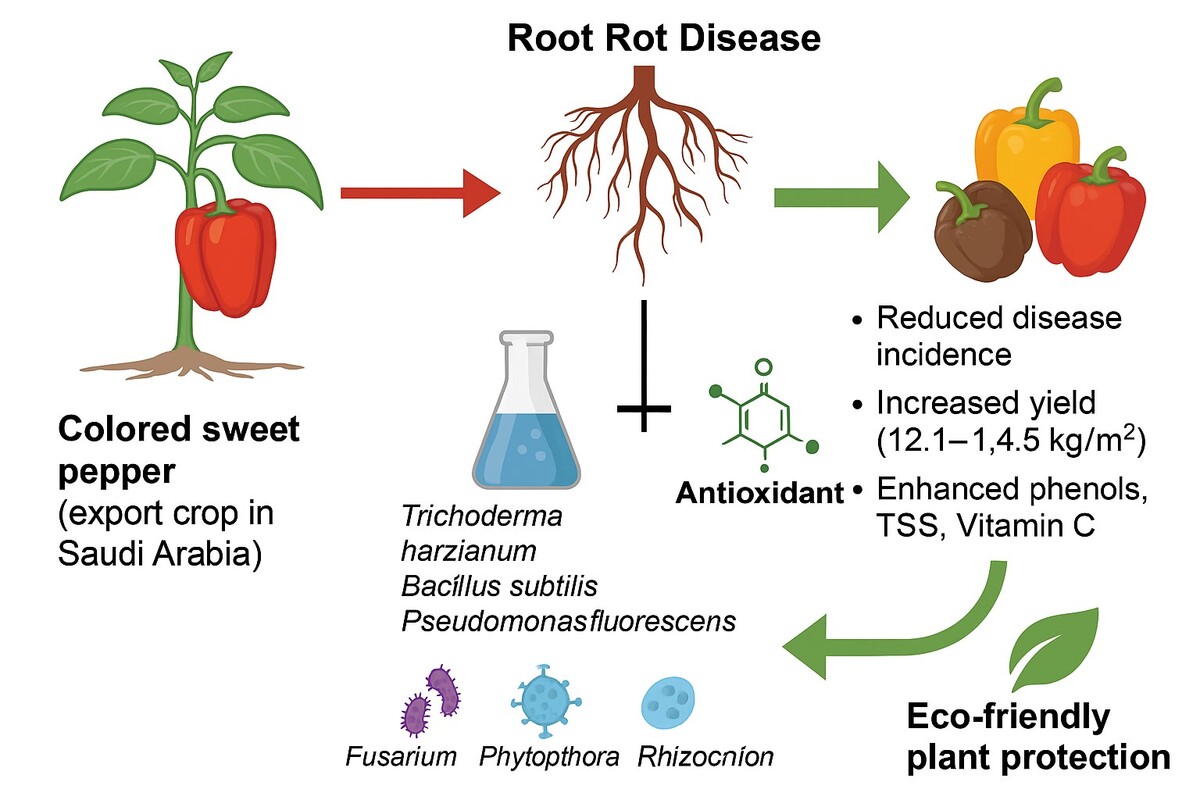
Controlling root rot disease in colored peppers utilizing mixtures of bio-agents or antioxidant with regard to yield qualities.
1
Biological Sciences, Faculty of Science, King Abdulaziz University, Jeddah, Saudi Arabia
A - Research concept and design; B - Collection and/or assembly of data; C - Data analysis and interpretation; D - Writing the article; E - Critical revision of the article; F - Final approval of article
Submission date: 2025-09-02
Acceptance date: 2026-01-19
Online publication date: 2026-01-26
Corresponding author
Tahani Alqahtani Alqahtani-T
Biological Sciences, Faculty of Science, King Abdulaziz University, Jeddah, Saudi Arabia
Biological Sciences, Faculty of Science, King Abdulaziz University, Jeddah, Saudi Arabia
HIGHLIGHTS
- Biocontrol agents significantly reduced root rot in colored sweet pepper
- Combining T. harzianum and B. subtilis provided the greatest disease protection
- Antioxidant integration enhanced yield and reduced pathogen impact
- Improved phenolic content, TSS and vitamin C correlated with resistance
- Eco-friendly biocontrol strategies support sustainable pepper production
KEYWORDS
TOPICS
ABSTRACT
Root rot caused by soil-borne fungi severely limits the productivity of colored sweet pepper in Saudi Arabia, challenging the sustainability of intensive greenhouse systems. This study assessed whether mixtures of microbial antagonists, with or without an antioxidant formulation, provided superior suppression of root rot and improvement of fruit quality compared to single applications. Greenhouse and commercial greenhouse experiments evaluated single strains of Trichoderma harzianum, Bacillus subtilis, and Pseudomonas fluorescens, their pairwise mixtures, and their combinations with a potassium tartrate-based antioxidant over two consecutive growing seasons. All biocontrol combinations significantly reduced disease incidence relative to the untreated control and increased marketable yield. The T. harzianum + B. subtilis mixture provided the greatest disease suppression and highest fruit yield, followed by T. harzianum + P. fluorescens. When B. subtilis was combined with an antioxidant, it produced the strongest reductions in root rot incidence. Treatments most effectively suppressing disease also enhanced total phenolic content, total soluble solids (TSS), and vitamin C (V.C.) concentration in fruits, which correlated positively with improved disease resistance and yield. These findings demonstrated that integrating compatible biocontrol agents, particularly Bacillus subtilis, with antioxidants can offer a promising and environmentally sound strategy for managing pepper root rot while simultaneously improving fruit nutritional quality in greenhouse production systems in Saudi Arabia.
RESPONSIBLE EDITOR
Laszlo Kredics
CONFLICT OF INTEREST
The authors have declared that no conflict of interests exist.
Share
RELATED ARTICLE
| eISSN: | 1899-007X |
| ISSN: | 1427-4345 |

We process personal data collected when visiting the website. The function of obtaining information about users and their behavior is carried out by voluntarily entered information in forms and saving cookies in end devices. Data, including cookies, are used to provide services, improve the user experience and to analyze the traffic in accordance with the Privacy policy. Data are also collected and processed by Google Analytics tool (more).
You can change cookies settings in your browser. Restricted use of cookies in the browser configuration may affect some functionalities of the website.
You can change cookies settings in your browser. Restricted use of cookies in the browser configuration may affect some functionalities of the website.