
ORIGINAL ARTICLE
Spatial Dynamics of Ambrosia Beetle Infestation in Avocado Orchards: A Geostatistical Approach from Indonesia

1
Department of Plant Pests and Diseases, Faculty of Agriculture, Universitas Brawijaya, Indonesia
A - Research concept and design; B - Collection and/or assembly of data; C - Data analysis and interpretation; D - Writing the article; E - Critical revision of the article; F - Final approval of article
Submission date: 2025-10-20
Acceptance date: 2026-01-16
Online pre-proof publication date: 2026-01-27
Corresponding author
Hagus Tarno
Department of Plant Pests and Diseases, Faculty of Agriculture, Universitas Brawijaya, Indonesia
Department of Plant Pests and Diseases, Faculty of Agriculture, Universitas Brawijaya, Indonesia
HIGHLIGHTS
- Geostatistical approach to ambrosia beetle infestation
- Impact of ambrosia beetle infestation on avocado trees
- Ambrosia beetle infestation in avocado orchards
- Ambrosia beetle preferences in infesting host plants
KEYWORDS
TOPICS
ABSTRACT
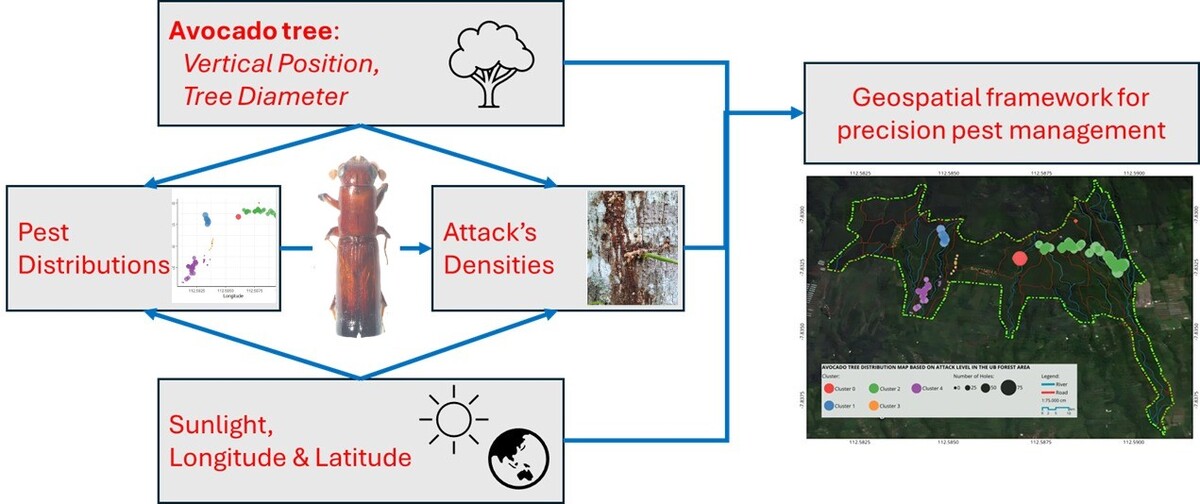
Ambrosia beetles (Coleoptera: Scolytinae and Platypodinae) represent a significant threat to tropical agroecosystems, yet their spatial ecology in Indonesian avocado orchards remains poorly understood. This study presents the first spatially explicit assessment of ambrosia beetle infestation patterns in East Java, integrating field surveys with geostatistical analyses. Using RStudio and spatial tools including kernel density estimation (KDE), density-based spatial clustering of applications with noise (DBSCAN) clustering, and Getis-Ord Gi* statistics, this research was aimed to distinguish spatial clusters, evaluate environmental correlates such as sunlight exposure, infestation holes vertical level position based on tree trunk, and recognize tree trunk diameter-related preferences in colonization of the ambrosia beetles. Results revealed strong spatial aggregation of beetle attacks, with significantly higher infestation intensity observed in trees exposed to prolonged sunlight, infestation holes located in upper trunk positions, and possessing larger tree trunk diameters. Global Moran’s I and LISA statistics confirmed significant clustering, validating the influence of orchard microheterogeneity on beetle colonization. These findings underscore the importance of integrating spatial analysis into pest management strategies and offer a replicable framework for monitoring cryptic pests in other tropical cropping systems.
RESPONSIBLE EDITOR
Janina Gospodarek
CONFLICT OF INTEREST
The authors have declared that no conflict of interests exist.
| eISSN: | 1899-007X |
| ISSN: | 1427-4345 |

We process personal data collected when visiting the website. The function of obtaining information about users and their behavior is carried out by voluntarily entered information in forms and saving cookies in end devices. Data, including cookies, are used to provide services, improve the user experience and to analyze the traffic in accordance with the Privacy policy. Data are also collected and processed by Google Analytics tool (more).
You can change cookies settings in your browser. Restricted use of cookies in the browser configuration may affect some functionalities of the website.
You can change cookies settings in your browser. Restricted use of cookies in the browser configuration may affect some functionalities of the website.