
ORIGINAL ARTICLE
Soil bacterial community associated with twisted disease of shallot plants with the addition of casuarina and maize leaf litters

1
Department of Plant Protection, Faculty of Agriculture, Universitas Gadjah Mada, Jl. Flora, Yogyakarta, Indonesia
2
School of Agriculture and Food Sciences Faculty of Science, University of Queensland, South Wing, Brisbane, Australia
A - Research concept and design; B - Collection and/or assembly of data; C - Data analysis and interpretation; D - Writing the article; E - Critical revision of the article; F - Final approval of article
Submission date: 2025-03-20
Acceptance date: 2025-08-05
Online publication date: 2025-08-25
Corresponding author
Arif Wibowo
Department of Plant Protection, Faculty of Agriculture, Universitas Gadjah Mada, Jl. Flora, Yogyakarta, Indonesia
Department of Plant Protection, Faculty of Agriculture, Universitas Gadjah Mada, Jl. Flora, Yogyakarta, Indonesia
Journal of Plant Protection Research 2026;66(1):88-100
HIGHLIGHTS
- Casuarina leaf litter affects Pseudarthrobacter that suppress twisted disease
- Maize leaf litter affects Paenibacillus that increase shallot production
- Addition of leaf litter during planting more effective than before planting
KEYWORDS
16s rRNA amplicon metagenomicapplication timecore microbekeystone taxaPaenibacillusPseudarthrobacter
TOPICS
ABSTRACT
Twisted disease caused by Fusarium is one of the causes of the decline in shallot production
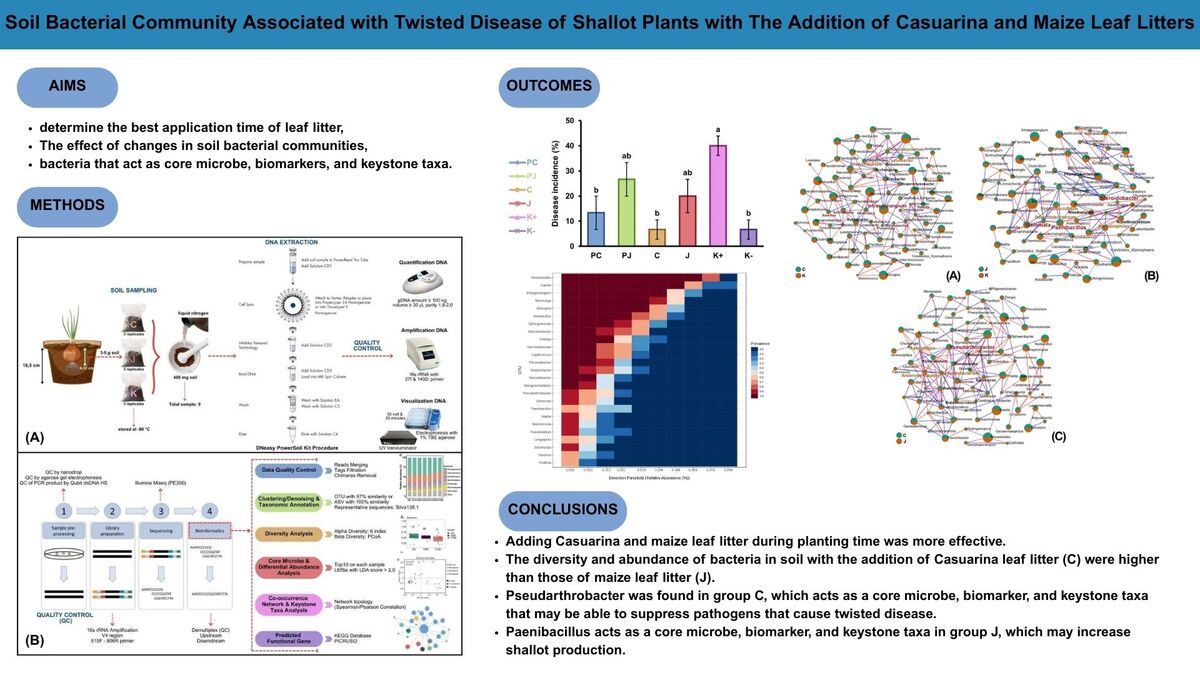
in Indonesia. Disease management by adding Casuarina leaf litter and maize leaf litter
during planting time has suppressed twisted disease incidence and increased shallot production
in previous studies. Bacterial communities can influence disease suppression and
increase plant production in soil. However, the effect of adding Casuarina and maize leaf
litter on the soil bacterial community, and its impact on suppressing twisted disease is still
unknown in shallot planting. In addition, no further studies have been conducted on the
effectiveness of the application time of Casuarina and maize leaf litter. This study aimed to
determine the best application time of leaf litter in suppressing twisted disease, the effect of
changes in soil bacterial communities, and bacteria that act as core microbe, biomarkers,
and keystone taxa. Results showed that adding Casuarina and maize leaf litter during planting
time was more effective than adding Casuarina and maize leaf litter two weeks before
planting. The diversity and abundance of bacteria in soil with the addition of Casuarina
leaf litter (C) were higher than those of maize leaf litter (J). In addition, Pseudarthrobacter
was found in group C, which acts as a core microbe, biomarker, and keystone taxa that
may be able to suppress pathogens that cause twisted disease. Paenibacillus acts as a core
microbe, biomarker, and keystone taxa in group J, which may increase shallot production.
This study’s results will help develop effective twisted disease management strategies to
control disease development.
ACKNOWLEDGEMENTS
The authors express their sincere gratitude to the Australian
Centre for International Agricultural Research (ACIAR) for providing the opportunity to join this outstanding research project and funding it so that this
study could be carried out successfully.
RESPONSIBLE EDITOR
Krzysztof Krawczyk
CONFLICT OF INTEREST
The authors have declared that no conflict of interests exist.
REFERENCES (39)
1.
Abdallah W.E., Shams K.A., El-Shamy A.M. 2024. Phytochemical analysis and evaluation of its antioxidant, antimicrobial, and cytotoxic activities for different extracts of Casuarina equisetifolia. BMC Complementary Medicine and Therapies 24 (128): 1–22. DOI: https://doi.org/10.1186/s12906....
2.
Banerjee S., Schlaeppi K., van der Heijden M.G.A. 2018. Keystone taxa in microbiology: roles, drivers and importance for microbiome functioning. Nature Reviews Microbiology 16 (9): 567–576. DOI: https://doi.org/10.1038/s41579....
3.
Berry D., Widder S. 2014. Deciphering microbial interactions and detecting keystone species with co-occurrence networks. Frontiers in Microbiology 5 (219): 1–14. DOI: https://doi.org/10.3389/fmicb.....
4.
Bhat M.A., Mishra A.K., Bhat M.A., Banday M.I., Bashir O., Rather I.A., Rahman S., Shah A.A., Jan A.T. 2021. Myxobacteria as a source of new bioactive compounds: A perspective study. Pharmaceutics 13 (1265): 1–32. DOI: https://doi.org/10.3390/pharma....
5.
Bollina V., Kumaraswamy G.K., Kushalappa A.C., Choo T.M., Dion Y., Rioux S., Faubert D., and Hamzehzarghani H. 2010. Mass spectrometry-based metabolomics application to identify quantitative resistance-related metabolites in barley against Fusarium head blight. Molecular Plant Pathology 11 (6): 769–782. DOI: https://10.1111/j.1364-3703.20....
6.
Chaiya L., Kumala J., Suwannarach N., Kiatsiriroat T., Lumyong S. 2021. Isolation, characterization, and efficacy of Actinobacteria associated with arbuscular mycorrhizal spores in promoting plant growth of chili (Capsicum flutescens L.). Microorganisms 9 (6): 1–19. DOI: https://doi.org/10.3390/microo....
7.
Dasgupta D., Richardson A.E., Camuy-Velez L.A., Kirkby C., Kirkegaard J.A., Banerjee S. 2024. Microbial dynamics during in-situ organic matter decomposition reveals the importance of keystone taxa in the core microbiome. Applied Soil Ecology 199: 1–10. DOI: https://doi.org/10.1016/j.apso....
8.
Gilardi G., Pugliese M., Gullino M.L., Garibaldi A. 2016. Effect of different organic amendments on lettuce Fusarium wilt and on selected soilborne microorganisms. Plant Pathology 65: 704–712. DOI: https://doi.org/10.1111/ppa.12....
9.
Huang X., Zhou X., Zhang J., Cai Z. 2019. Highly connected taxa located in the microbial network are prevalent in the rhizosphere soil of healthy plant. Biology and Fertility of Soils 55: 299–312. DOI: https://doi.org/10.1007/s00374....
10.
Jayasinghe H., Chang H.X., Knobloch S., Yang S.H., Hendalage D.P.B., Ariyawansa K.G.S.U., Liu P.Y., Stadler M., Ariyawansa H.A. 2024. Metagenomic insight to apprehend the fungal communities associated with leaf blight of welsh onion in Taiwan. Frontiers in Plant Science 15: 1–13. DOI: https://doi.org/10.3389/fpls.2....
11.
Kumar M., Ansari W.A., Zeyad M.T., Singh A., Chakdar H., Kumar A., Farooqi M.S., Sharma A., Srivastava S., Srivastava A.K. 2023. Core microbiota of wheat rhizosphere under Upper Indo-Gangetic plains and their response to soil physicochemical properties. Frontiers in Plant Science 14: 1–13. DOI: https://doi.org/10.3389/fpls.2....
12.
Kurniasari I., Wibowo A., Subandiyah S., Pattison A.B. 2024. Association of soil bacterial diversity and composition with Fusarium wilt disease of bananas in Yogyakarta Province, Indonesia. Biodiversitas 25 (5): 2264–2275. DOI: https://doi.org/10.13057/biodi....
13.
Kwaśna H., Walkowiak L., Lakomy P., Behnke-Borowczyk J., Garnowicz R., Mikiciński A., Gałązka S., Szewczyk W. 2015. Effects of silvicultural techniques on the diversity of microorganisms in forest soil and their possible participation in biological control of Armillaria and Heterobasidion. Journal of Plant Protection Research 55 (3): 241–253. DOI: https://doi.org/10.1515/jppr-2....
14.
Lestiyani A., Wibowo A., Subandiyah S., Gambey C., and Harper, S. 2016. Identification of Fusarium spp., the causal agent of twisted disease shallot. Acta Horticulturae 1128: 155–160. DOI: https://doi.org/10.17660/ActaH....
15.
Lestiyani A., Wibowo A., Subandiyah S. 2021. Pathogenicity and detection of phytohormone (gibberellic acid and indole acetic acid) produced by Fusarium spp. that causes twisted disease in shallot. Jurnal Proteksi Tanaman 5 (1): 24-33. DOI: https://doi.org/10.25077/jpt.5....
16.
Lin Q., Xu Z., Li M., Wang Y., Li L. 2022. Spatial differences in Casuarina equisetifolia L. endophyte community structure. Annals of Microbiology 72 (28): 1–12. DOI: https://doi.org/10.1186/s13213....
17.
Mayerhofer J., Thuerig B., Oberhaensli T., Enderle E., Lutz S., Ahrens C.H., Fuchs J.G., Widmer F. 2021. Indicative bacterial communities and taxa of disease-suppressing and growth-promoting composts and their associations to the rhizoplane. FEMS Microbiology Ecology 97 (10): 1–15. DOI: https://doi.org/10.1093/femsec....
18.
Morni M.A., William-Dee J., Jinggong E.R., Sabaruddin N.A., Azhar N.A.A., Iman M.A., Larsen P.A., Seelan J.S.S., Bilung L.M., Khan F.A.A. 2025. Gut microbiome community profiling of Bornean bats with different feeding guilds. Animal Microbiome 7 (21): 1–12. DOI: https://doi.org/10.1186/s42523....
19.
Navya B., Babu S. 2023. Comparative metataxonamic analyses of seeds and leaves of traditional varieties and hybrids of cucumber (Cucumis sativus L.) reveals distinct and core microbiome. Heliyon 9: 1–14. DOI: https://doi.org/0.1016/j.heliy....
20.
Pratiwi G.N.C. 2024. Dynamic of twisted disease related to agroclimatic factors and metagenomics microbial community in the rhizosphere of shallots on coastal areas (in Indonesian). Faculty of Agriculture. Universitas Gadjah Mada. Thesis.
21.
Rahmawati N.E. 2024. Fresh organic amendment for suppressing the development of twisted disease on shallot in the greenhouse (in Indonesian). Faculty of Agriculture. Universitas Gadjah Mada. Undergraduate Thesis.
22.
Ramzan M., Haider S.T.A., Hussain M.B., Ehsan A., Datta R., Alahmadi T.A., Ansari M.J., Alharbi S.A. 2024. Potential of kaempferol and cafeic acid to mitigate salinity stress and improving potato growth. Scientific Reports 14: 1–14. DOI: https://doi.org/10.1038/s41598....
23.
Sarr P.S., Diouf M., Diallo M.D., Ndiaye S., Dia R., Guisse A., Yamakawa T. 2013. Effects of different types of litters and fertilizer application on growth and productivity of maize (Zea mays L. var. Across 86 Pool 16) in Senegal. Journal of the Faculty of Agriculture, Kyushu University 58 (2): 259–267. DOI: https://doi.org/10.5109/27356.
24.
Shivlata L., Satyanarayana T. 2015. Thermophilic and alkaliphilic Actinobacteria: biology and potential application. Frontiers in Microbiology 6: 1–29. DOI: https://doi.org/10.3389/fmicb.....
25.
Sloot M.V.D., Maerowitz-Mcmahan S., Postma J., Limpens J., Deyn G.B.D. 2024. Soilborne disease suppressiveness after short and long term application of fermented, composted or fresh organic amendment treatments in arable soils. Applied Soil Ecology 195: 1–11. DOI: https://doi.org/10.1016/j.apso....
26.
Sudewi S., Patandjengi B., Ala A., Farid BDR M., Saleh A.R., Ratnawati. 2022. Siderophore production of the rhizobacteria isolated from local “Kamba” rice plants, Poso regency in Central Sulawesi. Agric 34 (2): 225–238. DOI: https://doi.org/10.24246/agric....
27.
Sundari D., Wibowo A., Joko T., Widiastuti A., Pustika A.B. 2023. Diversity of shallot rhizomicrobiome and twisted disease suppression with the application of Bacillus spp. and Trichoderma asperellum. Jurnal Fitopatologi Indonesia 19 (4): 156–165. DOI: https://doi.org/10.14692/jfi.1....
28.
Tan L., Gu S., Li S., Ren Z., Deng Y., Liu Z., Gong Z., Xiao W., Hu Q. 2019. Responses of microbial communities and interaction networks to different management practices in tea plantation soils. Sustainability 11 (16): 1–14. DOI: https://doi.org/10.3390/su1116....
29.
Torguet L., Zazurca L., Martinez G., Pons-Sole G., Luque J., Miarnau X. 2022. Evaluation of fungicides and application strategies for the management of the red leaf blotch disease of almond. Horticulturae 8 (6): 1–13. DOI: https://doi.org/10.3390/hortic....
30.
Wang Y., Lin S., Li J., Jia X., Hu M., Cai Y., Cheng P., Li M., Chen Y., Lin W., Wang H., Wu Z. 2023. Metagenomics-based exploration of key soil microorganisms contributing to continuously planted Casuarina equisetifolia growth inhibition and their interactions with soil nutrient transformation. Frontiers in Plant Science 14: 1–20. DOI: https://doi.org/10.3389/fpls.2....
31.
Weselowski B., Nathoo N., Eastman A.W., MacDonald J., Yuan Z. 2016. Isolation, identification and characterization of Paenibacillus polymyxa CR1 with potentials for biopesticide, biofertilization, biomass degradation and biofuel production. BMC Microbiology 16 (244): 1–10. DOI: https://doi.org/10.1186/s12866....
32.
Wibowo A., Santika I.A., Syafitri L.M., Widiastuti A., Subandiyah S., Harper S. 2023. Incidence of twisted disease and cultivation practice of shallot farmers in Bantul coastal area, Yogyakarta, Indonesia. Journal of Tropical Plant Pests Disease 23 (1): 23–30. DOI: https://doi.org/10.23960/jhptt....
33.
Widiastuti A., Suryanti, Giovanni A.C., Paramita N.R. 2024. Diversity of the fungal community on mango associated with stem end rot and anthracnose diseases based on amplicon targeted metagenomics. Journal of Plant Protection Research 6 (1): 42–51. DOI: https://doi.org/10.24425/jppr.....
34.
Yu L., Li D., Zhang Y., Wang Y., Yao Q., Yang K. 2024. An optimal combined slow-release nitrogen fertilizer and urea can enhance the decomposition rate of straw and the yield of maize by improving soil bacterial community and structure under full straw returning system. Frontiers in Microbiology 15: 1–19. DOI: https://doi.org/10.3389/fmicb.....
35.
Zhang S., Li M., Cui X., Pan Y. 2023. Effect of different straw retention techniques on soil microbial community structure in wheat-maize rotation system. Frontiers in Microbiology 13: 1–14. DOI: https://doi.org/10.3389/fmicb.....
36.
Zhang X.X., Zhang R.J., Gao J.S., Ma X.T., Yin H.Q., Zhang C.W., Feng K., Deng Y. 2017. Thirty-one years of rice-ricegreen manure rotations shape the rhizosphere microbial community and enrich beneficial bacteria. Soil Biology and Biochemistry. 104: 208–217. DOI: https://doi.org/10.1016/j.soil....
37.
Zhao F., Zhang Y., Dong W., Zhang Y., Zhang G., Sun Z., Yang L. 2019. Vermicompost can suppress Fusarium oxysporum f. sp. lycopersici via generation of beneficial bacteria in a long-term tomato monoculture soil. Plant Soil 440: 491–505. DOI: https://doi.org/10.1007/s11104....
38.
Zheng Y., Han X., Zhao D., Wei K., Yuan Y., Li Y., Liu M., Zhang C.S. 2021a. Exploring biocontrol agents from microbial keystone taxa associated to suppressive soil: A new attempt for a biocontrol strategy. Frontiers in Plant Science 12: 1–13. DOI: https://doi.org/10.3389/fpls.2....
39.
Zheng Y., Xu Z., Liu H., Liu Y., Zhou Y., Meng C., Ma S., Xie Z., Li Y., Zhang C. 2021b. Patterns in the microbial community of salt-tolerant plants and the functional genes associated with salt stress alleviation. Microbiology Spectrum 9 (2): 1–15. DOI: https://doi.org/10.1128/Spectr....
| eISSN: | 1899-007X |
| ISSN: | 1427-4345 |

We process personal data collected when visiting the website. The function of obtaining information about users and their behavior is carried out by voluntarily entered information in forms and saving cookies in end devices. Data, including cookies, are used to provide services, improve the user experience and to analyze the traffic in accordance with the Privacy policy. Data are also collected and processed by Google Analytics tool (more).
You can change cookies settings in your browser. Restricted use of cookies in the browser configuration may affect some functionalities of the website.
You can change cookies settings in your browser. Restricted use of cookies in the browser configuration may affect some functionalities of the website.