
ORIGINAL ARTICLE
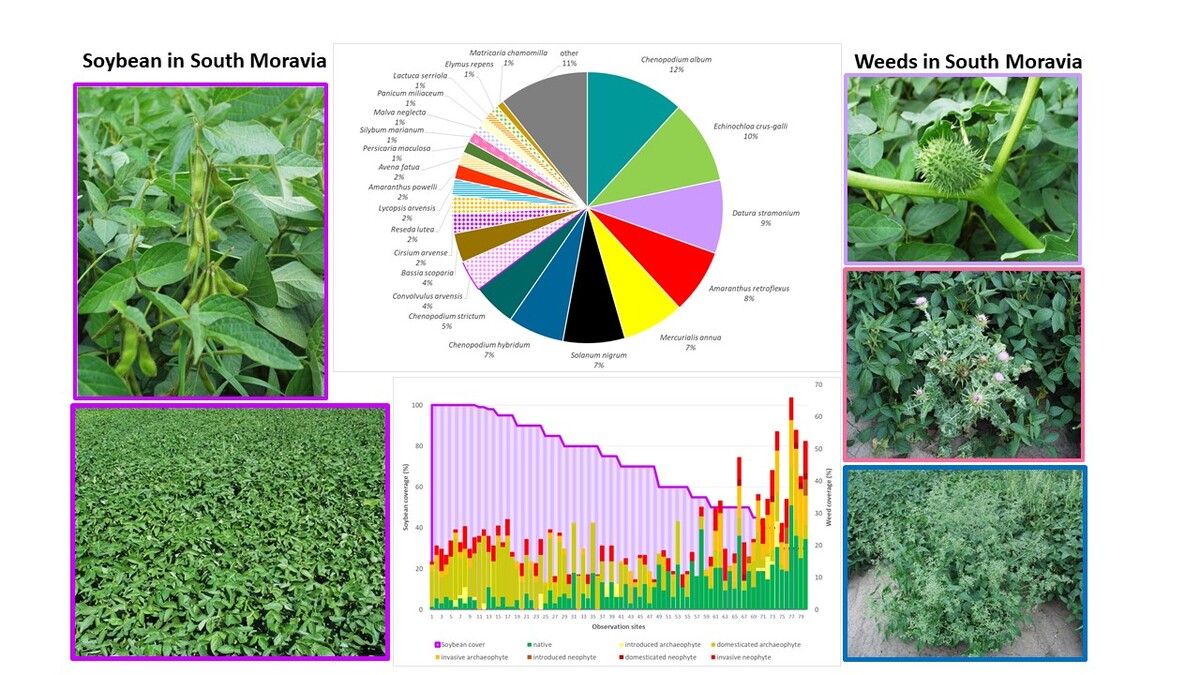
Spectrum of Weed Species in Soybean [Glycine max (L.) Merr.] Fields in South Moravia, Czech Republic

1
Department of Plant Biology, Mendel University in Brno, Zemědělská 1, 613 00, Brno, Czech Republic
A - Research concept and design; B - Collection and/or assembly of data; C - Data analysis and interpretation; D - Writing the article; E - Critical revision of the article; F - Final approval of article
Submission date: 2025-08-10
Acceptance date: 2025-11-12
Online publication date: 2025-12-22
Corresponding author
Jan Winkler
Department of Plant Biology, Mendel University in Brno, Zemědělská 1, 613 00, Brno, Czech Republic
Department of Plant Biology, Mendel University in Brno, Zemědělská 1, 613 00, Brno, Czech Republic
HIGHLIGHTS
- Weed diversity and abundance increase as soybean stand coverage decreases
- Mapping revealed that annual summer weeds dominate soybean fields in South Moravia
- Soybeans exhibit strong competitiveness against several native and non-native weeds
- Neophytes and Archaeophytic Weeds - Problematic Species in Dense Stands Soybean
KEYWORDS
TOPICS
ABSTRACT
The introduction of soybean cultivation in South Moravia (Czech Republic) has created new ecological habitats for weed species. Weed communities were surveyed using the phytosociological relevé method on 491 ha of operational land under soybean cultivation. Although soybean crops exhibited relatively strong competitive ability against weeds under field conditions, certain species were able to establish successfully. Among invasive neophytes, Bassia scoparia demonstrated the capacity to persist even within a dense crop stand. Naturalized archaeophytes that are successful even with high cover include Datura stramonium, Euphorbia exigua, Mercurialis annua, Panicum miliaceum, Setaria pumila, and Solanum nigrum. The cultivation of new crops creates opportunities for the spread of other weed species and may contribute to the invasion of non-native species where they did not previously occur.
CONFLICT OF INTEREST
The authors have declared that no conflict of interests exist.
Share
RELATED ARTICLE
| eISSN: | 1899-007X |
| ISSN: | 1427-4345 |

We process personal data collected when visiting the website. The function of obtaining information about users and their behavior is carried out by voluntarily entered information in forms and saving cookies in end devices. Data, including cookies, are used to provide services, improve the user experience and to analyze the traffic in accordance with the Privacy policy. Data are also collected and processed by Google Analytics tool (more).
You can change cookies settings in your browser. Restricted use of cookies in the browser configuration may affect some functionalities of the website.
You can change cookies settings in your browser. Restricted use of cookies in the browser configuration may affect some functionalities of the website.