
RAPID COMMUNICATION
Arthrinium sacchari – a novel causal agent of ripe rot on grapevine (Vitis vinifera)
1
Department of Horticulture, Agriculture Faculty, Bu-Ali Sina University, Hamedan, Iran
2
Phytopathology Section, Plant Protection Department, Bu-Ali Sina University, Hamedan, Iran
A - Research concept and design; B - Collection and/or assembly of data; C - Data analysis and interpretation; D - Writing the article; E - Critical revision of the article; F - Final approval of article
Submission date: 2025-10-14
Acceptance date: 2025-11-25
Online publication date: 2026-02-06
Corresponding author
Jalal Soltani
Phytopathology Section, Plant Protection Department, Bu-Ali Sina University, Hamedan, Iran
Phytopathology Section, Plant Protection Department, Bu-Ali Sina University, Hamedan, Iran
Journal of Plant Protection Research 2026;66(1):128-130
HIGHLIGHTS
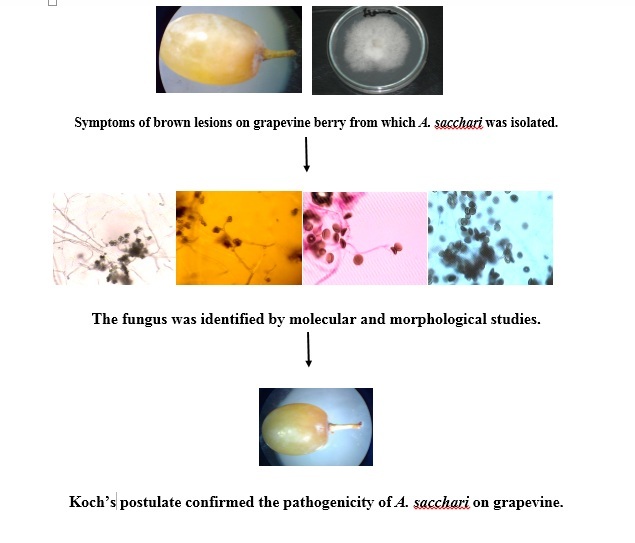
- Arthrinium sacchari seen to cause fruit lesion on V. vinifera
- Koch potulates confirmed its pathogenicity on V. vinifera
- Molecular and morphological studies confirmed its identity
KEYWORDS
TOPICS
ABSTRACT
During a survey conducted in Hamedan Province, Iran, Thompson seedless grapevine (Vitis
vinifera) bunches were observed exhibiting symptoms of brown ripe rot. To identify the
causal agent, samples were collected, and fragments from the infected tissues were cultured
on PCA and PDA media. Morphological studies and sequencing analyses of the ITS region
were performed to identify the emerging fungus. To confirm the pathogenicity of the fungal
isolate, Koch’s postulates were applied. Based on morphological assessments, pathogenicity
test, and the ITS sequences, the causal agent was identified as Arthrinium sacchari
(Apiosporaceae, Sordariomycetes). This study provides new information on ripe rot caused
by A. sacchari in grapevine plants.
RESPONSIBLE EDITOR
Sebastian Stenglein
CONFLICT OF INTEREST
The authors have declared that no conflict of interests exist.
REFERENCES (17)
1.
Crous P.W., Groenewald J.Z. 2013. A phylogenetic re-evaluation of Arthrinium. International Mycological Association Fungus 4 (1): 133–154.
2.
Elkhateeb W.A. 2005. Some mycological, phytopathological and physiological studies on mycobiota of selected newly reclaimed soils in Assiut Governorate, Egypt. M.Sc. Thesis, Faculty of Science, Assiut University, Egypt, 238 pp.
5.
He Y., Zhang Z. 2012. Diversity of organism in the Usnea longissima lichen. African Journal of Microbiology Research 6: 4797–4804.
6.
Hergholi N., Ghosta Y., Javan-Nikkhah M., Campisano A., Pancher M. 2015. New species of endophytic fungi from grapevine (Vitis vinifera) in Iran. Rostaniha 16 (1): 17–35.
7.
Jayawardena R.S., Zhang W., Li X.H., Liu M., Hao Y.Y., Zhao W.S., Hyde K.D., Liu J.H., Yan J.Y. 2018. Characterization of Botrytis cinerea causing grape bunch rot in Chinese Vineyards. Asian Journal of Mycology 1 (1): 74–87. DOI: 10.5943/ajom/1/1/6.
8.
Kumar S., Stecher G., Tamura K. 2016. MEGA7: molecular evolutionary genetics analysis version 7.0 for bigger datasets. Molecular Biology and Evolution 33 (7): 1870–1874. DOI: 10.1093/molbev/msw054.
9.
Mavragani D., Abdellatif L., Conkey B.G., Hamel C., Vujanovic V. 2007. First Report of Damping-Off of Durum Wheat Caused by Arthrinium sacchari in the Semi-Arid Saskatchewan Fields. Plant Disease 91 (4): 469. DOI: 10.1094/PDIS-91-4-0469A.
10.
Meng X., Li B., Liu J., Tian S. 2008. Physiological responses and quality attributes of table grape fruit to chitosan preharvest spray and postharvest coating during storage. Food Chemistry 106: 501–508. DOI: doi.org/10.1016/j.foodchem.2007.06.012.
11.
Murray G.C., Thompson W.F. 1980. Rapid isolation of high molecular weight DNA. Nucleic Acid Research 8: 4321–4325.
12.
Pintos A., Alvarado P., Planas J., Jarling R. 2019. Six new species of Arthrinium from Europe and notes about A. caricicola and other species found in Carex spp. Hosts. MycoKeys 49: 15–48. DOI: https://doi.org/10.3897/mycoke....
13.
Suryanarayanan T.S. 2012. Fungal endosymbionts of seaweeds. p. 53–70. In: “Biology of Marine Fungi” (Raghukumar C., ed.). Springer Dordrecht. DOI: 10.1007/978-3-642-23342-5_3.
14.
Tamura K., Nei M. 1993. Estimation of the number of nucleotide substitutions in the control region of mitochondrial DNA in humans and chimpanzees. Molecular Biology and Evolution 33: 1870–1874.
15.
Topfer R., Trapp O.A. 2022. A cool climate perspective on grapevine breeding: climate change and sustainability are driving forces for changing varieties in a traditional market. Theoretical and Applied Genetics 135: 3947–3960. DOI: 10.1007/s00122-022-04077-0.
16.
White T.J., Bruns T., Lee S., Taylor J. 1990. Amplification and direct sequencing of fungal ribosomal RNA genes for phylogenetics. In: “PCR Protocols: a Guide to Methods and Applications” (Innis M.A., Gelfand D.H., Sninsky J.J., White T.J., eds.). Academic Press, San Diego, USA.
17.
Wilcox W.F., Gubler W.D., Uyemoto J.K. 2015. Compendium of Grape Diseases, Disorders, and Pests. 2nd ed. Amer Phytopathological Society, St. Paul, Minnesota.
Share
RELATED ARTICLE
| eISSN: | 1899-007X |
| ISSN: | 1427-4345 |

We process personal data collected when visiting the website. The function of obtaining information about users and their behavior is carried out by voluntarily entered information in forms and saving cookies in end devices. Data, including cookies, are used to provide services, improve the user experience and to analyze the traffic in accordance with the Privacy policy. Data are also collected and processed by Google Analytics tool (more).
You can change cookies settings in your browser. Restricted use of cookies in the browser configuration may affect some functionalities of the website.
You can change cookies settings in your browser. Restricted use of cookies in the browser configuration may affect some functionalities of the website.