


REVIEW
BIOCONTROL: A Bibliometric Analysis of Microbial Biocontrol Research for Plant Disease Management

1
Department of Biotechnology, Graphic Era (Deemed to be University), 566/6, BELL ROAD CLEMENT TOWN, GRAPHIC ERA DEEMED , 248002, DEHRADUN, India
2
Forest Protection Division, Forest Research Institute, Kaulagarh Road, 248195, Dehradun, India
3
Department of Microbiology, School of Basic and Applied Sciences, Shri Guru Ram Rai University, Patel Nagar, 248001, Dehradun, India
4
Centre of Molecular Medicine and Diagnostics, Saveetha University, Saveetha Dental College & Hospitals, Saveetha Inst, 600072, Chennai, India
A - Research concept and design; B - Collection and/or assembly of data; C - Data analysis and interpretation; D - Writing the article; E - Critical revision of the article; F - Final approval of article
Submission date: 2026-03-22
Acceptance date: 2026-05-11
Online publication date: 2026-05-26
Corresponding author
NISHANT RAI
Department of Biotechnology, Graphic Era (Deemed to be University), 566/6, BELL ROAD CLEMENT TOWN, GRAPHIC ERA DEEMED , 248002, DEHRADUN, India
Department of Biotechnology, Graphic Era (Deemed to be University), 566/6, BELL ROAD CLEMENT TOWN, GRAPHIC ERA DEEMED , 248002, DEHRADUN, India
HIGHLIGHTS
- Microbial biocontrol offers a sustainable alternative to chemical control
- India leads global research output in microbial biocontrol studies
- Bibliometric analysis reveals key trends from 2006 to 2023
- Keyword and citation mapping show emerging research linkages
- Network analysis aids understanding of plant disease control
KEYWORDS
TOPICS
ABSTRACT
Biocontrol has enormous potential to replace chemical pest management as a sustainable alternative, especially in tackling plant diseases with microbes. This study provides a basic outline of the research impact, trend progression, and interdisciplinary relationships in biocontrol studies via a bibliometric analysis integrated with a systematic literature review.
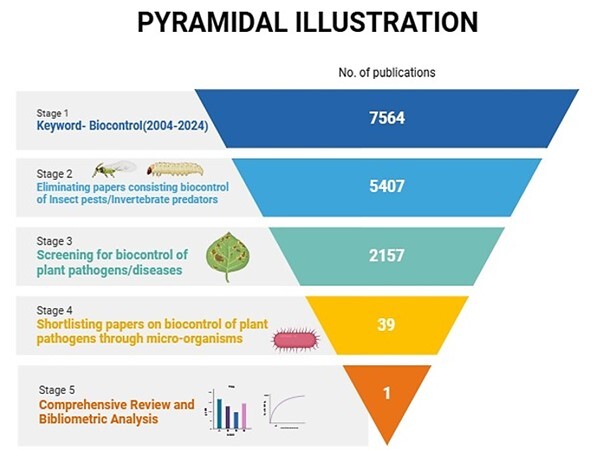
The bibliometric technique of traversing dominant themes, emerging trends, and interdisciplinary connections has piqued the interest and attention of researchers and their collaborators worldwide; however, a definitive conclusion can be drawn only after studying the methodological similarities and differences between the papers, for which more such analyses are required. This bibliometric analysis facilitates understanding of the severity and economic detriment implicated by plant pathogens in tandem with further research work on the application of biocontrol methods. Publications from Scopus (2004–2024) were analyzed using RStudio, complemented by a PRISMA-directed systematic review of methodological frameworks to determine the severity of research on combating plant pathogens. Publication output, country contributions, authorship patterns, citation metrics, and keyword occurrences were interpreted cautiously because the final subset is relatively small and reflects database and screening choices. The present study, therefore, integrates both approaches and also revealed that India contributed the highest number of papers within the final dataset of 39 papers, and that the literature is distributed across multiple journals and publishers, propounding a disjointed yet interdisciplinary field. The authors of this research do not claim any national or technological supremacy based solely on publication counts but position their findings as an exploratory overview of a screened Scopus dataset. Emphasis on the mechanisms that vary by strain, host, pathogen, and environmental context has also been laid. In summation, a network or graphical representation can be helpful in understanding a research problem and its efficacious remedial measures, here, 'plant diseases’ and ‘biological control,’ respectively.
CONFLICT OF INTEREST
The authors have declared that no conflict of interests exist.
| eISSN: | 1899-007X |
| ISSN: | 1427-4345 |

We process personal data collected when visiting the website. The function of obtaining information about users and their behavior is carried out by voluntarily entered information in forms and saving cookies in end devices. Data, including cookies, are used to provide services, improve the user experience and to analyze the traffic in accordance with the Privacy policy. Data are also collected and processed by Google Analytics tool (more).
You can change cookies settings in your browser. Restricted use of cookies in the browser configuration may affect some functionalities of the website.
You can change cookies settings in your browser. Restricted use of cookies in the browser configuration may affect some functionalities of the website.
