
REVIEW
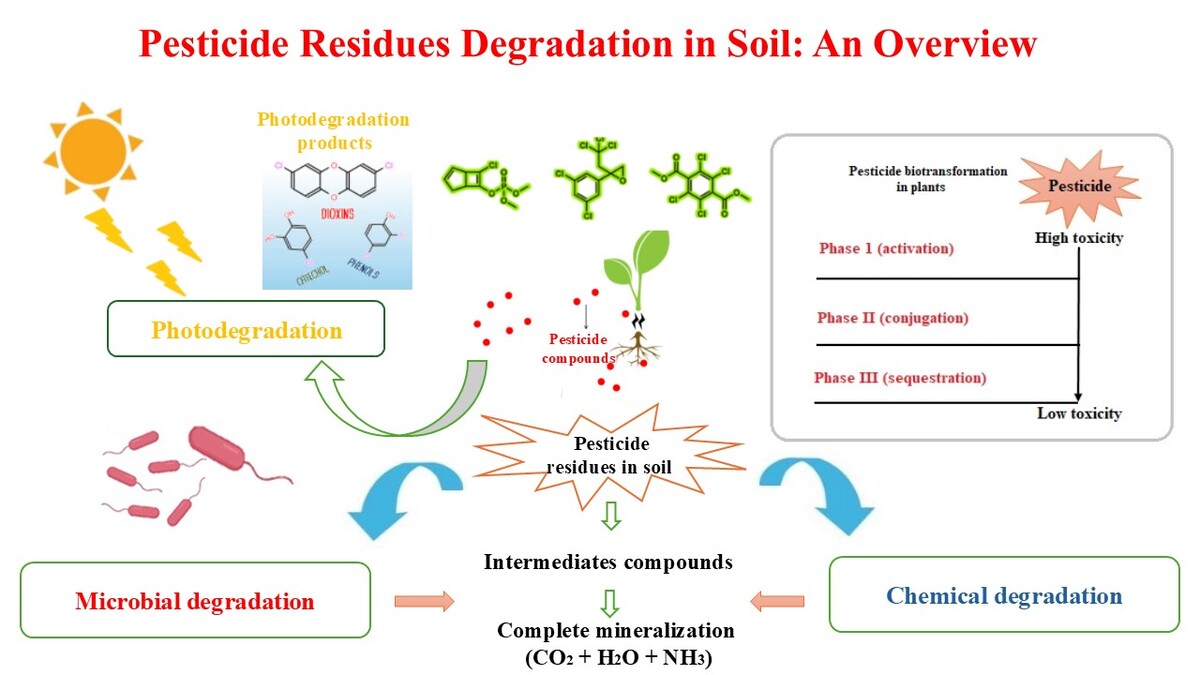
Pesticide Residues Degradation in Soil: An Overview
1
Department for Plant Physiology, Faculty of Agriculture and Food Sciences, University of Sarajevo, Faculty of Agriculture and Food Sciences Zmaja od, 71 000, Sarajevo, Bosnia and Herzegovina
2
Department for Plant Protection and Microbiology, University of Sarajevo, Faculty of Agriculture and Food Sciences, Zmaja od Bosne 8, 71000, Sarajevo, Bosnia and Herzegovina
3
Department for Soil Science and Agricultural Chemistry, Faculty of Agriculture and Food Sciences, University of Sarajevo, Zmaja od Bosne 8, 71000, Sarajevo, Bosnia and Herzegovina
A - Research concept and design; B - Collection and/or assembly of data; C - Data analysis and interpretation; D - Writing the article; E - Critical revision of the article; F - Final approval of article
Submission date: 2026-02-16
Acceptance date: 2026-05-27
Online publication date: 2026-06-09
Corresponding author
Senad Murtić
Department for Plant Physiology, Faculty of Agriculture and Food Sciences, University of Sarajevo, Faculty of Agriculture and Food Sciences Zmaja od, 71 000, Sarajevo, Bosnia and Herzegovina
Department for Plant Physiology, Faculty of Agriculture and Food Sciences, University of Sarajevo, Faculty of Agriculture and Food Sciences Zmaja od, 71 000, Sarajevo, Bosnia and Herzegovina
HIGHLIGHTS
- Pesticide properties and environmental factors are critical for pesticide degradation
- Soil microorganisms play a pivotal role in pesticide biotransformation
- Crucial chemical pathway involved in pesticide degradation is hydrolysis
- Pesticide photodegradation occurs through direct and indirect photolysis
- Sustainable management practices are essential for protecting soil fertility
KEYWORDS
TOPICS
ABSTRACT
This review summarizes the recent developments observed in the degradation of pesticide residues through biotransformation, chemical degradation, and photodegradation. The systematic review was performed in 2025 by searching for keywords like "pesticide biotransformation," "pesticide toxicity," and "pest management practices" in the PubMed, Scopus, and Web of Science scientific databases, without any time restrictions. The findings of this research indicate that the biotransformation of pesticides by microorganisms represents a pivotal process governing the fate of these chemicals in the environment, occurring mainly through three pathways: enzymatic degradation, co-metabolism, and complete mineralization. Plants generally have a much lower capacity to degrade pesticide residues than microorganisms; thus, their primary strategy is to detoxify and sequester pesticides within their cells instead of achieving full mineralization. The degradation of pesticides in the natural environment can also be accomplished through chemical degradation and photodegradation. Crucial chemical pathways involved in pesticide degradation include hydrolysis, along with oxidation and reduction reactions. In light of the escalating concerns regarding pesticide toxicity, it is important to implement sustainable management practices in the agricultural sector that focus on reducing pesticide toxicity in the soil. The first step in reducing the toxicity of pesticides in soils is to decrease their use by maximizing treatment effectiveness, minimizing the number of interventions, and lowering application rates. Applying agricultural practices like crop rotation, intercropping, organic farming, habitat management, and regular monitoring of pest populations substantially contributes to reducing pesticide toxicity in the soil. These practices not only mitigate pesticide-related soil contamination but also improve sustainable agricultural output and ecosystem resilience.
CONFLICT OF INTEREST
The authors have declared that no conflict of interests exist.
Share
RELATED ARTICLE
| eISSN: | 1899-007X |
| ISSN: | 1427-4345 |

We process personal data collected when visiting the website. The function of obtaining information about users and their behavior is carried out by voluntarily entered information in forms and saving cookies in end devices. Data, including cookies, are used to provide services, improve the user experience and to analyze the traffic in accordance with the Privacy policy. Data are also collected and processed by Google Analytics tool (more).
You can change cookies settings in your browser. Restricted use of cookies in the browser configuration may affect some functionalities of the website.
You can change cookies settings in your browser. Restricted use of cookies in the browser configuration may affect some functionalities of the website.