
ORIGINAL ARTICLE
First report of Quinisulcius capitatus (Allen, 1955) Siddiqi, 1971 infesting pepper (Capsicum annuum L.) crops in Poland
1
Museum and Institute of Zoology, Polish Academy of Sciences, Warsaw, Poland
2
NEFscience, Skierniewice, Poland
3
Department of Entomology and Animal Pests, Institute of Plant Protection-National Research Institute, Poznan, Poland
These authors had equal contribution to this work
A - Research concept and design; B - Collection and/or assembly of data; C - Data analysis and interpretation; D - Writing the article; E - Critical revision of the article; F - Final approval of article
Submission date: 2026-02-27
Acceptance date: 2026-06-01
Online pre-proof publication date: 2026-06-10
Corresponding author
Renata Dobosz
Department of Entomology and Animal Pests, Institute of Plant Protection-National Research Institute, Poznan, Poland
Department of Entomology and Animal Pests, Institute of Plant Protection-National Research Institute, Poznan, Poland
HIGHLIGHTS
- First record of Quinisulcius capitatus in a Polish Capsicum annuum crop
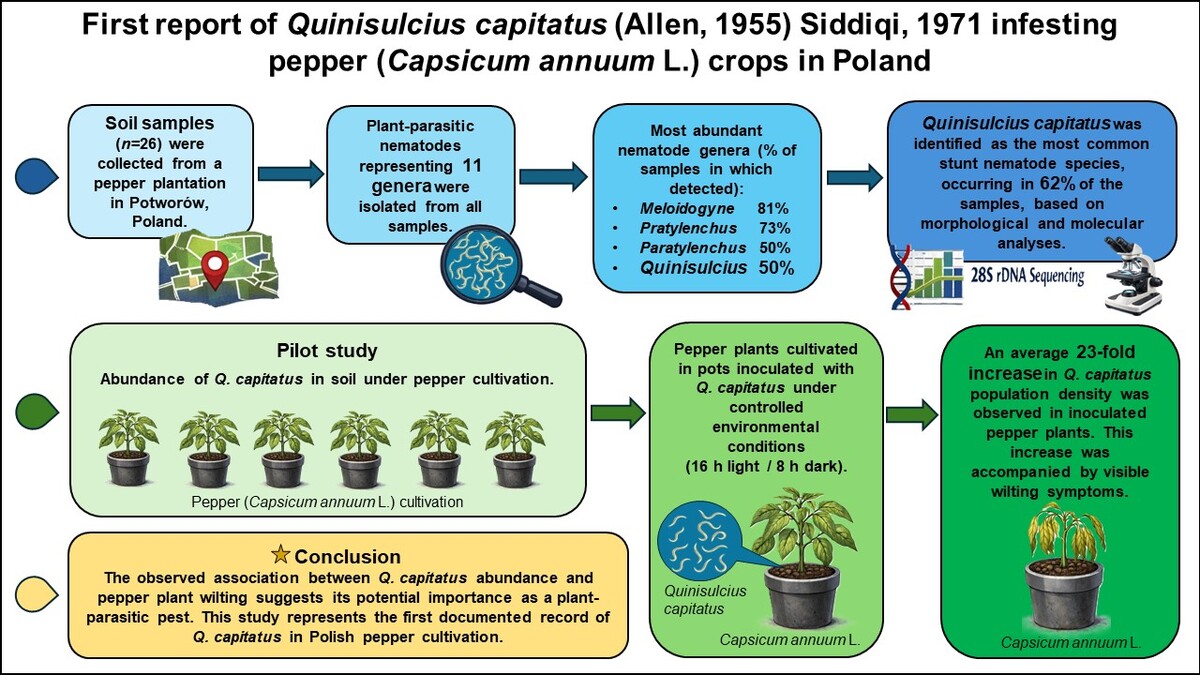
- The nematode occurred in 50 % of samples
- Plant wilting correlated with a density of 55 individuals per 100 ml of soil
- Q. capitatus population increased significantly during the pepper growing season
KEYWORDS
TOPICS
ABSTRACT
Among the plant-parasitic nematodes feeding on peppers (Capsicum annuum L.), the most frequently mentioned genera are root-knot nematodes (Meloidogyne), root-lesion nematodes (Pratylenchus), spiral nematodes (Helicotylenchus), and pearl nematodes (Naccobbus aberrans). These nematodes negatively impact pepper plant growth, manifesting as root damage and wilting of the above-ground parts. A study conducted in the intensive pepper cultivation area of Potworów, Poland identified the plant-parasitic nematode genera and species associated with wilting. Soil samples were collected from 26 sites, and 11 genera of plant-parasitic nematodes were found. The most prevalent were Meloidogyne (present in 81% of samples), Pratylenchus (73% of samples), along with Paratylenchus and Quinisulcius (both found in 50% of samples). An average of 55 Quinisulcius capitatus nematodes were found per 100 ml of soil, with the statistical significance of this value being 62.71 for the specific comparison being made in the study. This pilot study confirmed the species Q. capitatus through morphometric, morphological, and genetic analyses (sequencing of the 28S rDNA gene). Subsequently, the abundance of Q. capitatus in pepper crops was assessed under controlled conditions (16/8 hours day/night) by growing peppers in pots inoculated with the nematode. The study revealed an average 23-fold increase in nematode abundance. The observations of wilting symptoms in the pepper plants, concurrent with the rapid increase in Q. capitatus abundance, suggests this nematode is a potential pest for this crop. To our knowledge, this is the first report of Q. capitatus infesting peppers in Poland. These results provide a strong basis for further research into the specific impacts of Q. capitatus on pepper production in Poland.
CONFLICT OF INTEREST
The authors have declared that no conflict of interests exist.
Share
RELATED ARTICLE
| eISSN: | 1899-007X |
| ISSN: | 1427-4345 |

We process personal data collected when visiting the website. The function of obtaining information about users and their behavior is carried out by voluntarily entered information in forms and saving cookies in end devices. Data, including cookies, are used to provide services, improve the user experience and to analyze the traffic in accordance with the Privacy policy. Data are also collected and processed by Google Analytics tool (more).
You can change cookies settings in your browser. Restricted use of cookies in the browser configuration may affect some functionalities of the website.
You can change cookies settings in your browser. Restricted use of cookies in the browser configuration may affect some functionalities of the website.