
ORIGINAL ARTICLE
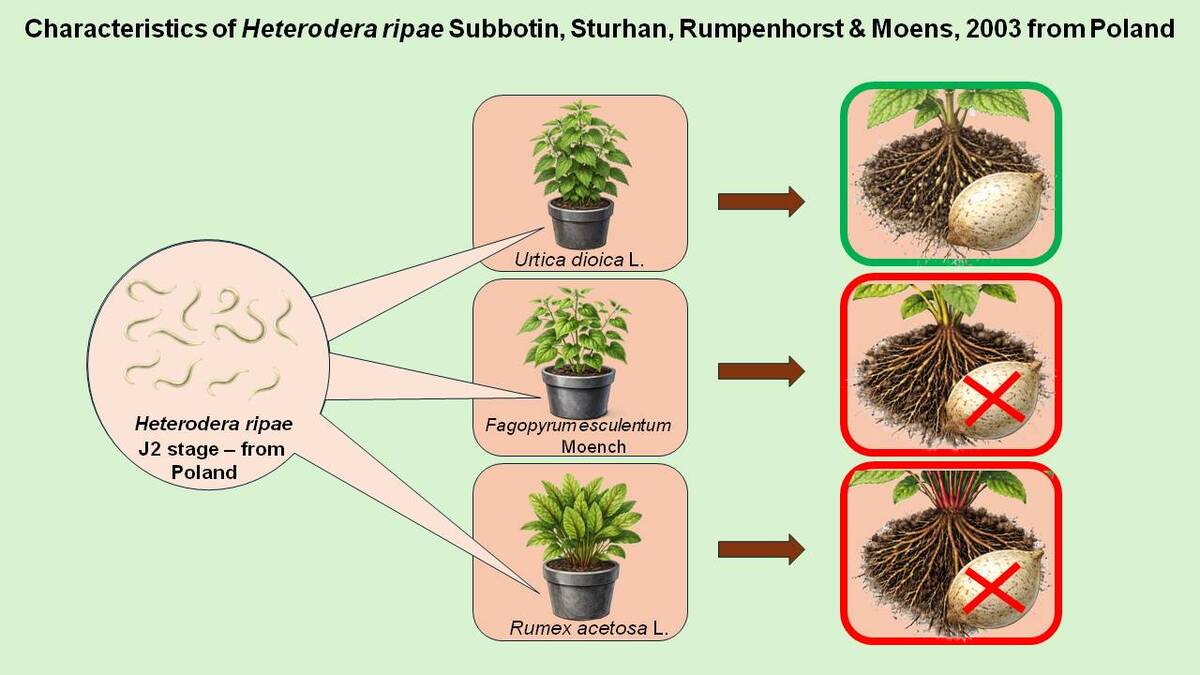
Characteristics of Heterodera ripae Subbotin, Sturhan, Rumpenhorst & Moens, 2003 from Poland
1
Department of Entomology and Agricultural Pests, Institute of Plant Protection – National Research Institute, Władysława Węgorka 20, 60-318, Poznań, Poland
2
Laboratory of Nematology, Museum and Institute of Zoology Polish Academy of Sciences, Twarda 51/55, 00-818, Warsaw, Poland
A - Research concept and design; B - Collection and/or assembly of data; C - Data analysis and interpretation; D - Writing the article; E - Critical revision of the article; F - Final approval of article
Submission date: 2026-03-23
Acceptance date: 2026-06-09
Online pre-proof publication date: 2026-06-24
Corresponding author
Katarzyna Rybarczyk-Mydłowska
Laboratory of Nematology, Museum and Institute of Zoology Polish Academy of Sciences, Twarda 51/55, 00-818, Warsaw, Poland
Laboratory of Nematology, Museum and Institute of Zoology Polish Academy of Sciences, Twarda 51/55, 00-818, Warsaw, Poland
HIGHLIGHTS
- • A development of a Polish population of H. ripae was studied on three plants
- • At 350 nematodes in 100 ml of soil, the plants had no signs of growth inhibition
- • Investigated nematodes do not develop on Fagopyrum esculentum and Rumex acetosa
- • It is recommended to monitor nettle plantations for the presence of H. ripae
KEYWORDS
TOPICS
ABSTRACT
Specimens of plant parasitic nematode species Heterodera ripae were isolated from the root zone of common nettle (Urtica dioica), a perennial growing near agricultural fields in Winna Góra near Poznań (Wielkopolska region, Poland). The species identity was confirmed by analyses of the structure of the vulval cyst cones, morphology and anatomy of J2, measurements of both developmental stages as well as analyses of the rDNA and mtCOI sequences.
Molecular analyses of the Polish H. ripae 28S rDNA sequence revealed that it was the most similar to the H. ripae sequences from South Korea and clustered with them in a phylogenetic tree near a closely related H. ripae from China and H. humuli. Similarly, the mtCOI sequence of the Polish H. ripae population clustered with most H. ripae sequences deriving from Europe and Asia, however it was more distantly related to the sequence from China.
Under controlled conditions, H. ripae pathogenicity and potential harmfulness was tested on three plants: common nettle (U. dioica) which served as a control, buckwheat (Fagopyrum esculentum), and sorrel (Rumex acetosa). During the pathogenicity test, H. ripae did not develop new cysts, neither on the roots of F. esculentum nor R. acetosa. At a population of 100–120 nematode eggs and larvae, cysts of the nematode developed on the common nettle’s U. dioica roots, however plants showed no signs of growth inhibition. These numbers may have been too low to lead to plant starvation.
It was recommended that soils intended for cultivation of U. dioica as a horticultural crop should be tested for the presence of H. ripae and that plantations of this plant should be monitored for the presence of other herbivorous nematodes, including cyst-forming species.
CONFLICT OF INTEREST
The authors have declared that no conflict of interests exist.
| eISSN: | 1899-007X |
| ISSN: | 1427-4345 |

We process personal data collected when visiting the website. The function of obtaining information about users and their behavior is carried out by voluntarily entered information in forms and saving cookies in end devices. Data, including cookies, are used to provide services, improve the user experience and to analyze the traffic in accordance with the Privacy policy. Data are also collected and processed by Google Analytics tool (more).
You can change cookies settings in your browser. Restricted use of cookies in the browser configuration may affect some functionalities of the website.
You can change cookies settings in your browser. Restricted use of cookies in the browser configuration may affect some functionalities of the website.