
REVIEW
Integrated pest management in the context of a changing world and the need for sustainable development
1
Department of Animal Diversity and Resources, Institute of biodiversity and Ecosystem Research, Bulgarian Academy of Sciences, 1, Tsar Osvoboditel, 1000, Sofia, Bulgaria
2
Department of Animal Diversity and Resouces, Institue of Biodiversity and Bulgarian Academy of Science, Bulgarian Academy of Sciences, 1, Tsar Osvoboditel, 1000, Sofia, Bulgaria
3
Department of Plant Pathology and Mycology, Institute of Forest Ecology, Slovak Academy of Sciences, Akademicka 2, 94901, Nitra, Slovak Republic
A - Research concept and design; B - Collection and/or assembly of data; C - Data analysis and interpretation; D - Writing the article; E - Critical revision of the article; F - Final approval of article
Submission date: 2026-02-17
Acceptance date: 2026-06-08
Online publication date: 2026-06-24
Corresponding author
Danail Ilchev Takov
Department of Animal Diversity and Resources, Institute of biodiversity and Ecosystem Research, Bulgarian Academy of Sciences, 1, Tsar Osvoboditel, 1000, Sofia, Bulgaria
Department of Animal Diversity and Resources, Institute of biodiversity and Ecosystem Research, Bulgarian Academy of Sciences, 1, Tsar Osvoboditel, 1000, Sofia, Bulgaria
HIGHLIGHTS
- Integrated Pest management - IPM
- Climate change and biodiversity loss
- IPM - prevention, monitoring, decison making, responsive actions
- IPM - traditional methods and hedgerow protection
- IPM - biological control and biopesticides, minimizing pesticide use
KEYWORDS
biodiversitysustainabilityinsect pests controlbiological approachesselection and reduction of pesticides
TOPICS
ABSTRACT
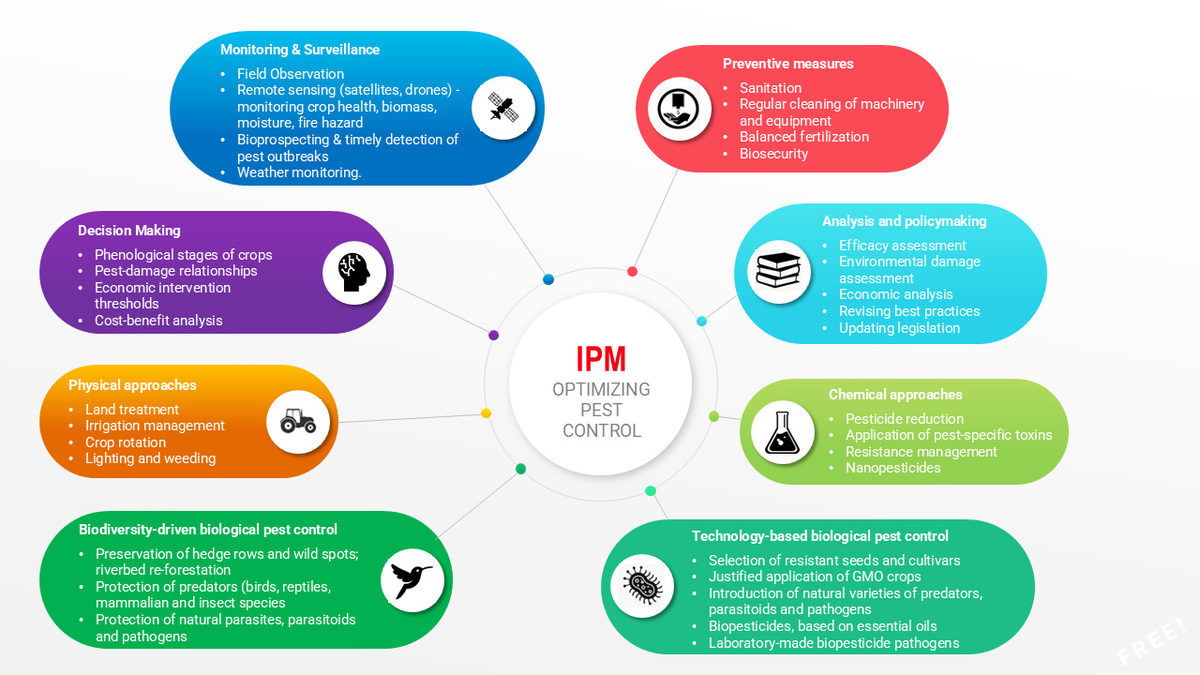
Integrated pest management (IPM) represents a cornerstone in the science of sustainable crop protection in an era of accelerating climate change, biodiversity loss, and rising food demand. This review synthesized contemporary knowledge on the eight core IPM principles – prevention and suppression, monitoring, decision making based on economic thresholds, biological control, pesticide selection, reduced pesticide use, resistance management, and evaluation - and links them explicitly to environmental, economic, and social sustainability goals. Also highlighted were how preventive measures, ecological engineering, and advanced monitoring tools, including remote sensing and artificial intelligence, can maintain pest populations below economic injury levels while reducing reliance on synthetic pesticides. Particular emphasis was placed on biological control and biopesticides, including entomopathogenic fungi and botanicals, as well as on selective pesticide use and resistance management strategies that conserve natural enemies, pollinators, and other non-target organisms. Further examined were the contributions of IPM to biodiversity conservation, improved ecosystem functioning, economic efficiency, and social benefits such as reduced human health risks from pesticides. Finally, key technical, economic, institutional, and cultural barriers that currently limit broader IPM adoption and outline future perspectives, including decision-support systems, policy incentives, and knowledge transfer mechanisms, needed to fully integrate IPM into resilient agricultural and forestry systems were discussed.
CONFLICT OF INTEREST
The authors have declared that no conflict of interests exist.
Share
RELATED ARTICLE
| eISSN: | 1899-007X |
| ISSN: | 1427-4345 |

We process personal data collected when visiting the website. The function of obtaining information about users and their behavior is carried out by voluntarily entered information in forms and saving cookies in end devices. Data, including cookies, are used to provide services, improve the user experience and to analyze the traffic in accordance with the Privacy policy. Data are also collected and processed by Google Analytics tool (more).
You can change cookies settings in your browser. Restricted use of cookies in the browser configuration may affect some functionalities of the website.
You can change cookies settings in your browser. Restricted use of cookies in the browser configuration may affect some functionalities of the website.