
ORIGINAL ARTICLE
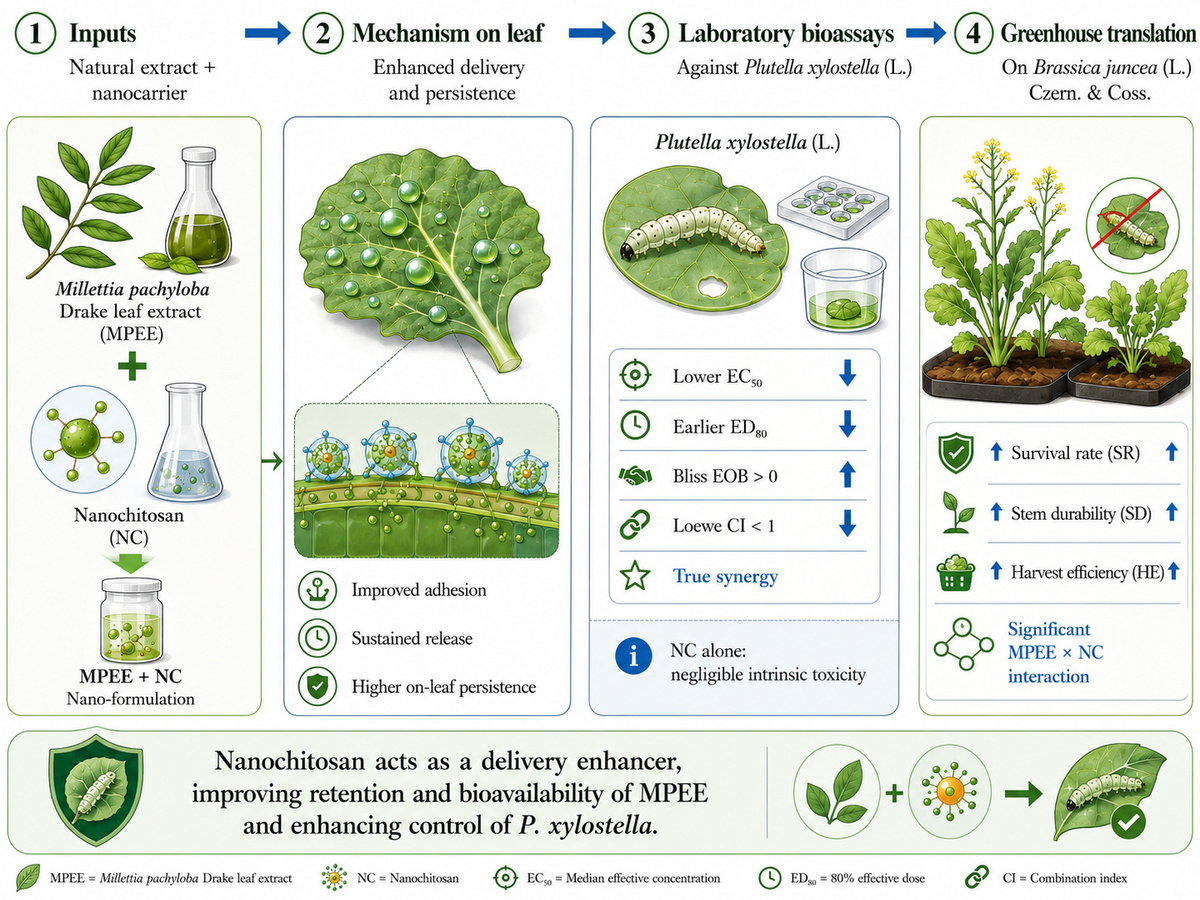
Synergy between nanochitosan and Millettia pachyloba extract improves control of Plutella xylostella
1
Institute of Environmental Science, Engineering and Management, Industrial University of Ho Chi Minh City, 12 Nguyen Van Bao, Hanh Thong Ward, Ho Chi Minh City 70000, Vietnam, 12 Nguyen Van Bao, 700000, Ho Chi Minh, Viet Nam
A - Research concept and design; B - Collection and/or assembly of data; C - Data analysis and interpretation; D - Writing the article; E - Critical revision of the article; F - Final approval of article
Submission date: 2025-10-26
Acceptance date: 2026-06-15
Online pre-proof publication date: 2026-06-25
Corresponding author
Thi Hien Tran
Institute of Environmental Science, Engineering and Management, Industrial University of Ho Chi Minh City, 12 Nguyen Van Bao, Hanh Thong Ward, Ho Chi Minh City 70000, Vietnam, 12 Nguyen Van Bao, 700000, Ho Chi Minh, Viet Nam
Institute of Environmental Science, Engineering and Management, Industrial University of Ho Chi Minh City, 12 Nguyen Van Bao, Hanh Thong Ward, Ho Chi Minh City 70000, Vietnam, 12 Nguyen Van Bao, 700000, Ho Chi Minh, Viet Nam
HIGHLIGHTS
- Nanochitosan enhanced foliar retention of Millettia pachyloba extract
- MPEE showed dose-dependent deterrent activity against Plutella xylostella
- Bliss, Loewe, and HSA criteria were used for transparent combination testing
- Greenhouse models supported cautious translation to Brassica juncea protection
KEYWORDS
TOPICS
ABSTRACT
Chemical control of the diamondback moth, Plutella xylostella (L.), is constrained by resistance and residue concerns, whereas botanical products often show limited persistence on foliage. This study evaluated whether nanochitosan (NC) can support the delivery of Millettia pachyloba Drake leaf ethanolic extract (MPEE) against P. xylostella and whether laboratory responses translate to Brassica juncea (L.) Czern. & Coss. under greenhouse conditions. Laboratory leaf-dip/spray bioassays compared MPEE, NC, and a fixed-ratio MPEE+NC co-formulation. Greenhouse performance was assessed in a randomized complete block design using plant survival rate (SR), stem durability (SD), and harvest efficiency (HE). Potency and efficacy were determined with four-parameter log-logistic models, and combination effects were evaluated a priori using Bliss independence, Loewe additivity, and highest-single-agent criteria. MPEE produced clear dose-dependent deterrent responses, while NC alone showed negligible intrinsic toxicity within the tested range. Greenhouse effective-dose estimates for MPEE and MPEE+NC were similar across observation times, and mixed/generalized models showed a positive but borderline treatment effect for SR after false-discovery-rate adjustment, with no significant Treatment × Time interaction. These results support NC as a delivery-compatible carrier that may improve the practical use of MPEE, but stronger claims of greenhouse synergy require a complete co-formulation dose-response and factorial interaction dataset.
CONFLICT OF INTEREST
The authors have declared that no conflict of interests exist.
Share
RELATED ARTICLE
| eISSN: | 1899-007X |
| ISSN: | 1427-4345 |

We process personal data collected when visiting the website. The function of obtaining information about users and their behavior is carried out by voluntarily entered information in forms and saving cookies in end devices. Data, including cookies, are used to provide services, improve the user experience and to analyze the traffic in accordance with the Privacy policy. Data are also collected and processed by Google Analytics tool (more).
You can change cookies settings in your browser. Restricted use of cookies in the browser configuration may affect some functionalities of the website.
You can change cookies settings in your browser. Restricted use of cookies in the browser configuration may affect some functionalities of the website.