
ORIGINAL ARTICLE
Effect of Eucalyptus citriodora and Schinus terebinthifolius essential oils on the diamondback moth
and its parasitoid Trichogramma pretiosum
1
Faculdade de Agronomia, Departamento de Fitossanidade, Universidade Federal do Rio Grande do Sul, Porto Alegre, Brazil
A - Research concept and design; B - Collection and/or assembly of data; C - Data analysis and interpretation; D - Writing the article; E - Critical revision of the article; F - Final approval of article
Submission date: 2024-08-13
Acceptance date: 2024-12-20
Online publication date: 2025-12-08
Corresponding author
Júlia Pétra dos Santos Souza
Faculdade de Agronomia, Departamento de Fitossanidade, Universidade Federal do Rio Grande do Sul, Porto Alegre, Brazil
Faculdade de Agronomia, Departamento de Fitossanidade, Universidade Federal do Rio Grande do Sul, Porto Alegre, Brazil
Journal of Plant Protection Research 2025;65(4):494-504
HIGHLIGHTS
- The EOEC and EOST have a phagodeterrent effect on P. xylostella larvae
- The EOEC showed insecticidal efficacy against P. xylostella
- The EOEC did not cause repellency to parasitoid T. pretiosum
- The EOEC at 0.5% did not affect the parasitism rate, and T. pretiosum survival
KEYWORDS
TOPICS
ABSTRACT
Essential oils (EOs), from plants’ secondary metabolism, present bioactive compounds that
may have insecticidal activity. Their use associated with parasitoid hymenoptera can be an
alternative, however, little is known about the impact of EOs on the diamondback moth,
Plutella xylostella and parasitoids. This work aimed to evaluate the effect of oils from Eucalyptus
citriodora (EOEC) and Schinus terebinthifolius (EOST) (0.5% and 1%) on eggs and
larvae of P. xylostella and on Trichogramma pretiosum. P. xylostella eggs were immersed
in solutions containing EOs and in water (control). Treated cabbage leaf discs were offered
to larvae. Eggs with EOs were offered to T. pretiosum females to evaluate parasitism
and emergence. Already parasitized P. xylostella eggs were immersed in the treatments to
observe the effect on the emergence of parasitoids. The survival of T. pretiosum adults exposed
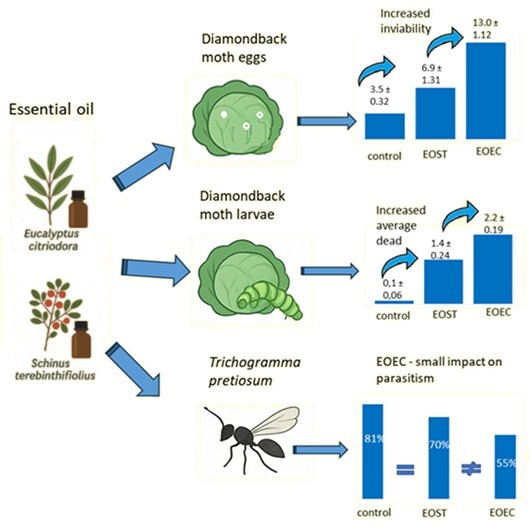
to EOs was recorded. The average number of inviable eggs was higher in treatments
with EOs, ranging from 6.9 ± 1.31 to 13.0 ± 1.12 than in the control (3.5 ± 0.32) (p < 0.05).
The average number of dead caterpillars was higher in treatments with EOs, ranging from
1.4 ± 0.24 to 2.2 ± 0.19 than in the control (0.1 ± 0.06) (p < 0.05) Leaf consumption in
48 h did not differ between the EOST treatment (0.05) (5.42%) and the control (9.7%). For
the other treatments it was significantly lower: 3.8% (EOEC 0.5), 1.6 (EOEC 1), and 3.4
(EOST 1). Eggs treated with EOs prior to exposure to the parasitoid had lower parasitism
rates than eggs that were already parasitized and subsequently treated with EOs. The mortality
of adults exposed to EOs was 3% to 6%. The EOs of E. citriodora and S. terebinthifolius
were toxic to eggs and larvae of P. xylostella, acted as feeding deterrents, and had minimal
impact on parasitoids. As a result, they are promising for use in IPM.
FUNDING
Financial support and scholarships were provided
by the National Council of Scientific and
Technological Development (CNPq) for the first and
third (309768/2021-7) authors, as well as research
grants from funding agencies (Biological inputs for
horticulture by Dr. Rosana Matos de Morais, Universal
Call – Ministry of Science, Technology and Innovation
/ National Council for Scientific and Technological
Development).
RESPONSIBLE EDITOR
Bożena Kordan
CONFLICT OF INTEREST
The authors have declared that no conflict of interests exist.
REFERENCES (53)
1.
Adams RP. 2007. Identification of essential oil components by gas chromatography/mass spectrometry. 4th ed. Allured Publishing Corporation, Carol Stream.
2.
AOAC - Association of official analytical chemistry. 1992. Official methods of analysis of the Association of Official Analytical Chemistry. 12th ed. Washington, United States. 1015 pp.
3.
Ayres M., Ayres J.R.M., Ayres D.L., Santos A.D. 2007. BioEstat 5.0: Statistical applications in the biological and medical sciences. Belém, Brasil, Sociedade Civil Mamirauá. 364 pp. (in Portuguese).
4.
Ayllón-Gutiérrez R., Rubio L.D., Soto M.M., Vázquez M.P.H., Guerrero I.C. 2024. Applications of plant essential oils in pest control and their encapsulation for controlled Release: A Review. Agriculture 14 (10): 1766. DOI: https://doi.org/10.3390/agricu....
5.
Banazeer A., Afzal M.B.S., Hassan S., Ijaz M., Shad S.A., Serrão J.E. 2021. Status of insecticide resistance in Plutella xylostella (Linnaeus) (Lepidoptera: Plutellidae) from 1997 to 2019: cross-resistance, genetics, biological costs, underlying mechanisms, and implications for management. Phytoparasitica 50: 465–485. DOI: https://doi.org/10.1007/s12600....
6.
Bandeira D.M., Correa J.M., Laskoski L.V., Batista J.M., Rosset J., Da costa W.F., Da silva F.G.P. 2022. Extraction, characterization of bioactive compounds and biological activities of the leaves of Podocarpus lambertii Klotzch ex Endl. Journal of Applied Research on Medicinal and Aromatic Plants 31: 100427. DOI: https://doi.org/10.1016/j.jarm....
7.
Bibiano C.S., Alves D.S., Freire B.C., Bertolucci S.K.V., Carvalho G.A. 2022. Toxicity of essential oils and pure compounds of Lamiaceae species against Spodoptera frugiperda (Lepidoptera: Noctuidae) and their safety for the nontarget organism Trichogramma pretiosum (Hymenoptera: Trichogrammatidae). Crop Protection 158: 106011. DOI: https://doi.org/10.1016/j.crop....
8.
Cai Y., Hu X., Wang P., Xie Y., Lin Z., Zhang Z. 2020. Biological activity and safety profile of monoterpenes against Plutella xylostella L. (Lepidoptera: Plutellidae). Environmental Science and Pollution Research 27: 24889–24901. DOI: https://doi.org/10.1007/s11356....
9.
Da Câmara C.A.G., De Melo J.P.R., Da Silva M.M.C. 2015. Insecticidal activity of Melaleuca leucadendron and Citrus reticulata essential oils against larvae of Plutella xylostella. Revista de Protección Vegetal 30: 1–39. [Online] [Available from: https://censa.edicionescervant...] [Accessed 18 may 2023].
10.
De Oliveira J.V., França S.M.D., Barbosa D.R., Dutra K.D.A., Araujo A.M.N.D., Navarro D.M.D.A.F. 2017. Fumigation and repellency of essential oils against Callosobruchus maculatus (Coleoptera: Chrysomelidae: Bruchinae) in cowpea. Pesquisa Agropecuária Brasileira 52: 10–17. DOI: https://doi.org/10.1590/S0100-....
11.
Ercan F., Baş H., Koç M., Pandir D., Öztemiz S. 2013. Insecticidal activity of essential oil of Prangos ferulacea (Umbelliferae) against Ephestia kuehniella (Lepidoptera: Pyralidae) and Trichogramma embryophagum (Hymenoptera: Trichogrammatidae). Turkish Journal of Agriculture and Forestry 37: 719–725. DOI: https://doi.org/10.3906/tar-12....
12.
Fleischer J., Pregitzer P., Breer H., Krieger J. 2018. Insect pheromone receptors – key elements in sensing intraspecific chemical signals. Frontiers in Cellular Neuroscience 12: 425. DOI: https://doi.org/10.3389/fncel.....
13.
Filomeno C.A., Barbosa L.C.A., Teixeira R.R., Pinheiro A.L., De sá farias E., De paula E.M.S., Picanço M.C. 2017. Corymbia spp. and Eucalyptus spp. essential oils have insecticidal activity against Plutella xylostella. Industrial Crops and Products 109: 374–383. DOI: https://doi.org/10.1016/j.indc....
14.
Garrido-Miranda K.A., Giraldo J.D., Schoebitz M. 2022. Essential oils and their formulations for the control of Curculionidae pests. Frontiers in agronomy 4: 876687. DOI: https://doi.org/10.3389/fagro.....
15.
Gupta I., Singh R., Muthusamy S., Sharma M., Grewal K., Singh H.P., Batish D.R. 2023. Plant essential oils as biopesticides: applications, mechanisms, innovations, and constraints. Plants 12 (16): 2916. DOI: https://doi.org/10.3390/plants....
16.
Hussein H.S., Salem M.Z., Soliman A.M. 2017. Repellent, attractive, and insecticidal effects of essential oils from Schinus terebinthifolius fruits and Corymbia citriodora leaves on two whitefly species, Bemisia tabaci, and Trialeurodes ricini. Scientia Horticulture 216: 111–119. DOI: https://doi.org/10.1016/j.scie....
17.
Khan M.A., Khan H., Ruberson J.R. 2015. Lethal and behavioral effects of selected novel pesticides on adults of Trichogramma pretiosum (Hymenoptera: Trichogrammatidae). Pest Management Science 71; 1640–1648. DOI: https://doi.org/10.1002/ps.397....
18.
Krinski D., Foerster L.A., Deschamps C. 2018. Ovicidal effect of the essential oils from 18 brazilian piper species: controlling Anticarsia gemmatalis (Lepidoptera, Erebidae) at the initial stage of development. Acta Scientiarum 40: 1–10. DOI: https://doi.org/10.4025/actasc....
19.
Lopes F.B., Sant’Ana J. 2019. Responses of Spodoptera frugiperda and Trichogramma pretiosum to rice plants exposed to herbivory and phytohormones. Neotropical Entomology 48: 381–390. DOI: https://doi.org/10.1007/s13744....
20.
Mardiningsih T.L, Rizal M. 2022. The potential of essential oils Eucalyptus citriodora and Artemisia vulgaris against Sitophilus zeamais (Coleoptera: Curculionidae). In IOP Conference Series: Earth and Environmental Science 974: 012009. DOI: https://doi.org/10.1088/1755-1....
21.
Massaroli A., Santos B.S., Souza R.A., Butnariu A.R., Pereira M.J.B., Moura M.O., Foerster L.A. 2021. Oviposition preference of Plutella xylostella (Lepidoptera: Plutelidae) and parasitism by Trichogramma pretiosum (Hymenoptera: Trichogrammatidae) in collard green. Brazilian Journal of Agriculture 96 (2): 408–424. DOI: https://doi.org/10.37856/bja.v....
22.
Mayanglambam S., Raghavendra A., Rajashekar Y. 2022. Use of Ageratina adenophora (Spreng.) essential oil as insecticidal and antifeedant agents against diamondback moth, Plutella xylostella (L.). Journal of Plant Diseases and Protection 129: 439–448. DOI: https://doi.org/10.1007/s41348....
23.
Milonas P.G., Partsinevelos G., Kapranas A. 2020. Susceptibility of different developmental stages of Trichogramma parasitoids to insecticides commonly used in the Mediterranean olive agroecosystem. Bulletin of Entomological Research 111: 301–306. DOI: https://doi.org/10.1017/S00074....
24.
Monsreal-Ceballos R.J., Ruiz-sánchez E., Ballina-gómez H.S., Reyes-ramírez A., González-moreno A. 2018. Effects of botanical insecticides on hymenopteran parasitoids: a meta-analysis approach. Neotropical Entomology 47: 681–688. DOI: https://doi.org/10.1007/s13744....
25.
Nascimento A.F.D., Da Camara C.A., Moraes M.M.D. 2018. Fumigant activity of Schinus terebinthifolius essential oil and its selected constituents against Rhyzopertha dominica. Revista Facultad Nacional de Agronomía Medellín 71: 8359–8366. DOI: https://doi.org/10.15446/rfna.....
26.
Nenaah G.E., Almadiy A.A., Al‐assiuty B.A., Mahnashi M.H. 2021. The essential oil of Schinus terebinthifolius and its nanoemulsion and isolated monoterpenes: investigation of their activity against Culex pipiens with insights into the adverse effects on non‐target organisms. Pest Management Science 78: 1035–1047. DOI: https://doi.org/10.1002/ps.671....
27.
Oliveira Junior L.F.G., Santos R.B., Reis F.O., Matsumoto S.T., Bispo W.M.S., Machado L.P., Oliveira L.F.M. 2013. Fungitoxic effect of aroeira da praia essential oil (Schinus terebinthifolius RADDI) over Colletotrichum gloeosporioides. Revista Brasileira de Plantas Medicinais 15: 150–157. DOI: https://doi.org/10.1590/S1516-... (in Portuguese).
28.
Parreira D.S., Alcántara-de la cruz R., Dimaté F.A.R., Batista L.D., Ribeiro R.C., Ferreira G.A.R., Zanuncio J.C. 2019. Bioactivity of ten essential oils on the biological parameters of Trichogramma pretiosum (Hymenoptera: Trichogrammatidae) adults. Industrial Crops and Products 127: 11–15. DOI: https://doi.org/10.1016/j.indc....
29.
Poorjavad N., Goldansaz S.H., Dadpour H. 2014. Effect of Ferula assafoetida essential oil on some biological and behavioral traits of Trichogramma embryophagum and T. evanescens. Biocontrol 59: 403–413. DOI: https://doi.org/10.1007/s10526....
30.
Purwatiningsih P., Heather N., Hassan E. 2012. Efficacy of Leptospermum petersonii oil, on Plutella xylostella, and its parasitoid, Trichogramma pretiosum. Journal of Economic Entomology 105: 1379–1384. DOI: http://dx.doi.org/10.1603/EC11....
31.
Püntener W. 1981. Manual for field trials in plant protection. 2nd ed. Basle: Ciba-Geigy, 205 pp.
32.
Rampelotti-ferreira F.T., Coelho J.R.A., Parra J.R.P., Vendramim J.D. 2017. Selectivity of plant extracts for Trichogramma pretiosum Riley (Hym.: Trichogrammatidae). Ecotoxicology and Environmental Safety 138: 78–82. DOI: https://doi.org/10.1016/j.ecoe....
33.
R Development Core Team. 2019: R: A language and environment for statistical computing. R Foundation for Statistical Computing. [Online] [Available from: https://www.rproject.org/] [Accessed: 11 november 2022].
34.
Rizzo R., Caleca V., Lombardo A., Lo verde G. 2018. Effectiveness of spinosad and mineral oil based commercial products on oviposition and egg hatching of Grapholita funebrana Treitschke. Redia 101: 161–166. DOI: https://doi.org/10.19263/REDIA....
35.
Rodrigues L. 2018. Toxicity of the odor of essential oils of Eucalyptus globulus and Corymbia citriodora on the tick Rhipicephalus microplus. Secretaria de Agricultura e Abastecimento do Estado de São Paulo. Nova Odessa, Brasil, 77 pp. (Master’s Dissertation).
36.
Saeed R., Sayyed A.H., Shad A.S., Zaka S.M. 2010. Effect of different host plants on the fitness of diamond-back moth, Plutella xylostella (Lepidoptera: Plutellidae). Crop Protection 29 (2): 178–182. DOI: https://doi.org/10.1016/j.crop....
37.
Sales T.A., Cardoso M.D.G., Guimarães L.G.D.L., Camargo K.C., Rezende D.A., Brandão R.M., Nelson D.L. 2017. Essential oils from the leaves and flowers of Callistemon viminalis: chemical characterization and evaluation of the insecticide and antifungal activities. American Journal of Plant Sciences 8: 2516. DOI: http://dx.doi.org/10.4236/ajps....
38.
Santos R.C., Paes J.S., Ribeiro, A.V., Santos, AA., Picanço, MC. 2020. Toxicity of Corymbia citriodora essential oil compounds against Ascia monuste (Linnaeus, 1764) (Lepidoptera: Pieridae) and Plutella xylostella (Linnaeus, 1758) (Lepidoptera: Plutellidae). Entomological Communications 2: 2675-1305. DOI: https://doi.org/10.37486/2675-....
39.
Schuman M.C. 2023. Where, when, and why do plant volatiles mediate ecological signaling? Annual Review of Plant Biology 74: 533–556. DOI: https://doi.org/10.1146/annure....
40.
Shasany A.K., Lal R.K., Patra N.K., Darokar M.P., Garg A., Kumar S., Khanuja S.P.S. 2000. Phenotypic and RAPD diversity among Cymbopogon winterianus Jowitt accessions in relation to Cymbopogon nardus Rendle. Genetic Resources and Crop Evolution 47: 553–559. DOI: http://doi.org/10.1023/a:10087....
41.
Shehzad M., Bodlah I., Siddiqui J.A., Bodlah M.A., Fareen A.G.E., Islam W. 2023. Recent insights into pesticide resistance mechanisms in Plutella xylostella and possible management strategies. Environmental Science and Pollution Research 30: 95296–95311. DOI: https://doi.org/10.1007/s11356....
42.
Silva S.G., Sant’Ana J., Jahnke S.M., Santos C.D.R. 2023. Effects of essential oils from the Brazilian pepper tree, eucalyptus and citronella on brassica aphids Brevicoryne brassicae and Myzus persicae (Hemiptera: Aphididae) and their parasitoid Diaeretiella rapae (Hymenoptera: Braconidae). Journal of Plant Protection Research 63: 286–296. DOI: https://doi.org/10.24425/jppr.....
43.
Sombra K.E.S., Pastori P.L., Aguiar C.V.S., André T.P.P., Oliveira S.J., Barbosa M.G., Pratissoli D. 2022. Seletivity of essential oils to the egg paraitoid Trichogramma pretiosum Riley (Hymenoptera: Trichogrammatidae). Revista Ciência Agronômica 53: e202077899. DOI: https://doi.org/10.5935/1806-6....
44.
Song C., Zhao J., Zheng R., Hao C., Yan X. 2022. Chemical composition and bioactivities of thirteen non-host plant essential oils against Plutella xylostella L. (Lepidoptera: Plutellidae). Journal of Asia-Pacific Entomology 25: 101881. DOI: https://doi.org/10.1016/j.aspe....
45.
Sousa M.F., Fernandes M.G., Mota T.A. 2017. Biology of Trichogramma pretiosum (Hymenoptera: Trichogrammatidae) fed transgenic maize pollen. Florida Entomologist 653–656. DOI: https://doi.org/10.1653/024.10....
46.
TNAU Agritch Portal. 2022. Mass production of Trichogramma sp. [online] [Available from: https://agritech.tnau.ac.in/cr...] [Accessed 11 november 2022].
47.
Turchen L.M., Golin V., Butnariu A.R., Pereira M.J.B. 2014. Selectivity of Annona (Annonaceae) extract on egg parasitoid Trissolcus urichi (Hymenoptera: Platygastridae). Revista Colombiana de Entomología 40 (2): 176–180.
48.
Vivekanandhan P., Usha-Raja-Nanthini A., Valli G., Shivakumar MS. 2019. Comparative efficacy of Eucalyptus globulus (Labill) hydrodistilled essential oil and temephos as mosquito larvicide. Natural Product Research 34 (18): 2626–2629. DOI: https://doi.org/10.1080/147864....
49.
Vivekanandhan P., Alharbi S.A., Ansari M.J. 2024. Toxicity, biochemical and molecular docking studies of Acacia nilotica L., essential oils against insect pests. Toxicon 243: 107737. DOI: https://doi.org/10.1016/j.toxi....
50.
Walia S., Saha S., Tripathi V., Sharma K.K. 2017. Phytochemical biopesticides: some recent developments. Phytochemistry Reviews 16: 989–1007. DOI: https://doi.org/10.1007/s11101....
51.
Wany A., Kumar A., Nallapeta S., Jha S., Nigam V.K., Pandey D.M. 2013. Extraction and characterization of essential oil components based on geraniol and citronellol from Java citronella (Cymbopogon winterianus Jowitt). Plant growth regulation 73: 133–145. DOI: http://dx.doi.org/10.1007/s107....
52.
Weber N.C., Sant’Ana J., Redaelli L.R. 2024. Chemotaxis of Tuta absoluta to tomato plants exposed to methyl jasmonate and conspecific injuries. Journal of Applied Entomology 148 (5): 508–517. DOI: https://doi.org/10.1111/jen.13....
53.
Yang J., Tian L., Xu B., Xie W., Wang S., Zhang Y., Wang X., Wu Q. 2015. Insight into the migration routes of Plutella xylostella in China using mtCOI and ISSR markers. PLoS One 10 (6): e0130905. DOI: https://doi.org/10.1371/journa....
| eISSN: | 1899-007X |
| ISSN: | 1427-4345 |

We process personal data collected when visiting the website. The function of obtaining information about users and their behavior is carried out by voluntarily entered information in forms and saving cookies in end devices. Data, including cookies, are used to provide services, improve the user experience and to analyze the traffic in accordance with the Privacy policy. Data are also collected and processed by Google Analytics tool (more).
You can change cookies settings in your browser. Restricted use of cookies in the browser configuration may affect some functionalities of the website.
You can change cookies settings in your browser. Restricted use of cookies in the browser configuration may affect some functionalities of the website.