
ORIGINAL ARTICLE
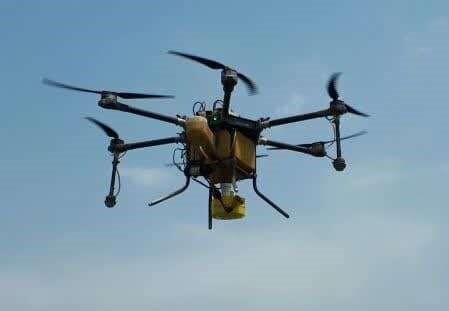
Performance evaluation of a UAV granule spreader in controlling rice striped stem borer (Chilo suppressalis)
1
Department of Research on Agricultural Machinery and Mechanization, Agricultural Engineering Research Institute, Agricultural Research, Education and Extension Organization (AREEO), Karaj, Iran
2
Rice Research Institute of Iran (RRII), Agricultural Research, Education and Extension Organization (AREEO), Rasht, Iran
3
Iranian Research Institute of Plant Protection, Agricultural Research, Education and Extension Organization (AREEO), Tehran, Iran
A - Research concept and design; B - Collection and/or assembly of data; C - Data analysis and interpretation; D - Writing the article; E - Critical revision of the article; F - Final approval of article
Submission date: 2024-09-08
Acceptance date: 2025-01-15
Online publication date: 2025-12-10
Corresponding author
Mahmoud Safari
Department of Research on Agricultural Machinery and Mechanization, Agricultural Engineering Research Institute, Agricultural Research, Education and Extension Organization (AREEO), Karaj, Iran
Department of Research on Agricultural Machinery and Mechanization, Agricultural Engineering Research Institute, Agricultural Research, Education and Extension Organization (AREEO), Karaj, Iran
Journal of Plant Protection Research 2025;65(4):505-515
HIGHLIGHTS
- The rice plant is one of the most important crops
- The granule spreading method is preferable
- The UAV granule spreading is recommended
- The striped stem borer hides inside the plant stem
KEYWORDS
TOPICS
ABSTRACT
The rice striped stem borer (Chilo suppressalis) is a significant pest of rice fields. This pest is
mainly controlled using chemical methods. In this research, the various pest control techniques
including solution pesticide spraying (Fipronil SC 5%, l · ha–1 or 50 g · ha–1 active substance)
and granule spreading (Fipronil G 0.2%, 20 kg · ha–1 or 40g · ha–1 active substances)
were evaluated. The study included the following treatments: solution pesticide spraying
with a UAV sprayer, spraying with a knapsack mist blower (KMB) sprayer, spraying with
a knapsack motorized lance (KML) sprayer, hand granule spreading (HGS), granule
spreading with a UAV granule spreader, and control (no application). The treatments
were carried out in a randomized complete block design (RCBD) with four replications.
The results indicated that the average consumed solution volume was 207.3, 195.6, and
18.2 l · ha–1 for KML, KMB, and UAV sprayers, respectively. The UAV sprayer had the lowest
drift at 13%, while the KML sprayer had the highest at 51.57%. The yield of granule pesticide
spreading was found to be higher than that of solution pesticide spraying. The granule
spraying methods were more efficient than solution pesticide spraying in controlling the
pest. The efficiency of HGS and UAV granule spreader methods was 87.25% and 79.7%, respectively,
while the efficiency of the UAV, KMB, and KML sprayers was 72.7%, 79.9%, and
77.8%, respectively. The results also showed that the granule-spreading methods were more
effective in controlling live larvae than solution pesticide spraying. In terms of income increase,
the UAV granule spreader was found to be more profitable than the UAV sprayer,
KMB sprayer, and KML sprayer, with increases of $109.2, $112.6, and $83.5 per hectare,
respectively. The study recommends the use of the UAV granule spreader for controlling
rice striped stem borers based on technical and economic evaluations of different pesticide
application methods.
ACKNOWLEDGEMENTS
We would like to express our gratitude to Dr. Sharifian,
the esteemed manager of Yaran Sirang Flight Company
for his valuable and effective collaboration in this
project.
RESPONSIBLE EDITOR
Zbigniew Czaczyk
CONFLICT OF INTEREST
The authors have declared that no conflict of interests exist.
REFERENCES (21)
1.
Ahmad F., Zhang S., Qiu B., Ma J., Xin H., Qiu W., Ahmed S., Chandio FA., Khaliq A. 2022. Comparison of water sensitive paper and glass strip sampling approaches to access spray deposit by UAV sprayers. Journal of Agronomy 12 (6): 1302. DOI: https://doi.org/10.3390/agrono....
2.
Amuagholi T.M., Alinia F.,Vedadpoor H. 2017. Guidelines for the management of tapeworm in replanting rice with the climatic conditions of Mazandaran, technical guidelines, Publications of the Agricultural Research, Education and Extension Organization, No: 53887.
3.
Chen P., Lan Y., Huang X., Qi H., Wang, G., Wang J., Wang L and Xiao H. 2020. Droplet deposition and control of plant hoppers of deferent nozzles in two-stage rice with a quad rotor unmanned aerial vehicle. Journal of Agronomy 10 (303): 2–14. DOI: 10.3390/agronomy10020303.
4.
Eduard G., Joan R., Rosell P., Ricardo S., Francesc R., Francesc S., Cruz G., Patricia C., Jaume Arnó I., Joan M., Ferran C., Rafael V., Alexandre E., Felip G., Santiago P., Enrique M. 2013.LIDAR as an alternative to passive collectors to measure pesticide spray drift. Journal of Atmospheric Environment 82: 83–93. DOI: https://doi.org/10.1016/j.atmo....
5.
Kharim M.N.A., Wayayok A., Shariff A.R.M., Abdullah A.F., Husin E.M. 2019. Droplet deposition density of organic liquid fertilizer at low altitude UAV aerial spraying in rice cultivation. Computers and Electronics in Agriculture 167: 1–6. DOI: 10.1016/j.compag.2019.105045.
7.
Majidi Shilsar F., Amuagholi Tabari M., Amini Khalafbadam A. 2013. Evaluation of the effect of fipronil pesticide in the control of rice tapeworm in paddy fields. Journal of Plant Protection (Agricultural sciences and industries) 27 (3): 341–333. DOI: 10.22067/jpp. v27i3.26760.
8.
Majidi Shilsar F. 2015. Crop loss assessment of rice stem borer, Chilo suppressalis Walker on Hashemi rice variety under field conditions. Plant Pest Research. 5 (2): 25–37. DOI: 10.22092/bcpp.2024.364738.359.
9.
Matthews G.A. 2004. How was the pesticide applied?" Crop Protection 23 (7): 651–653. DOI: 10.1016/j.cropro.2003.12.001.
10.
Miller J. W.2005. Report on the development and operation of a UAV for an experiment on the unmanned application of pesticides. Youngstown, Ohio: AFRL, USAF.
11.
Norouzieh S.H., Rezaei Asl A., Jokar M., Shafipour A.M. 2023. Evaluation of spraying quality of sprayer UAV compared to conventional sprayers in cotton field. Iranian Cotton Research Journal l10 (1): 109–132.
12.
Qin W., Bai-Jing Q., Xin-Yu X., Chen C., Zhu-Feng X and Qingqing Z. 2016. Droplet deposition and control effect insecticides sprayed with an unmanned aerial vehicle against plant hoppers. Crop Protection 85: 79–88. DOI:10.1016/j.cropro.2016.03.018.
13.
Safari M., Bagheri N. 2022. Technical criteria for the evaluation of sprayer UAVs. Agricultural Engineering Research Institute. Technical instructions.
14.
Safari M., Amirshaghaghi F., Louimi N., Chaji H. 2009. Evaluation of common sprayers used in wheat fields. Journal of Agricultural Engineering Research 10 (4): 1–12. DOI: https://sid.ir/paper/28044/fa.
15.
Shahrooz M., Talaeizadeh A., Alasti A. 2020. Agricultural spraying UAVs: advantages and disadvantages. Virtual Symposium in Plant Omics Sciences (OMICAS), Bogotá, Colombia. [Available: https://ieeexplore.ieee.org/ab...].
16.
Sheikhigarjan A., Safari M.,Ghazi M.M.,Zarnegar A.,Shahrokhi S., Bagheri N., Moein S., Seyedin P.2024. Chemical control of wheat sunn pest, Eurygaster integriceps, by UAV sprayer and very low volume knapsack sprayer. Phytoparasitica 52 (49). [Online] [Available from: https://doi.org/10.1007/s12600...].
17.
Soleimani A., Larijani A. 2012. Principles of rice cultivation. Arvij Publications. E-book, Arvij publications.ISBN:978-964-504-005-3.
18.
Srivastava K., Goering E., Rohrbach P. 2006. Engineering principles of agricultural machines. Second Edition, Chapter 10, Chemical application. ISBN: 1-892769-50-6. DOI: doi: https://doi.org/10.13031/epam.....
19.
Xinyu X., Kang T.,Weicai Q., LanY and Zhnag H. 2014. Drift and deposition of ultra-low altitude and low volume application in paddy field. International Journal Agriculture & Biology Engineering l (7) : 23–28.
20.
Yallappa D.2017. Development and evaluation of UAV mounted sprayer for pesticide applications to crops. IEEE Global Humanitarian Technology Conference (GHTC), 19–22 Oct San Jose, CA, USA.
21.
Zhua H., Salyani M., Fox R.2011. A portable scanning system for evaluation of spray deposit distribution. Computers and Electronics in Agriculture 76: 38–43. DOI: 10.1016/j.compag.2011.01.003.
Share
RELATED ARTICLE
| eISSN: | 1899-007X |
| ISSN: | 1427-4345 |

We process personal data collected when visiting the website. The function of obtaining information about users and their behavior is carried out by voluntarily entered information in forms and saving cookies in end devices. Data, including cookies, are used to provide services, improve the user experience and to analyze the traffic in accordance with the Privacy policy. Data are also collected and processed by Google Analytics tool (more).
You can change cookies settings in your browser. Restricted use of cookies in the browser configuration may affect some functionalities of the website.
You can change cookies settings in your browser. Restricted use of cookies in the browser configuration may affect some functionalities of the website.