
ORIGINAL ARTICLE
Insect community structure in tropical passion fruit (Passiflora edulis f. edulis Sims 1818) agroecosystems: Baseline data for integrated pest management and pollinator conservation

1
Pest and Plant Diseases, Universitas Andalas, Kampus Unand Limau manis, 25163, Padang, Indonesia
2
Agronomy, Universitas Andalas, Kampus Unand Limau manis, 25163, Padang, Indonesia
A - Research concept and design; B - Collection and/or assembly of data; C - Data analysis and interpretation; D - Writing the article; E - Critical revision of the article; F - Final approval of article
Submission date: 2026-01-01
Acceptance date: 2026-05-05
Online publication date: 2026-05-20
Corresponding author
Hasmiandy Hamid
Pest and Plant Diseases, Universitas Andalas, Kampus Unand Limau manis, 25163, Padang, Indonesia
Pest and Plant Diseases, Universitas Andalas, Kampus Unand Limau manis, 25163, Padang, Indonesia
HIGHLIGHTS
- Thirty insect species identified as IPM baseline for passion fruit
- Natural enemies (predatory ants, parasitoids) provide biological control potential
- Xylocopa pubescens identified as key pollinator requiring conservation
- High community evenness indicates a stable agroecosystem for pest suppression
- Findings support habitat management strategies for sustainable crop protection
KEYWORDS
TOPICS
ABSTRACT
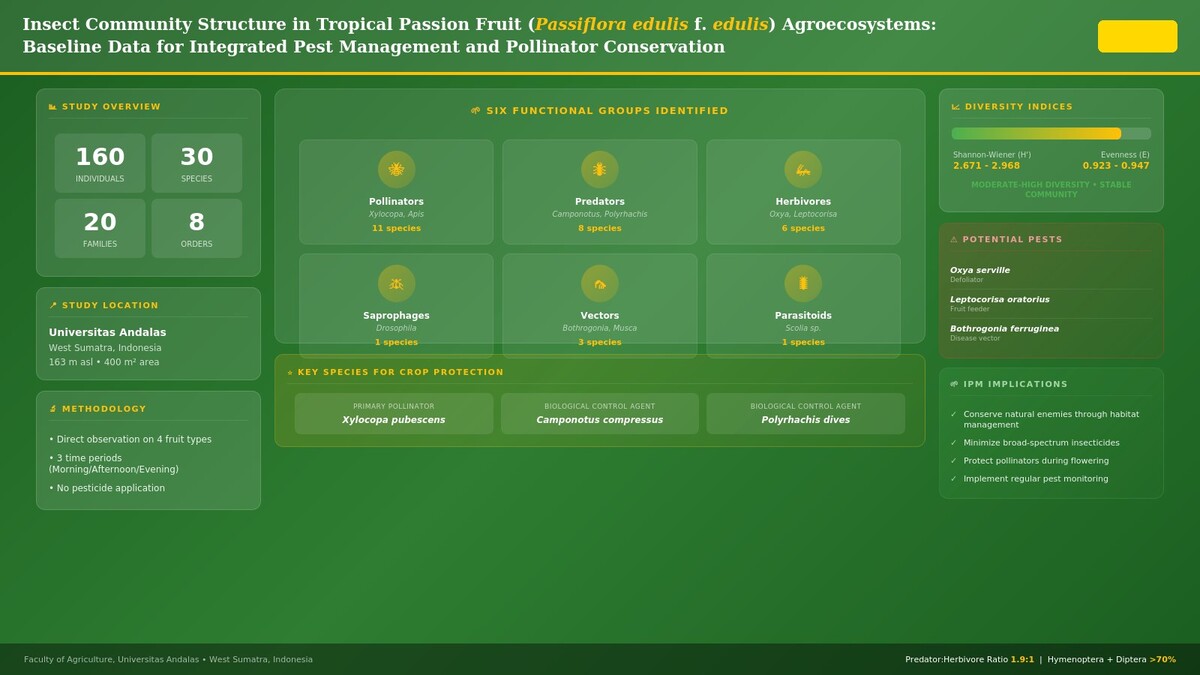
Effective integrated pest management (IPM) requires comprehensive knowledge of pest species, natural enemies, and beneficial insects within agroecosystems. This study characterized insect community structures associated with passion fruit (Passiflora edulis f. edulis Sims 1818). Observations were conducted on four morphological fruit types (yellow pulp and yellow-skinned, orange pulp and yellow-skinned, round red, and oval red) at three time periods using direct observation methods. A total of 160 individuals comprising 30 species, 20 families, and eight orders were recorded. Hymenoptera and Diptera dominated (>70%), with Kruskal-Wallis analysis revealing significant differences among insect orders (p = 0.0317) and functional groups (p < 0.0001), while Chi-square tests showed no significant association between passion fruit type or observation time and insect composition (Cramer's V = 0.18–0.20). Six functional groups were identified: pollinators, predators, herbivores, saprophages, vectors, and parasitoids. Xylocopa pubescens was the primary pollinator. Potential pest species identified included Oxya serville (defoliator), Leptocorisa oratorius (fruit feeder), and Bothrogonia ferruginea (disease vector). Predatory ants (Camponotus compressus, Polyrhachis dives) and coccinellid beetles represented significant natural enemy populations capable of providing conservation biological control. The diversity index ranged from moderate to high (H' = 2.671–2.968) with high evenness (E = 0.923–0.947), indicating stable communities supporting natural pest regulation. These findings provide baseline data for IPM development, emphasizing habitat management to conserve natural enemies and pollinators while minimizing pesticide disruption.
CONFLICT OF INTEREST
The authors have declared that no conflict of interests exist.
Share
RELATED ARTICLE
| eISSN: | 1899-007X |
| ISSN: | 1427-4345 |

We process personal data collected when visiting the website. The function of obtaining information about users and their behavior is carried out by voluntarily entered information in forms and saving cookies in end devices. Data, including cookies, are used to provide services, improve the user experience and to analyze the traffic in accordance with the Privacy policy. Data are also collected and processed by Google Analytics tool (more).
You can change cookies settings in your browser. Restricted use of cookies in the browser configuration may affect some functionalities of the website.
You can change cookies settings in your browser. Restricted use of cookies in the browser configuration may affect some functionalities of the website.