
ORIGINAL ARTICLE
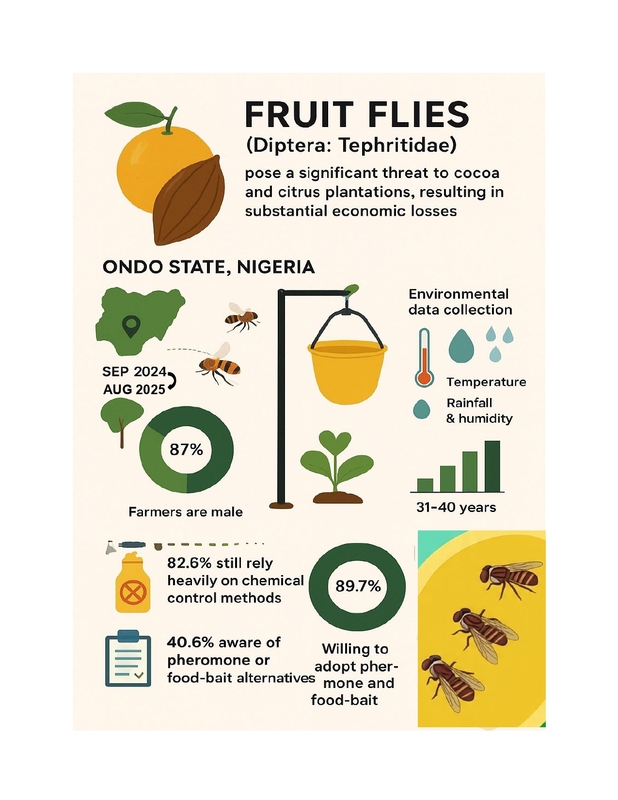
Efficacy of Food Bait and Synthetic Parapheromones for Monitoring Insect Diversity and Fruit Fly Abundance in Mixed Cocoa and Citrus Plantations

1
Department of Biology, School of Life Sciences, Federal University of Technology, Obanla, 340001, Akure, Ondo State, Nigeria
2
Teaching and Research Farm, Osun State University, Ejigbo, 232116, Ejigbo, Nigeria
3
Department of Crop, Soil and Pest Management, Federal University of Technology Akure, Obanla, 340001, Akure, Nigeria
4
Citrus and Product Development, National Horticultural Research Institute (NIHORT), Ibadan, Jericho Reservation Area, Idi-Ishin, P.M.B. 5432, Ibadan, Nigeria
A - Research concept and design; B - Collection and/or assembly of data; C - Data analysis and interpretation; D - Writing the article; E - Critical revision of the article; F - Final approval of article
Submission date: 2025-11-11
Acceptance date: 2026-05-14
Online publication date: 2026-05-21
Corresponding author
Emmanuel Ayobami Oyeniyi
Department of Biology, School of Life Sciences, Federal University of Technology, Obanla, 340001, Akure, Ondo State, Nigeria
Department of Biology, School of Life Sciences, Federal University of Technology, Obanla, 340001, Akure, Ondo State, Nigeria
HIGHLIGHTS
- Cuelure-baited traps were most effective, capturing 2,123 insects
- Yeast-baited traps attracted the highest species diversity
- Zeugodacus cucurbitae was the most dominant species found
- Insect populations showed species-specific relationships with abiotic factors
KEYWORDS
TOPICS
ABSTRACT
Fruit flies (Diptera: Tephritidae) pose a significant threat to wholesome fruit production, particularly in cocoa and citrus plantations, resulting in substantial economic losses. The abundance and diversity of fruit flies in Ondo State, Nigeria were monitored from September 2024 to August 2025 using a multi-faceted approach, including parapheromone and food-bait traps, environmental data collection (temperature, rainfall, relative humidity), and a survey of 224 local farmers. Surveyed farmers were predominantly male (87.05%), and the most common age range was 31–40 years (33.5%). Despite 63.0% of the respondents reporting negative effects from pesticide use, a large majority (82.6%) still relied heavily on chemical control methods. Although awareness of parapheromone or food-bait alternatives was relatively low (40.6%), willingness to adopt them was high (89.7%). This was primarily driven by the belief that these methods would reduce costs (63.4%). A total of 4,263 insects was captured, with Zeugodacus cucurbitae being the most dominant species, especially in cuelure-baited traps, while Torula® Yeast traps attracted the highest species diversity (Taxa_S: 21; Simpson's 1-D: 0.83; Shannon-Wiener H: 2.04; Margalef: 2.74), including Bradysia sp., Ceratitis capitata, Drosophila melanogaster, Dacus ciliatus, Eristalinus aeneus, and Zeugodacus cucurbitae, among others. Overall, cuelure-baited traps were the most effective (2,123 insects), while trimedlure-baited traps showed the least efficacy (231 insects). Correlation analysis revealed distinct and species-specific relationships between insect populations and abiotic factors. This study concluded that while fruit flies, predominantly Bactrocera, Ceratitis and Zeugodacus species, pose a significant economic threat in cocoa and citrus plantations, farmers showed a strong willingness to adopt more effective and cost-reducing alternative methods like parapheromone and food-bait traps. Integrating parapheromone-based strategies into Integrated Pest Management (IPM) programs could therefore be suggested for sustainable fruit fly control in Nigerian cocoa and citrus plantations.
CONFLICT OF INTEREST
The authors have declared that no conflict of interests exist.
| eISSN: | 1899-007X |
| ISSN: | 1427-4345 |

We process personal data collected when visiting the website. The function of obtaining information about users and their behavior is carried out by voluntarily entered information in forms and saving cookies in end devices. Data, including cookies, are used to provide services, improve the user experience and to analyze the traffic in accordance with the Privacy policy. Data are also collected and processed by Google Analytics tool (more).
You can change cookies settings in your browser. Restricted use of cookies in the browser configuration may affect some functionalities of the website.
You can change cookies settings in your browser. Restricted use of cookies in the browser configuration may affect some functionalities of the website.