
REVIEW
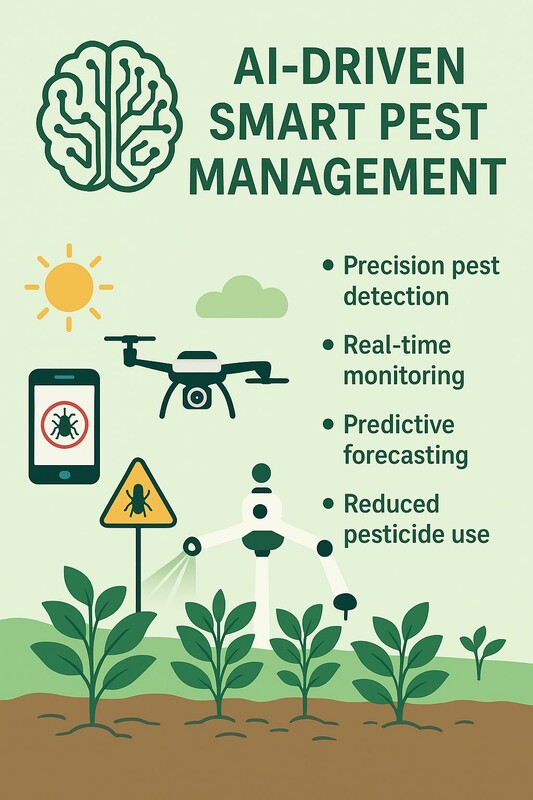
Smart Pest Management: The Evolution of AI-Driven Technologies in Plant Protection
1
Vignan Institute of Agriculture and Technology, Vignan University, Ground Floor VFF -10, H Block, Vignan University, , 522213, Guntur, India
2
Plant Pathology, Acharya N.G. Ranga Agricultural University, Administrative Office, Amaravathi Rd, Lam, 522034, Guntur, India
3
Plant Health Engineering Division, National Institute of Plant Health Management, Rajendranagar, 500030, Hyderabad, India
A - Research concept and design; B - Collection and/or assembly of data; C - Data analysis and interpretation; D - Writing the article; E - Critical revision of the article; F - Final approval of article
Submission date: 2025-11-04
Acceptance date: 2026-04-23
Online publication date: 2026-05-04
Corresponding author
Talari Naresh
Vignan Institute of Agriculture and Technology, Vignan University, Ground Floor VFF -10, H Block, Vignan University, , 522213, Guntur, India
Vignan Institute of Agriculture and Technology, Vignan University, Ground Floor VFF -10, H Block, Vignan University, , 522213, Guntur, India
HIGHLIGHTS
- AI enables precise, sustainable, and real-time pest management
- ML, DL, CV, IoT, and robotics enhance detection, diagnosis, and forecasting accuracy
- AI tools optimize pesticide use, reduce environmental impact
- open datasets, edge-AI,inclusive digital agriculture for sustainable plant protection
KEYWORDS
machine learningdecision support systemsintegrated pest managementdeep learningArtificial intelligence
TOPICS
ABSTRACT
Artificial intelligence (AI) has emerged as a transformative tool in plant protection, enabling improved accuracy, timeliness, and sustainability in pest and disease management. This review synthesizes the evolution of AI-driven technologies in plant protection, from early rule-based expert systems to modern machine learning, deep learning, computer vision, Internet of Things (IoT), robotics, and decision support systems. Numerous studies have demonstrated the potential of AI for pest detection, disease diagnosis, outbreak forecasting, and precision interventions using image analysis, sensor networks, and predictive models. Image-based pest and disease detection models commonly report accuracies ranging from 85-98% under controlled or semi-field conditions. At the same time, AI-guided precision spraying systems have achieved substantial reductions in pesticide use compared to conventional blanket applications. Despite rapid progress, challenges persist in areas such as data quality, regional generalization, infrastructure limitations, affordability, and integration with integrated pest management (IPM) frameworks. This review critically evaluates existing methodologies, summarizes key applications, and identifies research gaps and future directions for the responsible deployment of AI in sustainable plant protection. From a plant protection perspective, the value of AI lies not in replacing expert judgment, but in strengthening timely, evidence-based decisions within established integrated pest management frameworks under field conditions.
CONFLICT OF INTEREST
The authors have declared that no conflict of interests exist.
Share
RELATED ARTICLE
| eISSN: | 1899-007X |
| ISSN: | 1427-4345 |

We process personal data collected when visiting the website. The function of obtaining information about users and their behavior is carried out by voluntarily entered information in forms and saving cookies in end devices. Data, including cookies, are used to provide services, improve the user experience and to analyze the traffic in accordance with the Privacy policy. Data are also collected and processed by Google Analytics tool (more).
You can change cookies settings in your browser. Restricted use of cookies in the browser configuration may affect some functionalities of the website.
You can change cookies settings in your browser. Restricted use of cookies in the browser configuration may affect some functionalities of the website.