
ORIGINAL ARTICLE
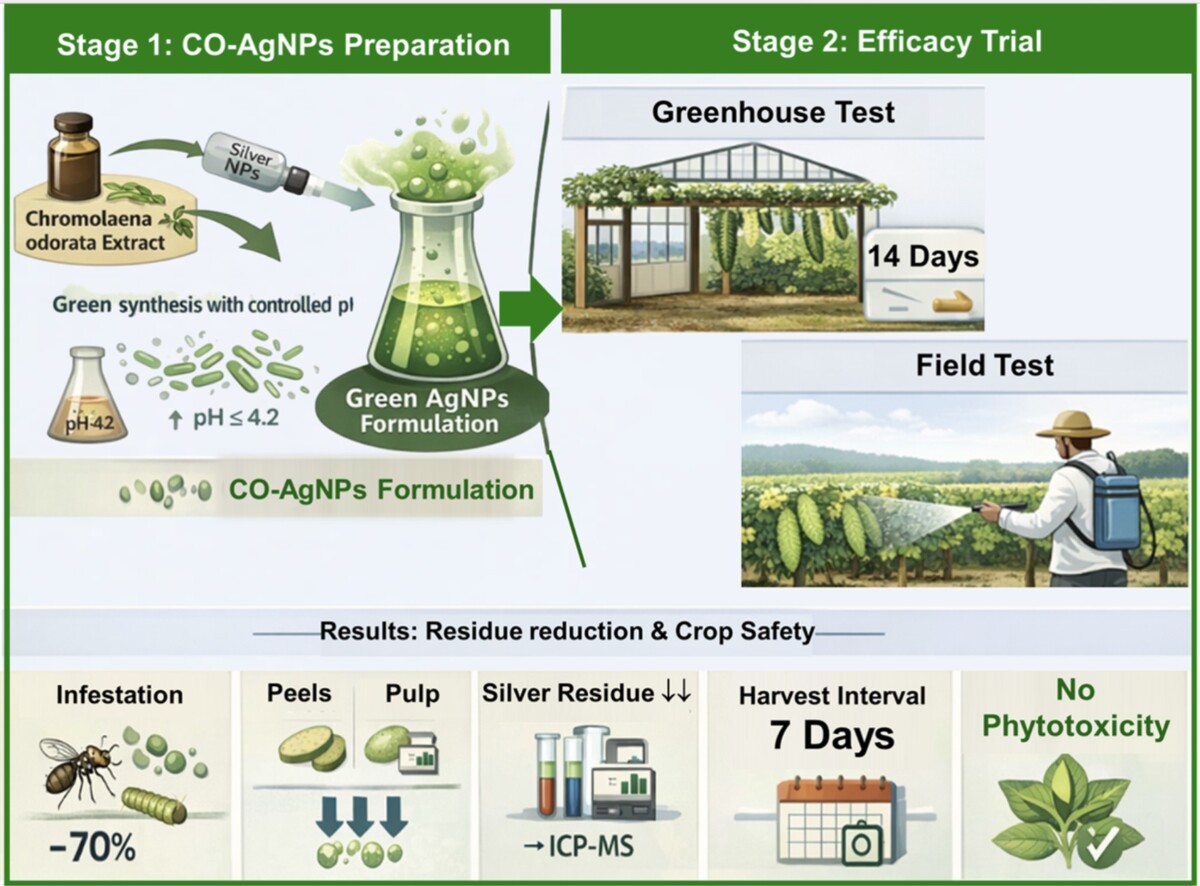
Greenhouse-to-field performance and residue profile of a green-synthesized silver nanoparticle formulation for melon fruit fly control on bitter gourd
1
Institute of Biotechnology and Food Technology, Industrial University of Ho Chi Minh City, Ho Chi Minh City, Vietnam, 12 Nguyen Van Bao, 700000, Ho Chi Minh, Viet Nam
2
Institute of Biotechnology and Food Technology, Industrial University of Ho Chi Minh City, 12 Nguyen Van Bao, 700000, Ho Chi Minh, Viet Nam
A - Research concept and design; B - Collection and/or assembly of data; C - Data analysis and interpretation; D - Writing the article; E - Critical revision of the article; F - Final approval of article
Submission date: 2026-01-01
Acceptance date: 2026-03-18
Online publication date: 2026-04-24
Corresponding author
Nhung T.P. Tran
Institute of Biotechnology and Food Technology, Industrial University of Ho Chi Minh City, Ho Chi Minh City, Vietnam, 12 Nguyen Van Bao, 700000, Ho Chi Minh, Viet Nam
Institute of Biotechnology and Food Technology, Industrial University of Ho Chi Minh City, Ho Chi Minh City, Vietnam, 12 Nguyen Van Bao, 700000, Ho Chi Minh, Viet Nam
HIGHLIGHTS
- - Plant-extract silver nanoparticles suppressed the melon fruit fly on bitter gourd
- - Field sprays reduced infestation from 65% to 23%, matching protein bait spinosad
- - Greenhouse sprays reduced infestation from 78% to 20-32% in two applications
- - Total silver residues were higher in peel than pulp and declined toward harvest
- - Residue decline supports a conservative 7-day pre-harvest interval
KEYWORDS
pre-harvest intervalChromolaena odorataMomordica charantiaBactrocera cucurbitaedose-response modelling
TOPICS
ABSTRACT
Melon fruit fly (Bactrocera cucurbitae (Coquillett)) severely constrains bitter gourd (Momordica charantia L.). We developed a Chromolaena odorata (L.) R.M.King & H.Rob. extract-mediated silver nanoparticle spray (CO-AgNPs) and evaluated its greenhouse-to-field efficacy together with residue dissipation and crop safety. CO-AgNPs were applied as full-cover foliar sprays in randomized complete block designs, comparing three rates with CO, AgNO₃, and a protein-bait benchmark (Sofri Protein 10DD; 0.02% spinosad). Under high pest pressure, CO-AgNPs reduced fruit infestation to 25.21-19.61% in greenhouse cages (control 78.01%) and to 28.06-22.55% in on-farm field plots (control 65.13%), comparable to Sofri (20.08% and 24.36%, respectively). Total silver residues (acid digestion followed by inductively coupled plasma-mass spectrometry) were higher in peel than in pulp and declined after the last spray; pulp concentrations remained low, and soil silver showed no increasing trend. Together, these findings support a conservative, provisional pre-harvest interval of 7 days for the tested program. Chromolaena odorata-derived silver nanoparticles (CO-AgNPs) were non-phytotoxic at the recommended rate based on the chlorophyll meter index (SPAD), the maximum quantum efficiency of photosystem II (Fv/Fm), and visual injury assessment. These results indicate CO-AgNPs as a promising foliar complement for residue-aware integrated pest management of melon fruit fly on bitter gourd.
CONFLICT OF INTEREST
The authors have declared that no conflict of interests exist.
| eISSN: | 1899-007X |
| ISSN: | 1427-4345 |

We process personal data collected when visiting the website. The function of obtaining information about users and their behavior is carried out by voluntarily entered information in forms and saving cookies in end devices. Data, including cookies, are used to provide services, improve the user experience and to analyze the traffic in accordance with the Privacy policy. Data are also collected and processed by Google Analytics tool (more).
You can change cookies settings in your browser. Restricted use of cookies in the browser configuration may affect some functionalities of the website.
You can change cookies settings in your browser. Restricted use of cookies in the browser configuration may affect some functionalities of the website.