
ORIGINAL ARTICLE
Antagonistic Interactions Between Cadherin Protein and Bt Cry1C Toxin in the Black Cutworm, Agrotis ipsilon (Hufnagel): Implications for Resistance Development and Genomic Stability
1
Economic Entomology and Pesticides, Faculty of Agriculture, Cairo University, Faculty of Agriculture, Cairo University, 12613, Giza, Egypt
2
Genetic, Agricultural Genetic Engineering Research Institute (AGERI), Agricultural Research Center, ElGamma, 12613, Giza, Egypt
These authors had equal contribution to this work
A - Research concept and design; B - Collection and/or assembly of data; C - Data analysis and interpretation; D - Writing the article; E - Critical revision of the article; F - Final approval of article
Submission date: 2025-10-30
Acceptance date: 2026-03-03
Online publication date: 2026-04-23
Corresponding author
Moataz Abdelmonem Mahmoud Moustafa
Economic Entomology and Pesticides, Faculty of Agriculture, Cairo University, Faculty of Agriculture, Cairo University, 12613, Giza, Egypt
Economic Entomology and Pesticides, Faculty of Agriculture, Cairo University, Faculty of Agriculture, Cairo University, 12613, Giza, Egypt
HIGHLIGHTS
- • CAD1000 dsRNA caused highest larval mortality in Agrotis ipsilon
- • Combination of Cry1C and CAD1000 showed an antagonistic effect on larval mortality
- • RAPD-PCR analysis revealed high level of genomic polymorphism
- • The AiCAD gene is highly expressed in the midgut and in second instar larvae
- • CAD1000 and Cry1C induced distinct genomic profiles in treated larvae
KEYWORDS
TOPICS
ABSTRACT
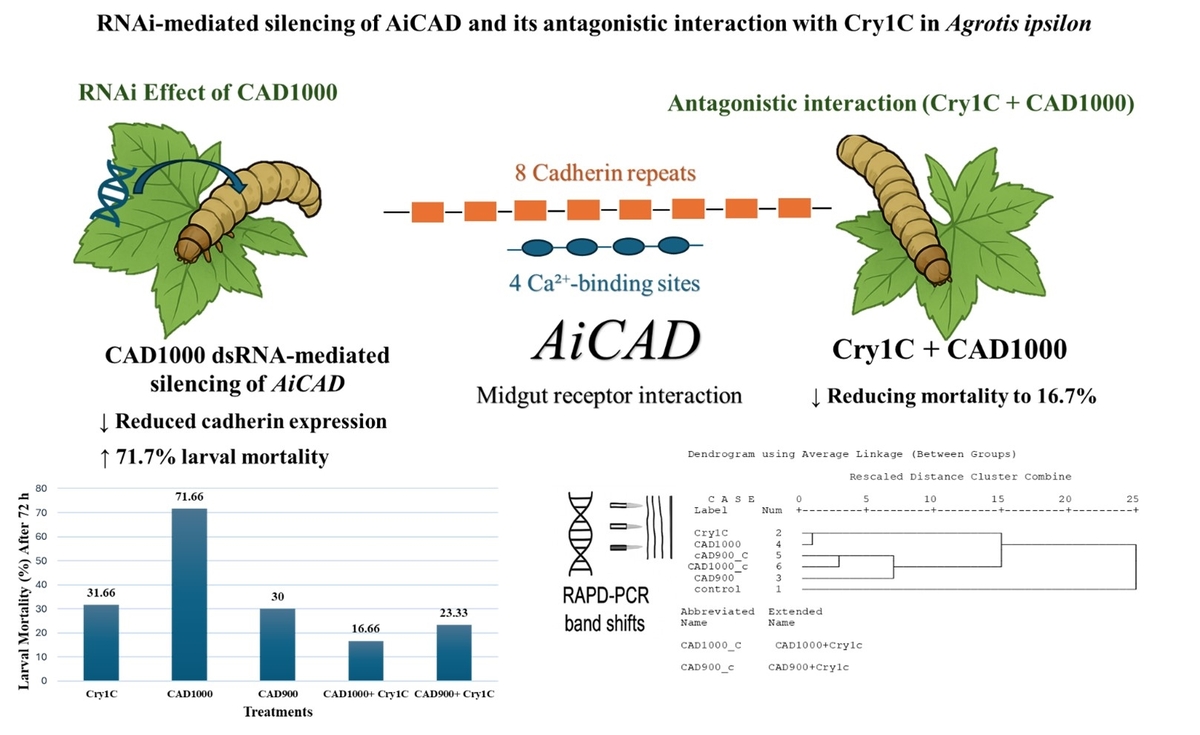
The black cutworm Agrotis ipsilon (Hufnagel) exhibits high tolerance to the Bacillus thuringiensis (Bt) Cry1C toxin, posing significant challenges for effective pest management. In this study, synthetic double-stranded RNA (dsRNA) fragments targeting two regions of the cadherin gene (CAD900 and CAD1000) were assessed for their larvicidal efficacy, interaction with Cry1C, and associated genomic alterations. The A. ipsilon cadherin (AiCAD) gene cloned using the A. ipsilon GenBank sequence (accession no. AEB97396.1) encodes a protein with eight cadherin repeat domains and four calcium-binding sites. Bioassays revealed that CAD1000 induced the highest larval mortality (71.67%), significantly exceeding that of Cry1C (31.67%) and CAD900 (30%). Notably, combining CAD1000 with Cry1C resulted in reduced mortality (16.67%), indicating a potential antagonistic interaction. RAPD-PCR analysis revealed pronounced treatment-associated polymorphisms, with CAD1000 inducing the highest level of variation (88.31%). Unique molecular markers differentiated five genotypes, and cluster analysis separated treatments into two primary groups: a genetically distinct control cluster and a second cluster comprising Cry1C, CAD1000, and their combination. The highest genetic similarity was observed between Cry1C and CAD1000 (0.787). Phylogenetic analysis indicated that AiCAD is most closely related to Sesamia inferens among 28 lepidopteran species. Quantitative real-time PCR (qRT-PCR) revealed significant developmental stage-dependent expression of AiCAD. In addition, tissue-specific profiling showed predominant transcript accumulation in the midgut, with minimal expression in the foregut, hindgut, and fat body, highlighting the midgut as the primary site of cadherin activity and Bt toxin interaction.
Overall, these findings identify CAD1000 as a promising RNAi-based larvicide candidate and suggest caution in its combined use with Cry1C due to the observed antagonistic effects. In addition, this study provides molecular and expression insights that may support the development of targeted management strategies against this resilient pest.
CONFLICT OF INTEREST
The authors have declared that no conflict of interests exist.
Share
RELATED ARTICLE
| eISSN: | 1899-007X |
| ISSN: | 1427-4345 |

We process personal data collected when visiting the website. The function of obtaining information about users and their behavior is carried out by voluntarily entered information in forms and saving cookies in end devices. Data, including cookies, are used to provide services, improve the user experience and to analyze the traffic in accordance with the Privacy policy. Data are also collected and processed by Google Analytics tool (more).
You can change cookies settings in your browser. Restricted use of cookies in the browser configuration may affect some functionalities of the website.
You can change cookies settings in your browser. Restricted use of cookies in the browser configuration may affect some functionalities of the website.