
ORIGINAL ARTICLE
Bio-efficacy and dynamic distribution of pymetrozine and cyantraniliprole against Aphis gossypii glover, and their residues in cucumber (Cucumis sativus l.) fruits using the QuEChERS method and LC-ESI-MS/MS
1
Department of Biology, College of Science and Humanities, Prince Sattam Bin Abdulziz University, Al-Kharj, Saudi Arabia
2
Central Laboratory of Residue Analysis of Pesticides and Heavy Metals in Foo, Agricultural Research Center, Ministry of Agriculture and Land Reclamation, El-Dokki, Giza, Egypt
3
Department of Economic Entomology and Pesticides, Faculty of Agriculture, Cairo University, Giza, Egypt
A - Research concept and design; B - Collection and/or assembly of data; C - Data analysis and interpretation; D - Writing the article; E - Critical revision of the article; F - Final approval of article
Submission date: 2024-07-06
Acceptance date: 2024-10-16
Online publication date: 2026-03-05
Corresponding author
Moataz A. M. Moustafa
Department of Economic Entomology and Pesticides, Faculty of Agriculture, Cairo University, Giza, Egypt
Department of Economic Entomology and Pesticides, Faculty of Agriculture, Cairo University, Giza, Egypt
Journal of Plant Protection Research 2026;66(1):1-10
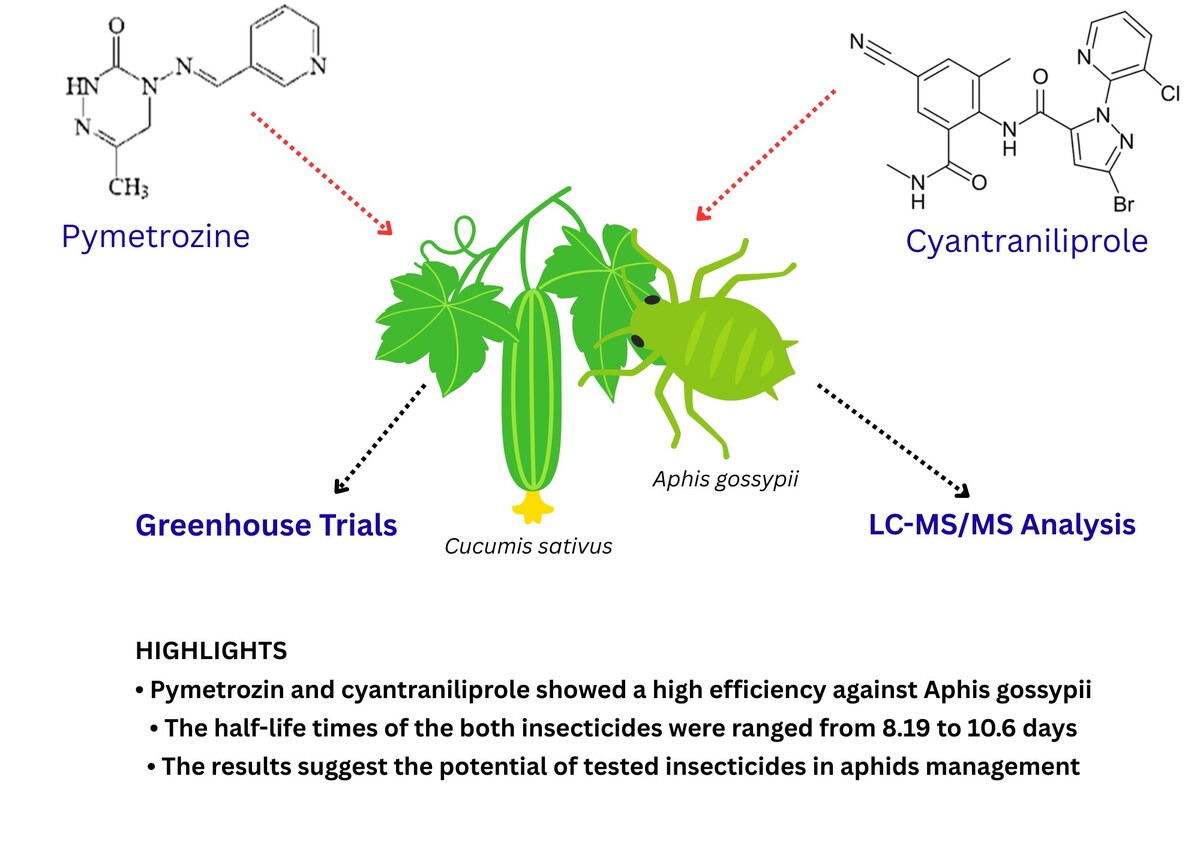
HIGHLIGHTS
- Pymetrozin and cyantraniliprole showed a high efficiency against Aphis gossypii
- The half-life times of the both insecticides were ranged from 8.19 to 10.6 days
- The results suggest the potential of tested insecticides in aphids management
KEYWORDS
TOPICS
ABSTRACT
Mixed pesticides are promising alternative approaches for insect pest management and
could reduce the risk to the environment. Therefore, their efficiency against pests and their
residues in the environment should be investigated. In this study, the efficacy of pymetrozine,
cyantraniliprole, and their mixture against Aphis gossypii Glover and their residues
in cucumber (Cucumis sativus L.) were studied. The results showed that pymetrozine and
cyantraniliprole alone or in combination were more effective than acetamiprid insecticide
for reducing A. gosspyii populations up to 15 days following application. Additionally,
a residual analytical method for insecticide determination in cucumber fruits, leaves, and
soil was optimized and validated. The tested insecticides’ residue extraction was carried
out using the QuEChERS method, and the determination was achieved using liquid chromatography-
tandem mass spectrometry (LC-MS/MS). The recovery tests were studied at
three spiking levels of low concentration (0.01, 0.05, and 0.1 mg · kg–1) with acceptable
recovery between 71 and 101% and good precision and expanded uncertainty up to ± 20%.
The half-life times of the tested formulations ranged from 8.19 to 10.6 days, while the preharvest
intervals (PHI) ranged from 8.8 to 23.8 days.
ACKNOWLEDGEMENTS
The manuscript has been edited for English language by
professional English-language Editors at RASAYELY
(https://www.rasayely.com) with Certification Verification
Key; RS_2024_Y23YFI. Many thanks are due
to Dr. Hamed Khairullah Said (Associate Professor,
Department of Economic Entomology and Pesticides,
Faculty of Agriculture, Cairo University, Egypt) for
revising and editing the manuscript for grammatical
correctness and coherence.
RESPONSIBLE EDITOR
Magdalena Jankowska
CONFLICT OF INTEREST
The authors have declared that no conflict of interests exist.
REFERENCES (34)
1.
Abd-Alrahman S.H., Kotb G.A.M. 2020. Dissipation kinetics of pymetrozine in Tomato field ecosystem. The Egyptian Journal of Hospital Medicine 81: 2305–2309. DOI: 10.21608/ejhm.2020.131248.
2.
Awad M., Hassan N.N., Alfuhaid N.A., Amer A., Salem M.Z.M., Fónagy A., Moustafa M.A.M. 2024. Insecticidal and biochemical impacts with molecular docking analysis of three essential oils against Spodoptera littoralis (Lepidoptera: Noctuidae). Crop Protection 180: 106659. DOI: 10.1016/j.cropro.2024.106659.
3.
Ding W., Guo L., Xue Y., Wang M., Li C., Zhang R., Xia X. 2024. Life parameters and physiological reactions of Cotton Aphids Aphis gossypii (Hemiptera: Aphididae) to sublethal concentrations of Afidopyropen. Agronomy 14: 258. DOI: https://doi.org/10.3390/agrono....
4.
Ebert T.A., Cartwright B. 1997. Biology and ecology of Aphis gossypii Glover (Homoptera: aphididae). Southweste Entomologi 22: 116–153..
5.
El-Hefny D.E., Ibrahim E.S., Alfuhaid N.A., Fónagy A., Moustafa M.A.M. 2024 Residual Effect of the Insecticides Flonicamid and Spiromesifen against Aphis craccivora (Hemiptera: Aphididae) and Persistence Dynamics in Faba Bean. Journal of Entomological Science 59: 165–181. DOI: 10.18474/JES2339.
6.
El-Shourbagy N.M., Farag S.M., Moustafa M.A.M., Al-Shuraym L.A., Sayed S., Zyaan O.H. 2023. Biochemical and insecticidal efficacy of clove and basil essential oils and two photosensitizers and their combinations on Aphis gossypii Glover (Hemiptera: Aphididae). Bioscience Journal 39: e39100. DOI: 10.14393/BJ-v39n0a2023-69129.
7.
Farag A.I., Said S.M., Abd El- Raheem A.M., Swalem N.O., Ataa O.I. 2024. Influence of five host plants on development and life table Parameters of Aphis gossypii Glover (Hemiptera: Aphididae). Egyptian Academic Journal of biological sciences17: 25-32. DOI: 10.21608/eajbsa.2024.353867.
8.
Ferguson J.S., Koenig J.P., White S.M., Dunbar D.M., Lawson D.S. 1999. Evaluation of Fulfill® 50WG (pymetrozine) for cotton aphid control in 1998 field trails. Proceedings of the Beltwide Cotton Conference 2: 1016–1019.
9.
Hanafy A.R. 2004. Studies on the most important Cucumber pests in the open field and suitable control programs. Ph.D. thesis, Fac. of Agric. Moshtohor, Benha Branch- Zagazig Univ., Egypt, 279 pp.
10.
Handerson C.F., Tilton E.W. 1955. Tests with acaricides against the brown wheat mite. Journal of Economic Entomology 48: 157–161. DOI: 10.1093/jee/48.2.157.
11.
Harrewijn P., Kayser H. 1997. Pymetrozine, a fast-acting and selective inhibitor of aphid feeding. In-situ studies with electronic monitoring of feeding behaviour. Pesticide Science 49: 130–140. DOI: 10.1002/(sici)1096-9063(199702)49:2<130::aid-ps509>3.0.co;2-u.
12.
Heilsnis B., Mahas J.B., Conner K., Pandey S., Clark W., Koebernick J., Jacobson A.L. 2023. Characterizing the vector competence of Aphis gossypii, Myzus persicae and Aphis craccivora (Hemiptera: Aphididae) to transmit cotton leafroll dwarf virus to cotton in the United States. Journal of Economic Entomology 116: 719–725. DOI: 10.1093/jee/toad080.
13.
Hong J.-H., Lee C.-R., Lim J.-S., Lee K.-S., Kyu L. 2011. Comparison of analytical methods and residue patterns of pymetrozine in Aster scaber. Bulletin of Environmental Contamination and Toxicology 87: 649–652. DOI: 10.1007/s00128-011-0407-8.
14.
Kandil M.A., Moustafa M.A.M., Saleh M.A., Ateya I.R. 2023. Dissipation kinetics and degradation products of cyantraniliprole in tomato plants and soil in the open field. Egyptian Journal of Chemistry 66: 483–493. DOI: 10.21608/ejchem.2023.195133.7625.
15.
Kim S.E., Kim H.K., Kim G.H. 2024. Sublethal effects of spirotetramat, cyantraniliprole, and pymetrozine on Aphis gossypii (Hemiptera: Aphididae). Insects 15: 247. DOI:10.3390/insects15040247.
16.
Koo H.-N., An J.-J., Park S.-E., Kim J.-I., Kim G.-H. 2014. Regional susceptibilities to 12 insecticides of melon and cotton aphid, Aphis gossypii (Hemiptera: Aphididae) and a point mutation associated with imidacloprid resistance. Crop Protection 55: 91–97. DOI: 10.1016/j.cropro.2013.09.010.
17.
Krishnan V.N. 2009. DPX-HGW86: Laboratory study of solubility in organic solvents.
18.
Kristinsson H. 1994. Pymetrozine: A new insecticide. In Advances in the Chemistry of Insect Control III, pp. 85-102. Cambridge: The Royal Society of Chemistry.
19.
Magnusson B., Örnemark U. 2014. Eurachem Guide: The Fitness for Purpose of Analytical Methods– A Laboratory Guide to Method Validation and Related Topics, (2nd ed.). https://www.eurachem.org/image....
20.
Malhat F., Abdallah O. 2019. Residue distribution and risk assessment of two macrocyclic lactone insecticides in green onion using micro-liquid-liquid extraction (MLLE) technique coupled with liquid chromatography tandem mass spectrometry. Environmental Monitoring and Assessment 191: 1–10. DOI: 10.1007/s10661-019-7752-1.
21.
Mohamed M.A., Homam H.B. 2012. Using some insecticides for controlling cotton and watermelon aphid, Aphis gossypii Glover on cucumber plants referring to the yield. Egyptian J. Agr. Res. 90: 517–527. DOI: 10.21608/ejar.2012.160147.
22.
Moustafa M.A.M., Amer A., Al-Shuraym L.A., Ibrahim E.S., El-Hefny D.E., Salem M.Z.M., Sayed S. 2022. Efficacy of chemical and bio-pesticides on cowpea aphid, Aphis craccivora, and their residues on the productivity of fennel plants (Foeniculum vulgare). Journal of King Saud University – Science 34: 101900. DOI: 10.1016/j.jksus.2022.101900.
23.
Moustafa M.A.M., El Hefny D.E., Alfuhaid N.A., Helmy R.M.A., El-Said N.A., Ibrahim E.S. 2024b. Effectiveness and biochemical impact of flubendiamide and flonicamid insecticides against Bemisia tabaci (Hemiptera: Aleyrodidae) and residue dissipation in Tomato plants and soil under greenhouse conditions. Journal of Entomological Science 59: 289–310. DOI: 10.18474/JES23-61.
24.
Moustafa M.A.M., Osman E.A., Mokbel E.M.S., Fouad E.A. 2024a. Biochemical and molecular characterization of chlorantraniliprole resistance in Spodoptera littoralis (Lepidoptera: Noctuidae). Crop Protection 177: 106533. DOI: 10.1016/j.cropro.2023.106533.
25.
Pes M.P., Melo A.A., Stacke R.S., Zanella R.Z., Perini C.R., Silva F.M.A., Guedes J.V.C. 2020. Translocation of chlorantraniliprole and cyantraniliprole applied to corn as seed treatment and foliar spraying to control Spodoptera frugiperda (Lepidoptera: Noctuidae). PLoS ONE 15: e0229151. DOI: 10.1371/journal.pone.0229151.
26.
Sattelle D.B., Cordova D., Cheek T.R. 2008. Insect ryanodine receptors: molecular targets for novel pest control chemicals. Invertebrate Neuroscience 8: 107–119. DOI: 10.1007/s10158-008-0076-4.
27.
Selby T.P., Lahm G.P., Stevenson T.M., Hughes K.A., Cordova D., Annan I.B., Pahutski T.F. 2013. Discovery of cyantraniliprole, a potent and selective anthranilic diamide ryanodine receptor activator with cross-spectrum insecticidal activity. Bioorganic & medicinal chemistry letters 23: 6341–6345. DOI: 10.1016/j.bmcl.2013.09.076.
28.
Somar R.O., Zamani A.A., Alizadeh M. 2019. Joint action toxicity of imidacloprid and pymetrozine on the melon aphid, Aphis gossypii. Crop Protection 124: 104850. DOI: 10.1016/j.cropro.2019.104850.
29.
Talebi-Jahromi K. 2007. Pesticide toxicology. University of Tehran Publication, Tehran. 492 pp.
30.
Tomizawa M., Casida J.E. 2005. Neonicotinoid insecticide toxicology: mechanisms of selective action. Annual Review of Pharmacology and Toxicology 45: 247–268. DOI: 10.1146/annurev.pharmtox.45.120403.095930.
31.
Ullah F., Gul H., Desneux N., Qu Y., Xiao X., Khattak A.M., Gao X., Song D. 2019. Acetamiprid-induced hormetic effects and vitellogenin gene (Vg) expression in the melon aphid, Aphis gossypii Entomologia Generalis 39: 259-270. DOI: 10.1127/entomologia/2019/0887.
32.
Wyss P., Bolinger M. 1997. Translocation of pymetrozine in plants. Pesticide Science 50: 195–202. DOI: 10.1002/(SICI)1096-9063(199707)50:33.0.CO;2-D.
33.
Wang K.Y., Guo Q.L., Xia X.M., Wang H.Y., Liu T.X. 2007. Resistance of Aphis gossypii (Homoptera:Aphididae) to selected insecticides on cotton from five cotton production regions in Shandong, China. Journal of Pesticide Science 32: 372–378. DOI: 10.1584/jpestics.G06-51.
34.
Zhang J., Kothalawala S., Yu C. 2023. Engineered silica nanomaterials in pesticide delivery: challenges and perspectives. Environmental Pollution 320: 121045. DOI: 10.1016/j.envpol.2023.121045.
Share
RELATED ARTICLE
| eISSN: | 1899-007X |
| ISSN: | 1427-4345 |

We process personal data collected when visiting the website. The function of obtaining information about users and their behavior is carried out by voluntarily entered information in forms and saving cookies in end devices. Data, including cookies, are used to provide services, improve the user experience and to analyze the traffic in accordance with the Privacy policy. Data are also collected and processed by Google Analytics tool (more).
You can change cookies settings in your browser. Restricted use of cookies in the browser configuration may affect some functionalities of the website.
You can change cookies settings in your browser. Restricted use of cookies in the browser configuration may affect some functionalities of the website.