
RAPID COMMUNICATION
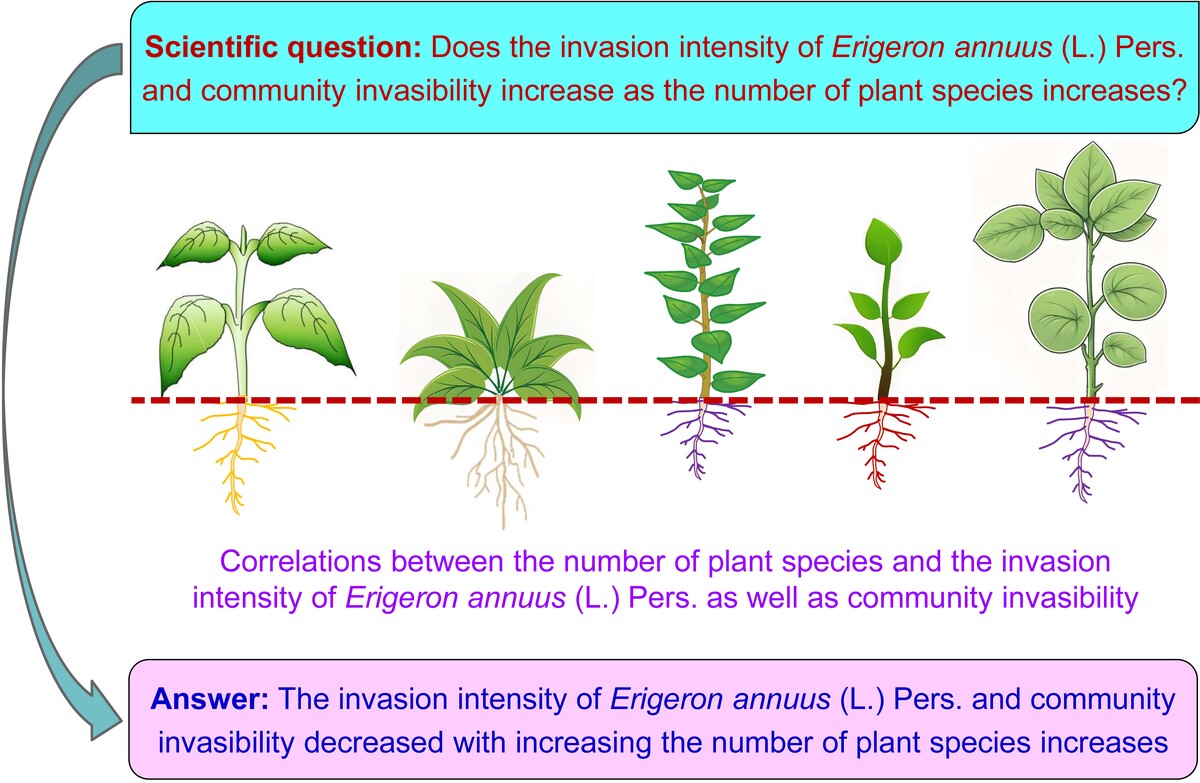
Does the invasion intensity of Erigeron annuus (L.) Pers. and community invasibility increase as the number of plant species increases?
1
Institute of Environment and Ecology, School of the Environment and Safety Engineering, Jiangsu University, Zhenjiang, China
2
Fujian Key Laboratory of Conservation and Sustainable Utilization of Marine Biodiversity, Minjiang University, Fuzhou, China
These authors had equal contribution to this work
A - Research concept and design; B - Collection and/or assembly of data; C - Data analysis and interpretation; D - Writing the article; E - Critical revision of the article; F - Final approval of article
Submission date: 2025-10-10
Acceptance date: 2026-01-23
Online publication date: 2026-09-07
Corresponding author
Congyan WANG
Institute of Environment and Ecology, School of the Environment and Safety Engineering, Jiangsu University, Zhenjiang, China
Institute of Environment and Ecology, School of the Environment and Safety Engineering, Jiangsu University, Zhenjiang, China
Journal of Plant Protection Research 2026;66(3):436-441
HIGHLIGHTS
- Relative abundance of E. annuus reduced with increasing number of plant species
- Invasion intensity of E. annuus decreased with increasing number of plant species
- Community invasibility declined with increasing number of plant species
- Community invasibility was positively regulated by relative abundance of E. annuus
- Community invasibility was positively regulated by invasion intensity of E. annuus
KEYWORDS
TOPICS
ABSTRACT
Habitats with different numbers of plant species (S) may exhibit varying levels of invasibility
when invaded by invasive plants (IPS). Nevertheless, there are still doubts about the
relationship between S and IPS’ invasion intensity as well as the community invasibility.
It is also unclear which environmental factor has the greatest influence on the community
invasibility, especially in habitats with different S. A cross-plot comparison approach
was employed to estimate the differences in IPS’ relative abundance and invasion intensity,
the community invasibility, and plant taxonomic diversity along a gradient of S under the
invasion of Erigeron annuus (L.) Pers. Plant diversity, dominance, evenness, and richness
evidently increased with increasing S. The relative abundance and invasion intensity of
E. annuus, as also the mean, maximum, and minimum relative abundances of all plants,
and the community invasibility significantly decreased with increasing S. The community
invasibility was positively regulated by the relative abundance and invasion intensity of
E. annuus, but negatively regulated by plant diversity, dominance, evenness, and richness.
Therefore, protecting the diversity of native plants is crucial for enhancing the resistance
to IPS’ invasion.
ACKNOWLEDGEMENTS
We are very grateful to the anonymous reviewers for
the insightful and constructive comments that greatly
improved this manuscript.
RESPONSIBLE EDITOR
Irena Suwara
CONFLICT OF INTEREST
The authors have declared that no conflict of interests exist.
REFERENCES (31)
1.
Abella S.R., Engel E.C., Springer J.D., Covington W.W. 2012. Relationships of exotic plant communities with native vegetation, environmental factors, disturbance, and landscape ecosystems of Pinus ponderosa forests, USA. Forest Ecology and Management 271: 65–74. DOI: 10.1016/j.foreco.2012.01.035.
2.
Ahmad R., Lone S.A., Rashid I., Khuroo A.A. 2025. A global synthesis of the ecological effects of co-invasions. Journal of Ecology 113: 570–581. DOI: 10.1111/1365-2745.14475.
3.
Bart D., Davenport T., Carpenter Q. 2015. Stress and land‒use legacies alter the relationship between invasive ‒ and native ‒ plant richness. Journal of Vegetation Science 26: 80–88. DOI: 10.1111/jvs.12220.
4.
Bartomeus I., Sol D., Pino J., Vicente P., Font X. 2012. Deconstructing the native–exotic richness relationship in plants. Global Ecology and Biogeography Letters 21: 524–533. DOI: 10.1111/j.1466-8238.2011.00708.x.
5.
Beshai R.A., Truong D.A., Henry A.K., Sorte C.J.B. 2023. Biotic resistance or invasional meltdown? Diversity reduces invasibility but not exotic dominance in southern California epibenthic communities. Biological Invasions 25: 533–549. DOI: 10.1007/s10530-022-02932-1.
6.
Byun C., de Blois S., Brisson J. 2013. Plant functional group identity and diversity determine biotic resistance to invasion by an exotic grass. Journal of Ecology 101: 128–139. DOI: 10.1111/1365-2745.12016.
7.
Catford J.A., Smith A.L., Wragg P.D., Clark A.T., Kosmala M., Cavender-Bares J., Reich P.B., Tilman D. 2019. Traits linked with species invasiveness and community invasibility vary with time, stage and indicator of invasion in a long-term grassland experiment. Ecology Letters 22: 593–604. DOI: 10.1111/ele.13220.
8.
Dong L.J., Yu H.W., He W.M. 2015. What determines positive, neutral and negative impacts of Solidago canadensis invasion on native plant species richness? Scientific Reports 5: 16804. DOI: 10.1038/srep16804.
9.
Driscoll D.A. 2017. Disturbance maintains native and exotic plant species richness in invaded grassy woodlands. Journal of Vegetation Science 28: 573–584. DOI: 10.1111/jvs.12513.
10.
Du Y.Z., Liu Y.S., Li Y., Li C., Wang C.Y., Cheng H.Y., Du D.L. 2025. The invasive tree Rhus typhina L. decreases plant diversity and richness but increases plant functional diversity in the invaded communities. Biologia 80: 1647–1658. DOI: 10.1007/s11756-025-01923-6.
11.
Ellis E.C., Antill E.C., Kreft H. 2012. All is not loss: Plant biodiversity in the Anthropocene. Plos One 7: e30535. DOI: 10.1371/journal.pone.0030535.
12.
Fenouillas P., Ah-Peng C., Amy E., Bracco I., Dafreville S., Gosset M., Ingrassia F., Lavergne C., Lequette B., Notter J.C., Pause J.M., Payet G., Payet N., Picot F., Poungavanon N., Strasberg D., Thomas H., Triolo J., Turquet V., Rouget M. 2021. Quantifying invasion degree by alien plants species in Reunion Island. Austral Ecology 46: 1125–1137. DOI: 10.1111/aec.13048.
13.
Hao Q., Ma J.S. 2023. Invasive alien plants in China: An update. Plant Diversity 45: 117–121. DOI: 10.1016/j.pld.2022.11.004.
14.
Hector A., Hautier Y., Saner P., Wacker L., Bagchi R., Joshi J., Scherer-Lorenzen M., Spehn E.M., Bazeley-White E., Weilenmann M., Caldeira M.C., Dimitrakopoulos P.G., Finn J.A., Huss-Danell K., Jumpponen A., Mulder C.P.H., Palmborg C., Pereira J.S., Siamantziouras A.S.D., Terry A.C., Troumbis A.Y., Schmid B., Loreau M. 2010. General stabilizing effects of plant diversity on grassland productivity through population asynchrony and overyielding. Ecology 91: 2213–2220. DOI: 10.1890/09-1162.1.
15.
Liu Y.S., Du Y.Z., Li C., Li Y., Wang C.Y., Du D.L. 2026. Co-invasion of three invasive alien plants increases plant taxonomic diversity and community invasibility. Plant Diversity: 48: 204‒211. DOI: 10.1016/j.pld.2025.05.013.
16.
Liu Y.Y., Li Z., Xu L., Fu Q., Wang Y.J. 2022. Effects of region and elevation on adaptation of leaf functional traits of an invasive plant Erigeron annuus in China. Phyton 91: 115-128. DOI: 10.32604/phyton.2022.015395.
17.
Lu Y.J., Wang Y.F., Wu B.D., Wang S., Wei M., Du D.L., Wang C.Y. 2020. Allelopathy of three Compositae invasive alien species on indigenous Lactuca sativa L. enhanced under Cu and Pb pollution. Scientia Horticulturae 267: 109323. DOI: 10.1016/j.scienta.2020.109323.
18.
Meffin R., Miller A.L., Hulme P.E., Duncan R.P. 2010. BIODIVERSITY RESEARCH: Experimental introduction of the alien plant Hieracium lepidulum reveals no significant impact on montane plant communities in New Zealand. Diversity and Distributions 16: 804–815. DOI: 10.1111/j.1472-4642.2010.00684.x.
19.
Negesse Z., Pan K.W., Guadie A., Justine M.F., Azene B., Pandey B., Wu X.G., Sun X.M., Zhang L. 2025. Plant invasions alter soil biota and microbial activities: a global meta-analysis. Plant and Soil 513: 1031–1050. DOI: 10.1007/s11104-025-07227-7.
20.
Peng S.J., Kinlock N.L., Gurevitch J., Peng S.L. 2019. Correlation of native and exotic species richness: a global meta-analysis finds no invasion paradox across scales. Ecology 100: e02552. DOI: 10.1002/ecy.2552.
21.
Rastogi R., Qureshi Q., Shrivastava A., Jhala Y.V. 2023. Multiple invasions exert combined magnified effects on native plants, soil nutrients and alters the plant-herbivore interaction in dry tropical forest. Forest Ecology and Management 531: 120781. DOI: 10.1016/j.foreco.2023.120781.
22.
Sato R.Y., Costa A.P.L., Padial A.A. 2021. The invasive tropical tanner grass decreases diversity of the native aquatic macrophyte community at two scales in a subtropical tidal river. Acta Botanica Brasilica 35: 140–150. DOI: 10.1590/0102-33062020abb0360.
23.
Swierszcz S., Czarniecka-Wiera M., Szymura T.H., Szymura M. 2024. From invasive species stand to species-rich grassland: Long-term changes in plant species composition during Solidago invaded site restoration. Journal of Environmental Management 353: 13. DOI: 10.1016/j.jenvman.2024.120216.
24.
Trevenen E.J., Veneklaas E.J., Teste F.P., Dobrowolski M.P., Mucina L., Renton M. 2024. Plant interactions can lead to emergent relationships between plant community diversity, productivity and vulnerability to invasion. Scientific Reports 14: 13932. DOI: 10.1038/s41598-024-59996-3.
25.
Wang C.Y., Liu J., Xiao H.G., Zhou J.W., Du D.L. 2016. Floristic characteristics of alien invasive seed plant species in China. Anais da Academia Brasileira de Ciências 88: 1791–1797. DOI: 10.1590/0001-3765201620150687.
26.
Wang C.Y., Yu Y.L., Cheng H.Y., Du D.L. 2022. Which factor contributes most to the invasion resistance of native plant communities under the co-invasion of two invasive plant species? Science of the Total Environment 813: 152628. DOI: 10.1016/j.scitotenv.2021.152628.
27.
Xiao Y.K., He J.X., Aishan T., Sui Q., Zhou Y.F., Yimingniyazi A. 2024. Effects of different degrees of Xanthium spinosum invasion on the invasibility of plant communities in the Yili Grassland of Northwest China. Biology 13: 14. DOI: 10.3390/biology13010014.
28.
Xu Z.L., Zhong S.S., Yu Y.L., Wang Y.Y., Cheng H.Y., Du D.L., Wang C.Y. 2023. Rhus typhina L. triggered greater allelopathic effects than Koelreuteria paniculata Laxm under ammonium fertilization. Scientia Horticulturae 309: 111703. DOI: 10.1016/j.scienta.2022.111703.
29.
Yan X.L., Liu Q.R., Shou H.Y., Zeng X.F., Zhang Y., Chen L., Liu Y., Ma H.Y., Qi S.Y., Ma J.S. 2014. The categorization and analysis on the geographic distribution patterns of Chinese alien invasive plants. Biodiversity Science 22: 667–676. DOI: 10.3724/SP.J.1003.2014.14069.
30.
Zhang K.M., Gu R.Y., Yang Y.B., Yan J., Ma Y.P., Shen Y. 2025. Recent distribution changes of invasive Asteraceae species in China: A five-year analysis (2016–2020). Journal of Environmental Management 376: 124445. DOI: 10.1016/j.jenvman.2025.124445.
31.
Zhang H.S., Li C., Li Y., Xu Z.L., Zhong S.S., Liu J., Du D.L., Wang C.Y. 2024. Relationship between plant diversity and community stability and invasibility in the heterogeneous landscape of urban habitats undergoing Solidago canadensis invasion. Plant Ecology & Diversity 17: 75–84. DOI: 10.1080/17550874.2024.2372713.
| eISSN: | 1899-007X |
| ISSN: | 1427-4345 |

We process personal data collected when visiting the website. The function of obtaining information about users and their behavior is carried out by voluntarily entered information in forms and saving cookies in end devices. Data, including cookies, are used to provide services, improve the user experience and to analyze the traffic in accordance with the Privacy policy. Data are also collected and processed by Google Analytics tool (more).
You can change cookies settings in your browser. Restricted use of cookies in the browser configuration may affect some functionalities of the website.
You can change cookies settings in your browser. Restricted use of cookies in the browser configuration may affect some functionalities of the website.