
ORIGINAL ARTICLE
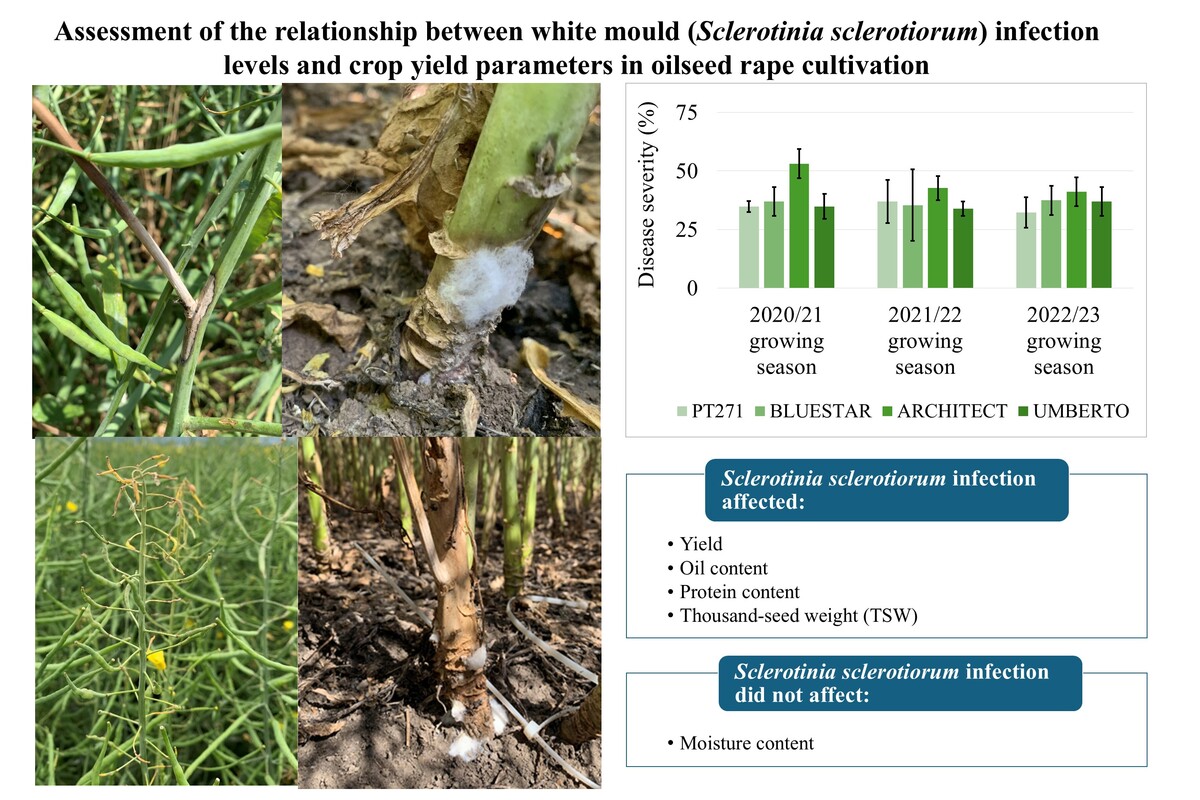
Assessment of the relationship between white mold (Sclerotinia sclerotiorum (Lib.) de Bary) infection levels and crop yield parameters in oilseed rape (Brassica napus L) cultivation
1
Department of Integrated Plant Protection, Institute of Plant Protection, Hungarian University of Agriculture and Life Sciences, Gödöllő, Hungary
A - Research concept and design; B - Collection and/or assembly of data; C - Data analysis and interpretation; D - Writing the article; E - Critical revision of the article; F - Final approval of article
Submission date: 2025-06-18
Acceptance date: 2025-08-26
Online publication date: 2025-10-09
Corresponding author
Ramóna Vizi
Department of Integrated Plant Protection, Institute of Plant Protection, Hungarian University of Agriculture and Life Sciences, Gödöllő, Hungary
Department of Integrated Plant Protection, Institute of Plant Protection, Hungarian University of Agriculture and Life Sciences, Gödöllő, Hungary
Journal of Plant Protection Research 2026;66(3):423-435
HIGHLIGHTS
- The hybrids showed a high infection, but no differences were observed between them
- Disease severity had an effect on protein content, oil content, and TSW
- Disease severity had no effect on moisture content
- There was no consistent effect between the hybrids tested for each quality parameter
KEYWORDS
TOPICS
ABSTRACT
White mold [Sclerotinia sclerotiorum (Lib.) de Bary] often results in substantial yield and
quality losses in winter oilseed rape (Brassica napus L.; OSR). This study investigated the
tolerance levels of four commonly cultivated OSR hybrids (Architect, Bluestar, PT271, and
Umberto) to white mold infection and assessed the effects of fungal infection on yield.
Artificial inoculation with mycelial disks of S. sclerotiorum was performed on the four OSR
hybrids during the siliqua formation stage (BBCH 71-79) over three consecutive growing
seasons (2020/21 to 2022/23). The levels of OSR plant infection and yield parameters
(thousand-seed weight (TSW), moisture, protein, and oil content) were determined. The
hybrids exhibited varying levels of tolerance to the pathogen, and these differences were
affected by the growing season. The Architect hybrid proved to be the most susceptible in
the 2020/21 season, while no differences were observed in the following growing seasons.
Infection resulted in yield reductions of up to 93% and impacted protein and oil content,
and TSW to varying extents, while moisture content remained unaffected. These results
underscore the importance of selecting S. sclerotiorum-resistant oilseed rape hybrids to
maintain yield quality and to inform integrated pest management (IPM) strategies tailored
to the conditions of each growing season.
ACKNOWLEDGEMENTS
The authors would like to thank Patrick L O’Brien,
as Senior International Environmental Consultant,
for his valuable comments and English editing. They
also thank Mihály Zalai for his help with the statistical
analysis.
RESPONSIBLE EDITOR
Zuzanna Sawińska
CONFLICT OF INTEREST
The authors have declared that no conflict of interests exist.
REFERENCES (29)
1.
AgriData. 2023. Oilseeds and protein crops production. Available online: https://agridata.ec.europa.eu/... [Accessed on 27 July 2024].
2.
Alizadeh N., Babai-Ahary A., Assadi Y., Valizadeh M., Passebaneslam B. 2006. The effects of Sclerotinia stem rot of oilseed rape on the production and quality of extracted oil. Isfahan University of Technology-Journal of Crop Production and Processing 10 (3): 485–495.
3.
Balodis O., Gaile Z. 2011. Winter oilseed rape (Brassica napus L.) autumn growth. pp. 6–12. In: Proceedings of 17th Annual International Scientific Conference. 18-20 May 2011, Jelgava, Latvia.
4.
Bán R., Baglyas G., Virányi F., Barna B., Posta K., Kiss J., Körösi K. 2017. The chemical inducer, BTH (benzothiadiazole) and root colonization by mycorrhizal fungi (Glomus spp.) trigger resistance against white rot (Sclerotinia sclerotiorum) in sunflower. Acta Biologica Hungarica 68 (1): 50–59. DOI: https://doi.org/10.1556/018.68....
5.
Baráth Cs., Ittzés A., Ugrósdy Gy. 1996. Basics of Biometrics Methodology and Use of the Minitab Software Package. Mezőgazda Kiadó, Budapest, Hungary, 217 pp. (in Hungarian).
6.
Barzman M., Barberi P., Birch N., Boonekamp P., Dachbrodt-Saaydeh S., Graf B., Hommel B., Jensen J.E., Kiss J., Kudsk P., Lamichane J.M., Messean A., Moonen C., Ratnadass A., Ricci P., Sarah J.L., Sattin M. 2015. Eight principles of integrated pest management. Agronomy for Sustainable Development 35: 1199–1215. DOI: https://doi.org/10.1007/s13593....
7.
Bhuiyan M. Z. R., Lakshman D. K., Mendoza L. E., Mosher P., Khan M. F. 2021. Sclerotinia sclerotiorum (Lib) de Bary causes root rot and necrosis in sugar beet in Moorhead, MN, USA. Journal of Plant Protection Research 61 (4): 384–391. DOI: https://doi.org/10.24425/jppr.....
8.
Bolton M.D., Thomma B.P., Nelson B.D. 2006. Sclerotinia sclerotiorum (Lib.) de Bary: Biology and molecular traits of a cosmopolitan pathogen. Molecular Plant Pathology 7: 1–16. DOI: https://doi.org/10.1111/j.1364....
9.
Danielson G.A., Nelson B.D., Helms T.C. 2004. Effect of Sclerotinia stem rot on yield of soybean inoculated at different growth stages. Plant Disease 88 (3): 297–300. DOI: https://doi.org/10.1094/PDIS.2....
10.
del Rio L.E., Bradley C.A., Henson R.A., Endres G.J., Hanson B.K., McKay K., Halvorson M., Porter P.M., Le Gare D.G., Lamey H.A. 2007. Impact of Sclerotinia stem rot on yield of canola. Plant Disease 91: 191–194. DOI: https://doi.org/10.1094/PDIS-9....
11.
Dhingra O.D., Sinclair J.B. 1985. Basic Plant Pathology Methods. CRC Press, Boca Raton, USA, 341 pp. DOI: https://doi.org/10.1201/978131....
12.
Dorrell D.G., Huang H.C. 1978. Influence of Sclerotinia wilt on seed yield and quality of sunflower wilted at different stages of development. Crop Science 18 (6): 974–976. DOI: https://doi.org/10.2135/cropsc....
13.
Fall M. L., Boyse J. F., Wang D., Willbur J. F., Smith D. L., Chilvers M. I. 2018. Case study of an epidemiological approach dissecting historical soybean Sclerotinia stem rot observations and identifying environmental predictors of epidemics and yield loss. Phytopathology 108 (4): 469–478. DOI: https://doi.org/10.1094/PHYTO-....
14.
Gupta N.C., Sharma P., Rao M., Rai P.K., Gupta A.K. 2020. Evaluation of non-injury inoculation technique for assessing Sclerotinia stem rot (Sclerotinia sclerotiorum) in oilseed Brassica. Journal of Microbiological Methods 175: 105983. DOI: https://doi.org/10.1016/j.mime....
15.
Hu B., Chen F., Li Q., Wu X., Hou S., Fei W., Wang X. 1999. Effect of cultural control on rapeseed stem rot (Sclerotinia sclerotiorum) in Brassica napus. In: Proceedings of the 10th International Rapeseed Congress. 1999, Adelaide, Australia.
16.
Li C.X., Li H., Sivasithamparam K., Fu T.D., Li Y.C., Liu S.Y., Barbetti M.J. 2006. Expression of field resistance under Western Australian conditions to Sclerotinia sclerotiorum in Chinese and Australian Brassica napus and Brassica juncea germplasm and its relation with stem diameter. Australian Journal of Agricultural Research 57: 1131–1135. DOI: https://doi.org/10.1071/AR0606....
18.
Pálinkás Z., Perczel M., Szénási Á., Dorner Z., Kiss J., Bán R. 2018. Integrated protection of sunflowers. Növényvédelem 79 (54): 483–504. (in Hungarian).
19.
Pope S.J., Varney P.L., Sweet J.B. 1989. Susceptibility of cultivars of oilseed rape to Sclerotinia sclerotiorum and the effect of infection on yield. Aspects of Applied Biology 23: 451–456.
20.
Rashid K.Y., Dedio W. 1992. Differences in the reaction of sunflower hybrids to sclerotinia wilt. Canadian Journal of Plant Science 72 (3): 925–930. DOI: https://doi.org/10.4141/cjps92....
21.
Saharan G.S., Mehta N. 2008. The disease and symptoms. p. 47–70. In: “Sclerotinia Diseases of Crop Plants: Biology, Ecology and Disease Management” (G.S. Saharan, N. Mehta, N., eds.). Springer, Berlin, 486 pp. DOI: https://doi.org/10.1007/978 1 4020 8408 9.
22.
Sharma P., Verma P.R., Meena P.D., Kumar V., Singh D. 2015. Research progress analysis of sclerotinia rot (Sclerotinia sclerotiorum) of oilseed brassicas through bibliography. Journal of Oilseed Brassica 6 (S): 45–125.
23.
Shukla AK. 2005. Estimation of yield losses to indian mustard (Brassica juncea) due to Sclerotinia stem rot. Journal of Phytological Research 18 (2): 267–268.
24.
Singh M., Avtar R., Kumar N., Punia R., Pal A., Lakra N., Kumari N., Kumar D., Naruka A., Bishnoi M., Khedwal RS., Choudhary RR., Singh A., Meena RK., Dhillon A., Singh VK. 2022. Genetic analysis for resistance to sclerotinia stem rot, yield and its component traits in Indian mustard [Brassica juncea (L.) Czern & Coss.]. Plants 11 (5): 671. DOI: https://doi.org/10.3390/plants....
25.
Singh M., Avtar R., Bishnoi M., Kumari N. 2023. Unveiling the molecular basis of stem-physical-strength-mediated-resistance (SPSMR) mechanism against Sclerotinia sclerotiorum in oilseed Brassica: A comparative transcriptome analysis between resistant Sinapis alba and susceptible Brassica juncea. Physiological and Molecular Plant Pathology 128: 102179. DOI: https://doi.org/10.1016/j.pmpp....
26.
Yu X., Li B., Fu Y., Xie J., Cheng J., Ghabrial S.A., Li G., Yi X., Jiang D. 2013. Extracellular transmission of a DNA mycovirus and its use as a natural fungicide. Proceedings of the National Academy of Sciences 110 (4): 1452–1457. DOI: https://doi.org/10.1073/pnas.1....
27.
Zală C.R., Cristea S., Radu E., Manole M.S., Bălașu V.A., Clinciu E.C. 2012. Research regarding the response of rapeseed hybrids to pathogens. Agronomy 55: 265–268.
28.
Zamani-Noor N., Jedryczka M. 2025. Inoculum and inoculation techniques: key steps in studying pathogenicity and resistance to Sclerotinia stem rot in oilseed rape. Frontiers in Plant Science 16: 1610049. DOI: https://doi.org/10.3389/fpls.2....
29.
Zawieja B., Slebioda L., Mikulski T. 2023. Progress in plant tolerance to the fungal disease Sclerotinia in breeding experiments on winter oilseed rape. Biometrical Letters 60 (1): 23–35. DOI: https://doi.org/10.2478/bile-2....
Share
RELATED ARTICLE
| eISSN: | 1899-007X |
| ISSN: | 1427-4345 |

We process personal data collected when visiting the website. The function of obtaining information about users and their behavior is carried out by voluntarily entered information in forms and saving cookies in end devices. Data, including cookies, are used to provide services, improve the user experience and to analyze the traffic in accordance with the Privacy policy. Data are also collected and processed by Google Analytics tool (more).
You can change cookies settings in your browser. Restricted use of cookies in the browser configuration may affect some functionalities of the website.
You can change cookies settings in your browser. Restricted use of cookies in the browser configuration may affect some functionalities of the website.