
ORIGINAL ARTICLE
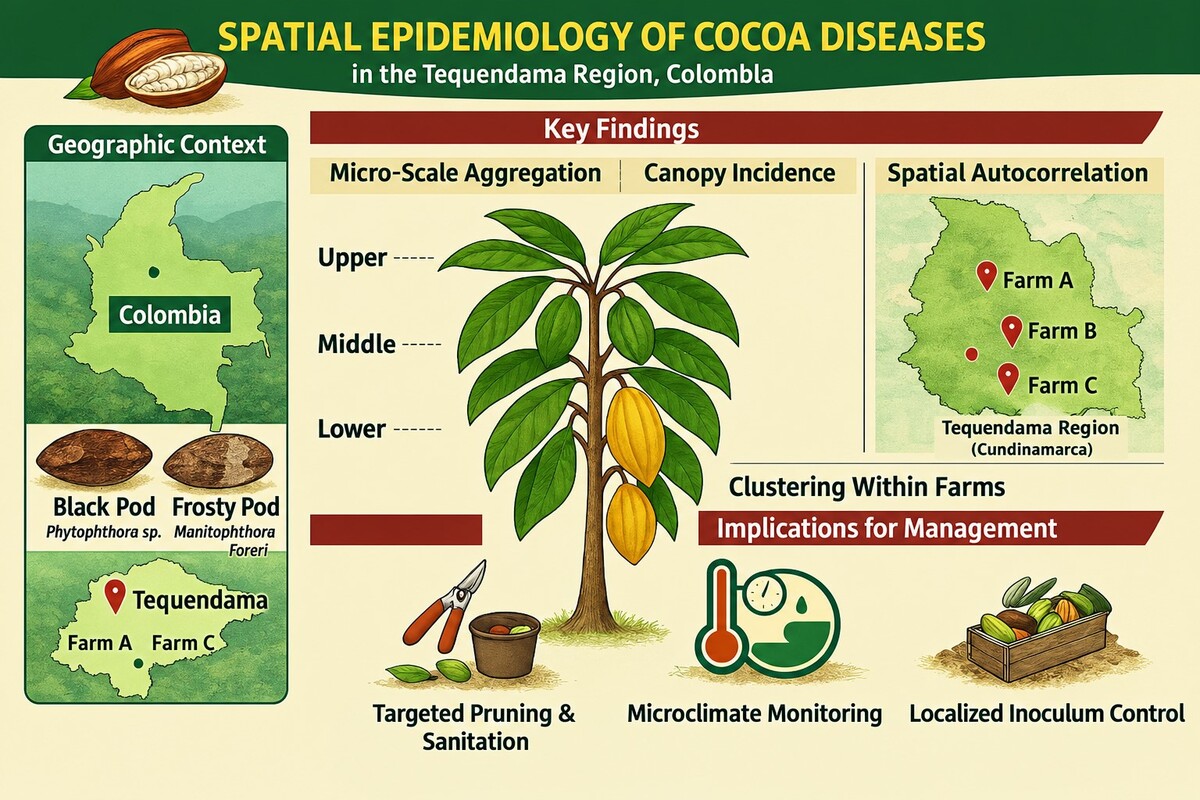
Epidemiological patterns of black pod (Phytophthora spp.) and frosty pod rot (Moniliophthora roreri) in cocoa plantations of Tequendama, Colombia
1
Faculty of Agricultural Sciences, Universidad Nacional de Colombia, Carrera 45 No. 26-85, 111311, Bogotá, Colombia
2
Department of Agricultural Engineering, Faculty of Agricultural Sciences, Universidad de Cundinamarca, Manuel Humberto Cárdenas, 25290, Fusagasuga, Colombia
A - Research concept and design; B - Collection and/or assembly of data; C - Data analysis and interpretation; D - Writing the article; E - Critical revision of the article; F - Final approval of article
Submission date: 2026-03-20
Acceptance date: 2026-10-15
Online pre-proof publication date: 2026-11-02
Corresponding author
Jenny Paola Moreno-López
Faculty of Agricultural Sciences, Universidad Nacional de Colombia, Carrera 45 No. 26-85, 111311, Bogotá, Colombia
Faculty of Agricultural Sciences, Universidad Nacional de Colombia, Carrera 45 No. 26-85, 111311, Bogotá, Colombia
HIGHLIGHTS
- Disease evaluation of cocoa diseases presents an opportunity to optimize production
- Disease evaluation improve the quality and food safety of cocoa farmers
- Epidemiological dynamics in essential for improving disease management strategies
KEYWORDS
TOPICS
ABSTRACT
Cocoa is an important crop in Colombia and a key productive alternative in post-conflict rural areas. Similar to other tropical production systems, yields are constrained by diseases such as black pod disease and frosty pod rot. This study evaluated the temporal and spatial epidemiological patterns of both diseases on three cocoa farms located in the Tequendama region of Colombia through analyses of disease incidence, severity, disease progress, and spatial distribution. Pod assessments were conducted over a six-month period, recording disease incidence, severity, pod developmental stage, and canopy stratum. Temporal analyses evaluated the effects of temperature and relative humidity on disease incidence, whereas spatial analyses examined disease distribution among farms and canopy strata and assessed horizontal spatial autocorrelation using Moran’s I. The results revealed contrasting epidemiological patterns. Black pod incidence was not significantly associated with temperature or relative humidity and remained low throughout the study period. Incidence increased from the lower to the upper canopy layer, and most variability occurred among trees rather than among farms. In contrast, frosty pod rot showed significant negative associations with temperature and relative humidity and consistently there was a higher incidence in the upper canopy layer. Severity and AUDPC values were also greater for frosty pod rot than for black pod disease. Moran’s I analyses did not detect significant spatial autocorrelation at the farm scale. These findings demonstrated that black pod disease and frosty pod rot differed in their temporal dynamics and canopy distribution patterns despite affecting the same host organ. The results highlighted the importance of disease-specific epidemiological approaches and provided information relevant for improving disease monitoring and management in cocoa production systems.
ACKNOWLEDGEMENTS
The authors wish to thank Dr. Adriana González Almario (Faculty of Agricultural Sciences, Universidad Nacional de Colombia – Bogotá Campus) and Professor César Ariza Castillo (Faculty of Agricultural Sciences, Universidad de Cundinamarca) for their contributions to manuscript review and statistical analysis. The authors also want to thank the Bajo Tequendama Cocoa Growers Association (ASCABATE) for allowing field sampling on their cocoa farms and for their contributions to manuscript review and statistical analysis. The authors also thank the Bajo Tequendama Cocoa Growers Association (ASCABATE) for allowing field sampling on their cocoa farms.
FUNDING
This research was funded by the Ministry of Science, Technology and Innovation (MINCIENCIAS), University of Cundinamarca and National University of Colombia (Bogotá) through the call “802-2018 R&D Projects for Biological-Based Technological Development, Department of Cundinamarca”.
RESPONSIBLE EDITOR
Kallol Das
CONFLICT OF INTEREST
The authors have declared that no conflict of interests exist.
Share
RELATED ARTICLE
| eISSN: | 1899-007X |
| ISSN: | 1427-4345 |

We process personal data collected when visiting the website. The function of obtaining information about users and their behavior is carried out by voluntarily entered information in forms and saving cookies in end devices. Data, including cookies, are used to provide services, improve the user experience and to analyze the traffic in accordance with the Privacy policy. Data are also collected and processed by Google Analytics tool (more).
You can change cookies settings in your browser. Restricted use of cookies in the browser configuration may affect some functionalities of the website.
You can change cookies settings in your browser. Restricted use of cookies in the browser configuration may affect some functionalities of the website.