
ORIGINAL ARTICLE
Isolation, molecular identification, and biocontrol efficacy of potential indigenous fungi against the Pentalonia nigronervosa in selected provinces of Eastern Visayas, Philippines
1
Department of Agricultural Sciences, Biliran Province State University, Biliran Province, Philippines
2
Science Education Institute, Department of Science and Technology, Taguig City, Metro Manila, Philippines
3
Department of Pest Management, Visayas State University, Baybay, Philippines
A - Research concept and design; B - Collection and/or assembly of data; C - Data analysis and interpretation; D - Writing the article; E - Critical revision of the article; F - Final approval of article
Submission date: 2026-07-09
Acceptance date: 2026-10-05
Online pre-proof publication date: 2026-10-28
Corresponding author
JOFIL ALAO MATI OM
Department of Agricultural Sciences, Biliran Province State University, Biliran Province, Philippines
Department of Agricultural Sciences, Biliran Province State University, Biliran Province, Philippines
HIGHLIGHTS
- A. nomiae and F. proliferatum showed the highest indigenous efficacy
- Indigenous fungi associated with banana aphids were isolated from Eastern Visayas
- Molecular analyses revealed diverse banana-associated fungal communities
- Laboratory and screenhouse bioassays confirmed pathogenicity against the banana aphid
KEYWORDS
TOPICS
ABSTRACT
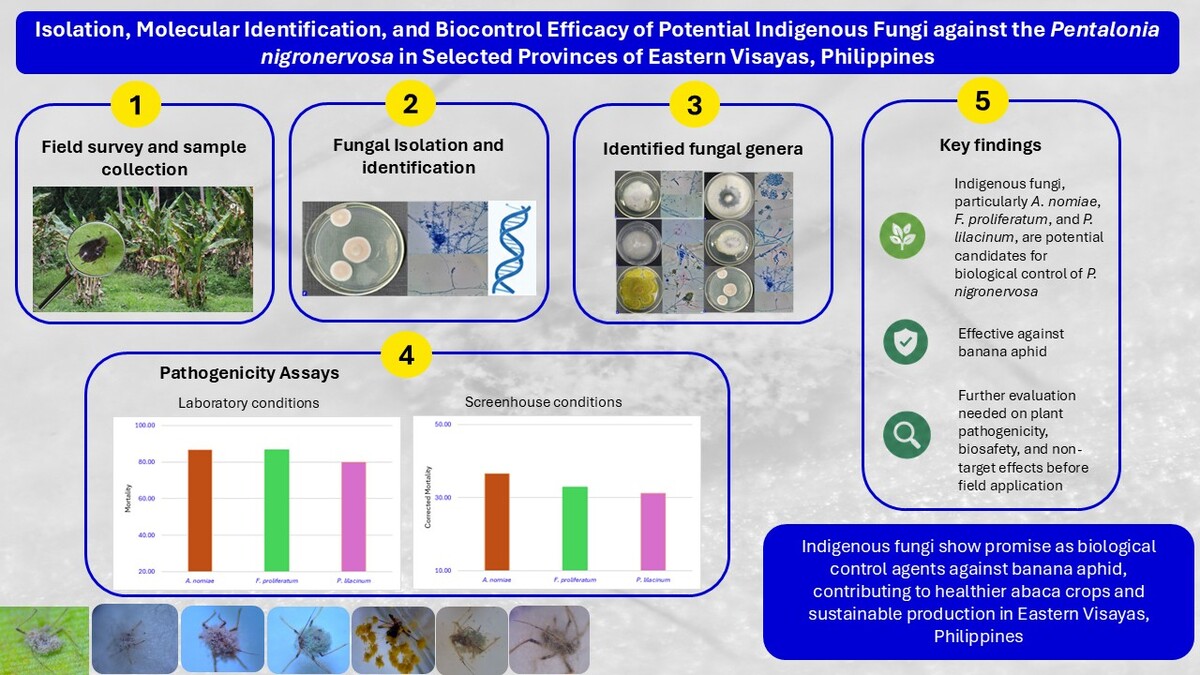
Abaca bunchy top virus (ABTV) is a major constraint to abaca (Musa textilis Nee) production in the Philippines. As the disease is transmitted by the banana aphid, Pentalonia nigronervosa, effective vector management is critical for limiting virus transmission and disease spread. Although chemical insecticides are widely used, their prolonged application may lead to insecticide resistance, environmental contamination, and pest resurgence. This study evaluated indigenous fungi as potential biological control agents against the banana aphid. Field surveys were conducted in selected abaca-growing areas of Biliran, Leyte, and Southern Leyte, Philippines, where aphids were collected from symptomatic plants and examined for natural fungal infection. Fungal isolates recovered from infected aphid cadavers were identified using morphological and cultural characteristics and internal transcribed spacer rDNA sequence analysis. Molecular identification revealed a diverse assemblage of indigenous fungi, with Fusarium spp. being the predominant group recovered from aphid cadavers. Pathogenicity assays conducted under laboratory and screenhouse conditions demonstrated that all tested fungal isolates exhibited pathogenicity against the banana aphid, although their efficacy varied significantly between isolates. Among the indigenous isolates, Aspergillus nomiae and Fusarium proliferatum, showed the highest laboratory pathogenicity, each causing 86.67% mortality at 96 hours after treatment initiation, while Purpureocillium lilacinum caused 80.00% mortality. Under screenhouse conditions, P. lilacinum produced the highest corrected mortality among the indigenous isolates (36.61%) by Day 7, followed by Fusarium sp. (32.86%) and F. proliferatum (31.23%). These findings identified indigenous fungi, particularly A. nomiae, F. proliferatum, and P. lilacinum, as potential candidates for further evaluation as biological control agents against P. nigronervosa in selected provinces of Eastern Visayas, Philippines. However, further assessment of plant pathogenicity, biosafety, and effects on non-target organisms is necessary before these isolates can be considered for field application.
ACKNOWLEDGEMENTS
The authors sincerely thank the abaca farmers in Biliran, Leyte and Southern Leyte for their cooperation and assistance during field sampling and survey activities. The authors also gratefully acknowledge the financial support provided by the Department of Science and Technology – Philippine Council for Agriculture, Aquatic and Natural Resources Research and Development (DOST–PCAARRD), Philippines.
FUNDING
This research was funded by the Department of Science and Technology – Philippine Council for Agriculture, Aquatic and Natural Resources Research and Development (DOST–PCAARRD), Philippines, under the program "Entomopathogenic Fungi as Biocontrol Agent Against the Aphid Vector Pentalonia nigronervosa Coquerel to Manage Abaca Bunchy Top Disease in Eastern Visayas", through the project "Survey and Assessment of Entomopathogens Against the Aphid Vector Pentalonia nigronervosa of Abaca Bunchy Top Virus in Eastern Visayas."
RESPONSIBLE EDITOR
Jalal Shirazi
CONFLICT OF INTEREST
The authors have declared that no conflict of interests exist.
Share
RELATED ARTICLE
| eISSN: | 1899-007X |
| ISSN: | 1427-4345 |

We process personal data collected when visiting the website. The function of obtaining information about users and their behavior is carried out by voluntarily entered information in forms and saving cookies in end devices. Data, including cookies, are used to provide services, improve the user experience and to analyze the traffic in accordance with the Privacy policy. Data are also collected and processed by Google Analytics tool (more).
You can change cookies settings in your browser. Restricted use of cookies in the browser configuration may affect some functionalities of the website.
You can change cookies settings in your browser. Restricted use of cookies in the browser configuration may affect some functionalities of the website.