
ORIGINAL ARTICLE
Susceptibility of the Colorado potato beetle, Leptinotarsa decemlineata (Coleoptera: Chrysomelidae) to microsporidian parasites of the genus Nosema from lepidopteran hosts

1
Laboratory of Insect Pathology and Biotechnology, All-Russian Institute of Plant Protection, Podbelskogo, 3, 196608, St. Petersburg – Pushkin, Russia
2
Laboratory of Agricultural Entomology, All-Russian Institute of Plant Protection, Podbelskogo 3, 196608, St. Petersburg – Pushkin, Russia
3
Laboratory of Antiparasitic Preparations, Institute of Zoology, Academy of Sciences of the Republic of Uzbekistan, Bogishamol 232b, 10053, Tashkent, Uzbekistan
4
Laboratory of Biological Plant Protection, The Scientific Research Institute of Plant Quarantine and Protection, Bobur 4, 100070, Tashkent, Uzbekistan
A - Research concept and design; B - Collection and/or assembly of data; C - Data analysis and interpretation; D - Writing the article; E - Critical revision of the article; F - Final approval of article
Submission date: 2026-04-22
Acceptance date: 2026-09-28
Online pre-proof publication date: 2026-10-27
Corresponding author
Svetlana Malysh
Laboratory of Insect Pathology and Biotechnology, All-Russian Institute of Plant Protection, Podbelskogo, 3, 196608, St. Petersburg – Pushkin, Russia
Laboratory of Insect Pathology and Biotechnology, All-Russian Institute of Plant Protection, Podbelskogo, 3, 196608, St. Petersburg – Pushkin, Russia
HIGHLIGHTS
- Five species of microsporidia were assayed against Leptinotarsa decemlineata
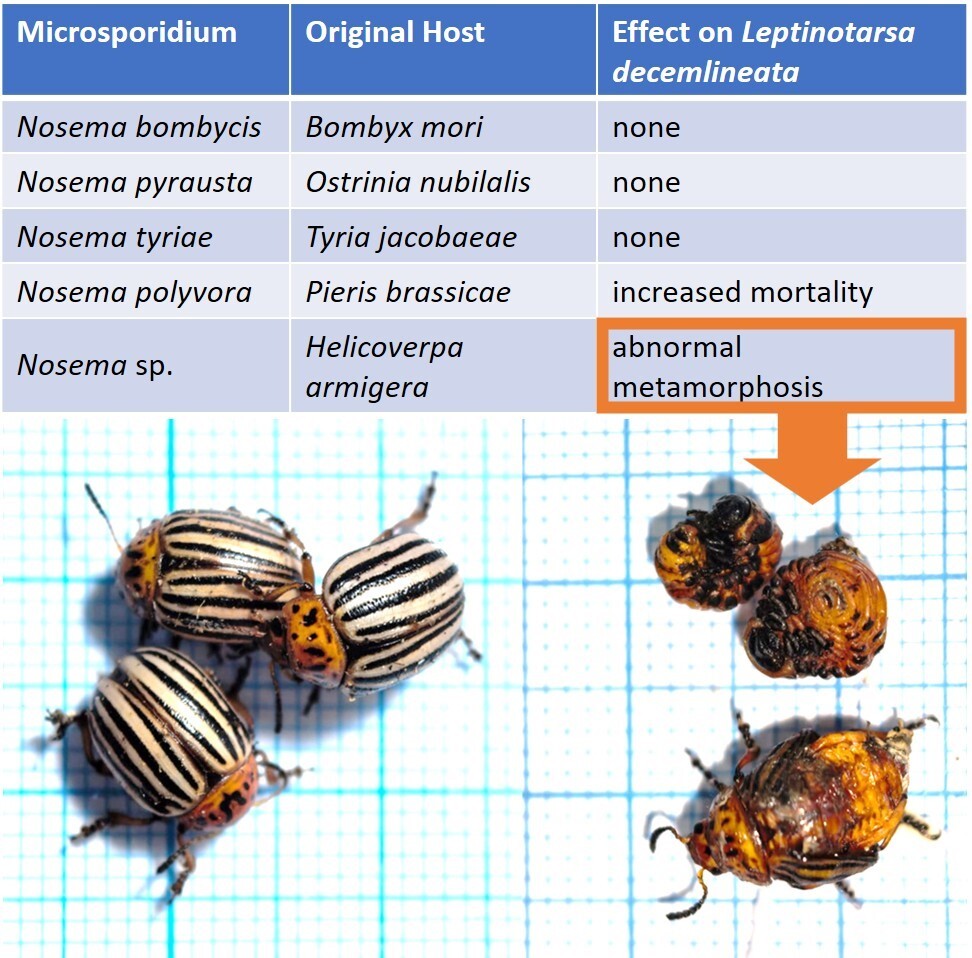
- Nosema sp. from Helicoverpa armigera caused abnormalities of the beetle metamorphosis
- Nosema polyvora caused increased insect mortality
- Two promising pathogens were identified for further testing against L. decemlineata
KEYWORDS
TOPICS
ABSTRACT
Microsporidia are intracellular parasites of animals and some protists. They are promising agents of biological protection of plants against insect pests in which they cause chronic diseases, ultimately leading to death. In this study, five species of microsporidia of the genus Nosema from different Lepidoptera (the silkworm, cotton bollworm, cinnabar moth, beet webworm, and European corn borer) were tested for their ability to infect larvae of the Colorado potato beetle Leptinotarsa decemlineata (Say). Infection was orally induced by feeding fresh potato leaves treated with microsporidian spores. Only the microsporidium Nosema sp. NspHA from the cotton bollworm Helicoverpa armigera (Hübner) had a negative impact on the growth of the Colorado potato beetle, resulting in delayed development and abnormalities during metamorphosis. Insect mortality was also increased after treatment with spores of Nosema polyvora (Blunck) from the cabbage white Pieris brassicae (Linnaeus). Further studies will include testing low doses of these isolates on beetle larvae and assessing their impact on the viability and fertility of the offspring of infected beetles.
FUNDING
The research was supported by the Russian Science Foundation, project # 23-16-00262 (laboratory bioassays) and the State Assignment of the Ministry of Science and Higher Education of the Russian Federation to FSBSI VIZR, state registration # 126012115890-6, theme FGEU-2026-0001 (light microscopy, molecular detection, and statistical analysis).
RESPONSIBLE EDITOR
Paweł Sienkiewicz
CONFLICT OF INTEREST
The authors have declared that no conflict of interests exist.
Share
RELATED ARTICLE
| eISSN: | 1899-007X |
| ISSN: | 1427-4345 |

We process personal data collected when visiting the website. The function of obtaining information about users and their behavior is carried out by voluntarily entered information in forms and saving cookies in end devices. Data, including cookies, are used to provide services, improve the user experience and to analyze the traffic in accordance with the Privacy policy. Data are also collected and processed by Google Analytics tool (more).
You can change cookies settings in your browser. Restricted use of cookies in the browser configuration may affect some functionalities of the website.
You can change cookies settings in your browser. Restricted use of cookies in the browser configuration may affect some functionalities of the website.