
ORIGINAL ARTICLE
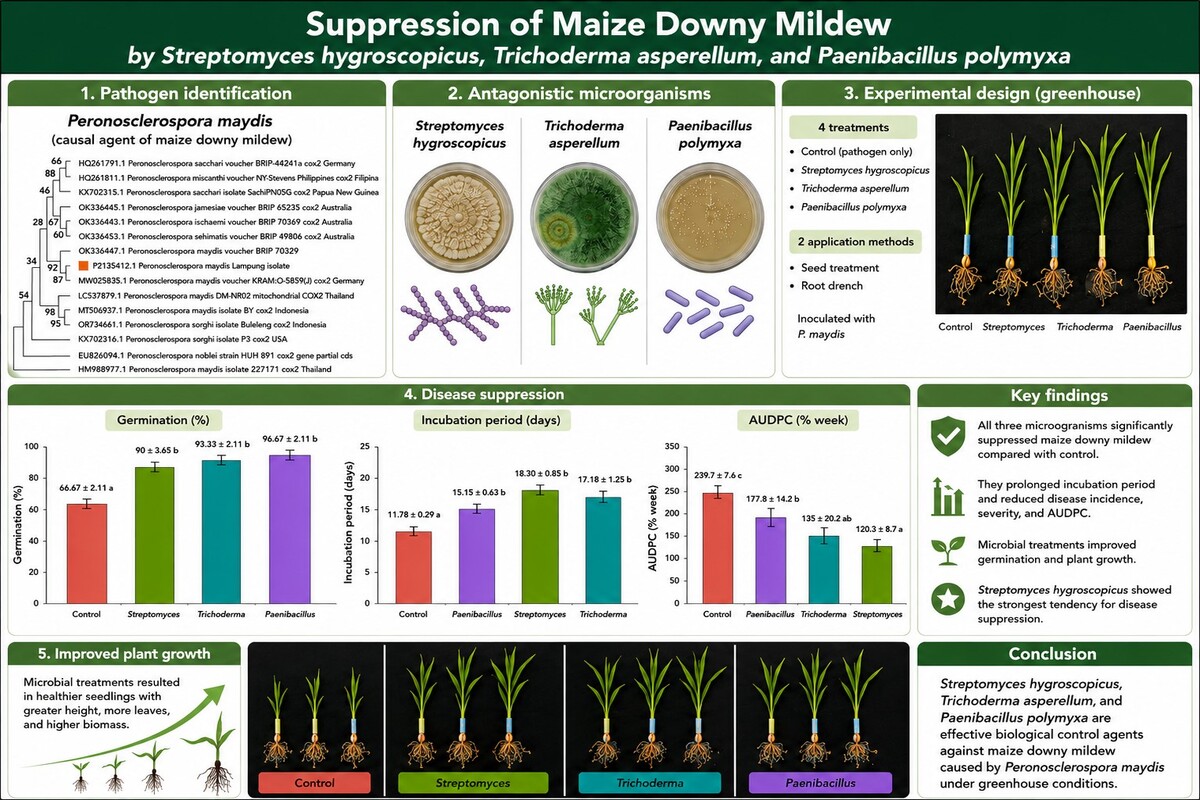
Suppression of maize downy mildew by Streptomyces hygroscopicus, Trichoderma asperellum, and Paenibacillus polymyxa

1
Department of Plant Protection, University of Lampung, Jl. Sumantri Brojonegoro No. 1, Bandar Lampung 35145, Indonesia
2
Department of Agronomy and Horticulture, University of Lampung, Jl. Sumantri Brojonegoro No. 1, Bandar Lampung 35145, Indonesia
A - Research concept and design; B - Collection and/or assembly of data; C - Data analysis and interpretation; D - Writing the article; E - Critical revision of the article; F - Final approval of article
Submission date: 2026-06-25
Acceptance date: 2026-08-31
Online publication date: 2026-10-06
Corresponding author
Titik Nur Aeny
Department of Plant Protection, University of Lampung, Jl. Sumantri Brojonegoro No. 1, Bandar Lampung 35145, Indonesia
Department of Plant Protection, University of Lampung, Jl. Sumantri Brojonegoro No. 1, Bandar Lampung 35145, Indonesia
Journal of Plant Protection Research 2026;66(3):318-324
HIGHLIGHTS
- Cox2 phylogeny confirmed the Lampung isolate as Peronosclerospora maydis
- All three antagonists significantly suppressed maize downy mildew
- Microbial treatments delayed symptom onset and reduced disease progress
- Application method did not affect disease suppression efficacy
- Streptomyces hygroscopicus showed the lowest disease severity and AUDPC
KEYWORDS
TOPICS
ABSTRACT
This study identified the causal agent of maize (Zea mays L.) downy mildew in Lampung and evaluated the suppressive effects of three antagonistic microorganisms. The pathogen was identified as Peronosclerospora maydis (Racib.) C.G. Shaw based on cox2 sequence and phylogenetic analyses. Streptomyces hygroscopicus (Jensen) Waksman & Henrici, Trichoderma asperellum Samuels, Lieckf. & Nirenberg, and Paenibacillus polymyxa (Prazmowski) Ash, Priest & Collins were evaluated via a seed germination assay and a greenhouse experiment with soil-drenching and foliar-spraying applications. Microbial treatments increased germination from 66.67% to 90.00–96.67% and prolonged the incubation period from 11.78 to 15.15–18.30 days. At 5 weeks post-treatment, disease severity decreased from 96.88% to 63.13–81.87%, and AUDPC decreased from 239.69 (control) to 120.31–177.81. Streptomyces hygroscopicus and T. asperellum significantly reduced final disease severity, whereas P. polymyxa showed an intermediate response. The application method had no significant effect, indicating that S. hygroscopicus and T. asperellum are promising biological control agents against maize downy mildew.
ACKNOWLEDGEMENTS
The authors wish to thank the Plant Disease Laboratory, Faculty of Agriculture, University of Lampung, and the Food Crop and Horticulture Protection Laboratory, Gading Rejo, Pringsewu, for providing facilities and technical support. The authors also thank the Institute for Research and Community Service, University of Lampung, for partially supporting this research, as well as the laboratory staff and students who assisted with the experiments.
FUNDING
This research was partially funded by the Institute for Research and Community Service, University of Lampung, through the Professorship Research Grant, Contract No. 469/UN26.21/PN/2024, dated 24 April 2024.
RESPONSIBLE EDITOR
Zuzanna Sawińska
CONFLICT OF INTEREST
The authors have declared that no conflict of interests exist.
REFERENCES (24)
1.
Adhi S.R., Widiantini F., Yulia E. 2024. Early detection of fungicide resistance through sensitivity testing of various fungicide active ingredients and genetic variation of downy mildew-causing Peronosclerospora maydis from maize (corn) production centers in Java, Indonesia. AGRIVITA Journal of Agricultural Science 46 (2): 276–288. DOI: https://doi.org/10.17503/agriv....
2.
Aeny T.N., Prasetyo J., Suharjo R., Dirmawati S.R., Efri, Niswati A. 2018. Short communication: Isolation and identification of actinomycetes potential as the antagonist of Dickeya zeae pineapple soft rot in Lampung, Indonesia. Biodiversitas 19 (6): 2252–2258. DOI: https://doi.org/10.13057/biodi....
3.
Backer R., Rokem J.S., Ilangumaran G., Lamont J., Praslickova D., Ricci E., Subramanian S., Smith D.L. 2018. Plant Growth-Promoting Rhizobacteria: Context, Mechanisms of Action, and Roadmap to Commercialization of Biostimulants for Sustainable Agriculture. Frontiers in Plant Science 9: 1473. DOI: https://doi.org/10.3389/fpls.2....
4.
Bocianowski J., Tratwal A., Nowosad K. 2020. Genotype by environment interaction for area under the disease-progress curve (AUDPC) value in spring barley using additive main effects and multiplicative interaction model. Australasian Plant Pathology 49 (4): 525–529. DOI: https://doi.org/10.1007/s13313....
5.
Dobrzyński J., Naziębło A. 2024. Paenibacillus as a biocontrol agent for fungal phytopathogens: Is P. polymyxa the only one worth attention? Microbial Ecology 87: 134. DOI: https://doi.org/10.1007/s00248....
6.
Guzmán-Guzmán P., Kumar A., de los Santos-Villalobos S., Parra-Cota F.I., Orozco-Mosqueda M.d.C., Fadiji A.E., Hyder S., Babalola O.O., Santoyo G. 2023. Trichoderma Species: Our Best Fungal Allies in the Biocontrol of Plant Diseases—A Review. Plants 12 (3): 432. DOI: https://doi.org/10.3390/plants....
7.
Habibullah M., Joko T., Wibowo A., Widiastuti A. 2025. Maize induced resistance against downy mildew mediated by benzoic acid increased photosynthesis rate and chlorophyll content. Journal of Tropical Plant Pests and Diseases 25 (2): 255–261. DOI: https://doi.org/10.23960/jhptt....
8.
Hanafiah D.S., Syamsafitri, Mariati, Hanum C., Muhdi, Rakasiwi G., Abdurrahman M.H., Nur M.A., Sahtika D. 2025. Identification and characterization of corn plants for downy mildew resistance in North Sumatra, Indonesia. Biodiversitas 26 (5): 2130–2138. DOI: https://doi.org/10.13057/biodi....
9.
Hudspeth D.S.S., Nadler S.A., Hudspeth M.E.S. 2000. A cox2 molecular phylogeny of the Peronosporomycetes. Mycologia 92 (4): 674–684. DOI: https://doi.org/10.1080/002755....
10.
Khan M.S., Gao J., Chen X., Zhang M., Yang F., Du Y., Moe T.S., Munir I., Xue J., Zhang X. 2020. Isolation and characterization of plant growth-promoting endophytic bacteria Paenibacillus polymyxa SK1 from Lilium lancifolium. BioMed Research International 2020: 8650957. DOI: https://doi.org/10.1155/2020/8....
11.
Kumar S., Stecher G., Suleski M., Sanderford M., Sharma S., Tamura K. 2024. MEGA12: molecular evolutionary genetics analysis version 12 for adaptive and green computing. Molecular Biology and Evolution 41 (11): msae263. DOI: https://doi.org/10.1093/molbev....
12.
Montesdeoca-Flores D.T., Hernández-Bolaños E., León-Barrios M., Hernández-Amador E., Díaz-González S., Abreu-Acosta N., Luis-Jorge, J.C. 2023. Antifungal Activity of Streptomyces spp. Extracts In Vitro and on Post-Harvest Tomato Fruits against Plant Pathogenic Fungi. Horticulturae 9 (12): 1319. DOI: https://doi.org/10.3390/hortic....
13.
Mugiastuti E., Manan A., Soesanto L. 2023. Biological control of maize downy mildew with the antagonistic bacterial consortium. Biodiversitas 24 (9): 4644–4650. DOI: https://doi.org/10.13057/biodi....
14.
Pakki S., Djaenuddin N. 2019. The effectiveness combination of resistant varieties and metalaxyl fungicide in controlling downy mildew disease (Peronosclerospora maydis) in maize plant. Journal of Tropical Plant Pests and Diseases 19 (1): 42–51. DOI: https://doi.org/10.23960/j.hpt....
15.
Précigout P.A., Claessen D., Makowski D., Robert C. 2020. Does the latent period of leaf fungal pathogens reflect their trophic type? A meta-analysis of biotrophs, hemibiotrophs, and necrotrophs. Phytopathology 110 (2): 345–361. DOI: https://doi.org/10.1094/PHYTO-....
16.
R Core Team. 2024. R: a language and environment for statistical computing. R Foundation for Statistical Computing, Vienna, Austria. Available from: https://www.R-project.org/.
17.
Sinclair J.B., Dhingra O.D. 2017. Basic Plant Pathology Methods. 2nd ed. CRC Press, Boca Raton, FL, USA, 434 pp. DOI: https://doi.org/10.1201/978131....
18.
Suharjo R., Swibawa G., Prasetyo J., Fitriana Y., Danaatmadja Y., Budiawan A., Roberts S., Noorhajati N., Amad M., Thines M. 2020. Peronosclerospora australiensis is a synonym of P. maydis. Mycological Progress 19 (12): 1309–1315. DOI: https://doi.org/10.1007/s11557....
19.
Townsend G.R., Heuberger J.W. 1943. Methods for estimating losses caused by diseases in fungicide experiments. Plant Disease Reporter 27: 340–343.
20.
Velásquez A.C., Castroverde C.D.M., He S.Y. 2018. Plant-pathogen warfare under changing climate conditions. Current Biology 28 (10): R619–R634. DOI: https://doi.org/10.1016/j.cub.....
21.
Viaene T., Langendries S., Beirinckx S., Maes M., Goormachtig S. 2016. Streptomyces as a plant’s best friend? FEMS Microbiology Ecology 92 (2): fiw119. DOI: https://doi.org/10.1093/femsec....
22.
Vitale A. 2023. Epidemiology and Control of Plant Diseases. Plants 12 (4): 793. DOI: https://doi.org/10.3390/plants....
23.
Yuan P., Zhu L., Song Z., Wang Y., Chen X. 2025a. From biocontrol to synthesis: innovative progress of Paenibacillus in mechanism analysis, gene editing and platform construction. International Journal of Molecular Sciences 26 (22): 10886. DOI: https://doi.org/10.3390/ijms26....
24.
Yuan P., Song Z., Zhang L., Pan Z., Chen X. 2025b. Exploring the multifunctional role of Paenibacillus metabolites in various fields. International Journal of Molecular Sciences 26 (24): 12089. DOI: https://doi.org/10.3390/ijms26....
Share
RELATED ARTICLE
| eISSN: | 1899-007X |
| ISSN: | 1427-4345 |

We process personal data collected when visiting the website. The function of obtaining information about users and their behavior is carried out by voluntarily entered information in forms and saving cookies in end devices. Data, including cookies, are used to provide services, improve the user experience and to analyze the traffic in accordance with the Privacy policy. Data are also collected and processed by Google Analytics tool (more).
You can change cookies settings in your browser. Restricted use of cookies in the browser configuration may affect some functionalities of the website.
You can change cookies settings in your browser. Restricted use of cookies in the browser configuration may affect some functionalities of the website.