
ORIGINAL ARTICLE
Preliminary studies on the efficacy of Blattisocius mali (Acari: Blattisociidae) against Tyrophagus putrescentiae (Acari: Acaridae) on cucumber plants

1
Department of Plant Protection, Warsaw University of Life Sciences, Warsaw, Poland
2
Department of Biometry, Warsaw University of Life Sciences, Warsaw, Poland
A - Research concept and design; B - Collection and/or assembly of data; C - Data analysis and interpretation; D - Writing the article; E - Critical revision of the article; F - Final approval of article
Submission date: 2026-05-29
Acceptance date: 2026-08-10
Online pre-proof publication date: 2026-08-18
Corresponding author
Katarzyna Michalska
Department of Plant Protection, Warsaw University of Life Sciences, Warsaw, Poland
Department of Plant Protection, Warsaw University of Life Sciences, Warsaw, Poland
HIGHLIGHTS
- 1. B. mali is highly efficient against T. putrescentiae on young cucumber plants
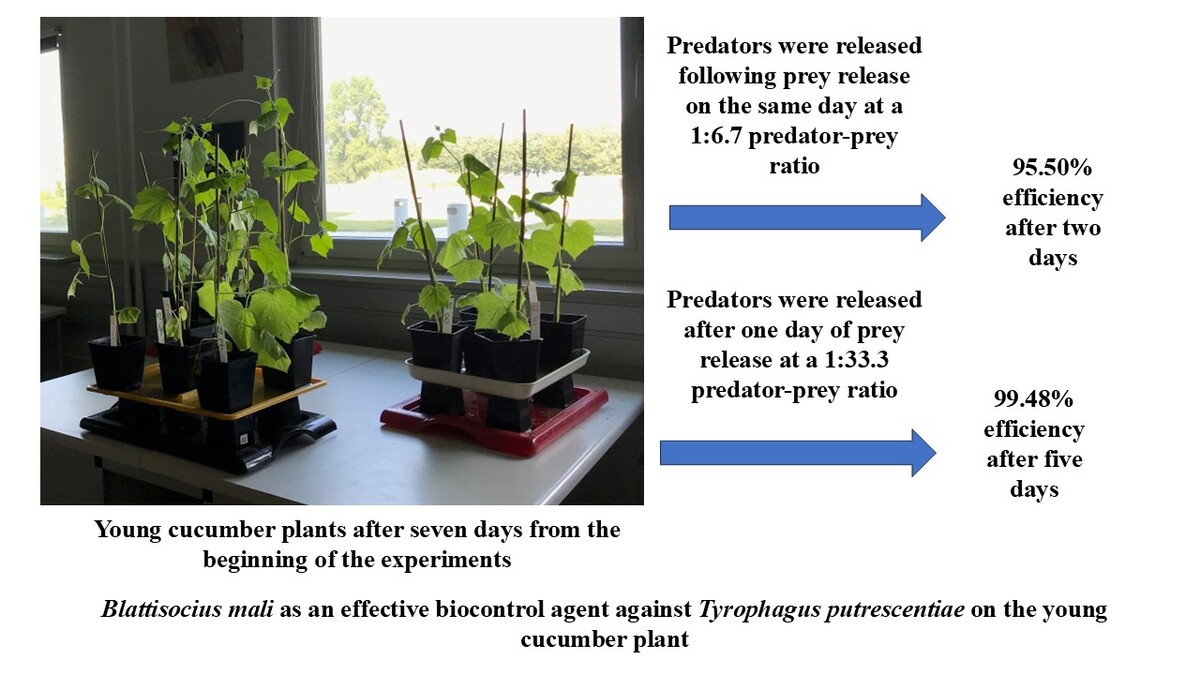
- 2. B. mali was 95.50% efficient when predators and prey were released on the same day
- 3. B. mali was 99.48% efficient when predators and prey were released on diverse days
- 4. B. mali can manage acarid-mite pests infesting cucumber seedlings
KEYWORDS
TOPICS
ABSTRACT
The predatory soil mite Blattisocius mali (Oudemans) is highly efficient in controlling arthropod pests infesting stored flower bulbs and tubers. Still, its ability to control pests of crop plants has not been tested to date. This study aimed to assess whether B. mali could control Tyrophagus putrescentiae (Schrank) infesting young cucumber plants using two different methods of predator-prey release at two predator-prey ratios and varying observation frequencies. In one test, predators were released on plants on the same day as prey infestation at a 1:6.7 predator-prey ratio, while in the other test, predators were released after one day of prey infestation at a 1:33.3 ratio. The experiments were conducted under semi-natural conditions at 21-23 °C, 16L/8D photoperiod, and 80 ± 10% RH. Each treatment was replicated eight times. When predators were released simultaneously with prey infestation at a 1:6.7 ratio, a 95.50% efficiency was observed after just two days. Conversely, releasing predators one day after the initial infestation at a 1:33.3 ratio achieved 99.48% efficiency after five days. This study indicated that B. mali was highly effective at reducing T. putrescentiae populations on young cucumber plants in both tests and may be used as a practical alternative for managing acarid-mite pests infesting young cucumber plants. Further tests at a larger spatial scale under greenhouse and field conditions are necessary to confirm this.
RESPONSIBLE EDITOR
Jacek Twardowski
CONFLICT OF INTEREST
The authors have declared that no conflict of interests exist.
REFERENCES (43)
1.
Abbas A.A., Yassin E.M.A., El-Bahrawy A.F., El-Sharabasy H.M., Kamel M.S. 2020. Biology of Blattisocius mali (Oudemans) (Acari: Gamasida: Ascidae) feeding on different diets under laboratory conditions. Egyptian Veterinary Medical Society of Parasitology Journal 16: 92-101. DOI: https://doi.org/10.21608/evmsp....
2.
Asgari F., Safavi S.A., Sarraf-Moayeri H. 2023. An investigation on demographic parameters of the predatory mite Blattisocius mali (Blattisociidae) fed on eggs of the fungus gnat Lycoriella auripila (Sciaridae). Plant Pest Research 13(1): 1-14. DOI: https://doi.org/10.22124/iprj.....
3.
Beretta G.M., Deere J.A., Messelink G.J., Muñoz-Cárdenas K., Janssen A. 2022. Review: Predatory soil mites as biocontrol agents of above- and below-ground plant pests. Experimental and Applied Acarology 87: 143-162. DOI: https://doi.org/10.1007/s10493....
4.
Buitenhuis R., Shipp L., Scott-Dupree C. 2010. Dispersal of Amblyseius swirskii Athias-Henriot (Acari: Phytoseiidae) on potted greenhouse chrysanthemum. Biological Control 52: 110–111. DOI: https://doi.org/10.1016/j.bioc....
5.
Cabello T., Gallego J.R., Fernandez F.J., Gamez M., Vila E., Pino M., Hernandez-Suarez E. 2012. Biological control strategies for the South American tomato moth Tuta absoluta (Lep.: Gelechiidae) on greenhouse tomatoes. Journal of Economic Entomology 105: 2085-2096. DOI: https://doi.org/10.1603/EC1222....
6.
Czajkowska B. 2006. Ocena stopnia zagrożenia kultur in vitro przez rozkruszkę drobnego [Tyrophagus putrescentiae Schrank] w zależności od modyfikacji podstawowej pożywki [MS] stosowanej do mikrorozmnażania cebul lilii. Progress in Plant Protection 46 (2): 424-428.
7.
de Moraes G.J., Venancio R., dos Santos V.L.V., Paschoal A.D. 2015. Potential of Ascidae, Blattisociidae and Melicharidae (Acari: Mesostigmata) as Biological Control Agents of Pest Organisms. In: Carrillo D., de Moraes G., Peña J. (eds), Prospects for Biological Control of Plant Feeding Mites and Other Harmful Organisms. Springer International Publishing: Cham, Switzerland, pp. 33-75. DOI: https://doi.org/10.1007/978-3-....
8.
Esteca F.D.C.N., Pérez-Madruga Y., Britto E.P.J., de Moraes G.J. 2014. Does the ability of Blattisocius species to prey on mites and insects vary according to the relative length of the cheliceral digits? Acarologia 54 (3): 359-365. DOI: https://doi.org/10.1051/acarol....
9.
Gallego J.R., Gamez M., Cabello T. 2020. Potential of the Blattisocius mali mite (Acari: Blattisociidae) as a biological control agent of potato tuber moth (Lep.: Gelechiidae) in stored potatoes. Potato Research 63: 241-251. DOI: https://doi.org/10.1007/s11540....
10.
Gavara J., Piedra-Buena A., Hernandez-Suarez E., Gamez M., Cabello T., Gallego J.R. 2021. Potential for the Postharvest Biological Control of Phthorimaea operculella (Lep.: Gelechiidae) by Blattisocius tarsalis (Mesostigmata, Blattisociidae). Agronomy 11: 288. DOI: https://doi.org/10.3390/agrono....
11.
Hnilička F., Koudela M., Martinková J., Svozilová L. 2012. Effects of deficit irrigation and straw mulching on gas exchange of cucumber plants (Cucumis sativus L.). Acta Universitatis Agriculturae et Silviculturae Mendelianae Brunensis 28-60: 43-50.
12.
Hoy M.A. 1985. Almonds (California). In: Helle W., Sabelis M.W. (Eds.), Spider Mites: Their Biology, Natural Enemies and Control, Elsevier: Amsterdam, The Netherlands 1: 299-310.
13.
Jena M.K., Michalska K., Studnicki M. 2025. Functional response of different life stages of predatory mite Blattisocius mali preying on acarid mite Tyrophagus putrescentiae. Systematic and Applied Acarology 30 (1): 181-195. DOI: https://doi.org/10.11158/saa.3....
14.
Jena M.K., Michalska K., Studnicki M. 2024. The impact of humidity on the functional response of Blattisocius mali (Acari: Blattisociidae) preying on the acarid mite Tyrophagus putrescentiae. Scientific Reports 14: 28051. DOI: https://doi.org/10.1038/s41598....
15.
Jena M.K., Studnicki M., Sochacki D., Michalska K. 2026. Evaluation of the predatory soil mite Blattisocius mali (Acari: Blattisociidae) as a biocontrol agent of the acarid mite Tyrophagus putrescentiae (Acari: Acaridae) infesting bulbs. BioControl 71: 559-571. DOI: https://doi.org/10.1007/s10526....
16.
Kassem E.M.K. 2019. Predation by Blattisocius tarsalis (Acari: Ascidae) on two stored product pest mites. International Journal of Entomological Research 4 (4): 74-76.
17.
Kersten A.K., Büttner C., Lentzsch P. 2022. Determination of spider mite abundance in soil of field-grown cucumbers and in plants under predatory mite pressure in invasive infestations using HRM real-time PCR assay. PLoS One 17 (7): e0270068. DOI: https://doi.org/10.1371/journa....
18.
Kuwahara Y. 2004. Chemical ecology of astigmatid mites. In Ring T. Cardé, Jocelyn G. Millar (Eds.) Advances in insect chemical ecology, Cambridge University Press, pp.76-109.
19.
Łabanowski G. 2013. Rozkruszki-szkodniki bulw i cebul. Hasło Ogrodnicze 5: 22-23.
20.
Lopez L. 2023. Meet Amblyseius swirskii (Acari: Phytoseiidae): a commonly used predatory mite in vegetable crops. Journal of Integrated Pest Management 14 (1): 20. DOI: https://doi.org/10.1093/jipm/p....
21.
Mayland H., Margolies D.C., Charlton R.E. 2000. Local and distant prey-related cues influence when an acarine predator leaves a prey patch. Entomologia Experimentalis et Applicata 96: 245-252. DOI: https://doi.org/10.1046/j.1570....
22.
Michalska K., Jena M.K., Mrowińska A., Nowakowski P., Maciejewska D., Ziółkowska K., Wit M. 2023. Preliminary studies on the predation of the mite Blattisocius mali (Acari: Blattisociidae) on various life stages of spider mite, thrips and fruit fly. Insects 14: 747. DOI: https://doi.org/10.3390/insect....
23.
Michalska K., Jena M.K., Studnicki M. 2025. Effect of temperature on functional response of Blattisocius mali (Acari: Blattisociidae) preying on the acarid mite Tyrophagus putrescentiae. Scientific Reports 15 (1): 15457. DOI: https://doi.org/10.1038/s41598....
24.
Michalska K., Ziółkowska K., Radziejewska A., Studnicki M., Ibrahim M.A. 2024. Distribution and survival of the predatory mite Blattisocius mali on cucumber leaves with the addition of bran, yeast and pollen. Journal of Plant Protection Research 2024: 178-88. DOI: https://doi.org/10.24425/jppr.....
25.
Mukhametov A., Benin D., Mutalibova G., Snegirev D., Pshidatok S. 2023. The impact of entomophages on the population dynamics of major greenhouse cucumber pests. Crop, Forage and Turfgrass Management 9 (1): e20196. DOI: https://doi.org/10.1002/cft2.2....
26.
Murillo P., Arias J., Aguilari H. 2021. First record and verification of Tyrophagus putrescentiae (Acari: Acaridae) causing direct damage on anthurium seedlings cultivated in vitro. Systematic and Applied Acarology 26 (11): 2048-2058. DOI: https://doi.org/10.11158/saa.2....
27.
Nakao H. 1991. Studies on Acarid Mites (Acari: Astigmata) Damaging Vegetable Seedlings. Japanese Journal of Applied Entomology and Zoology 35(4): 303-309. DOI: https://doi.org/10.1303/jjaez.....
28.
Oliveira C.M., Navia D., Frizzas M.R. 2007. First record of Tyrophagus putrescentiae (Schrank) (Acari: Acaridae) in soybean seedlings under no tillage in Minas Gerais, Brazil. Ciência Rural, Santa Maria 37: 876-877. DOI: https://doi.org/10.1590/S0103-....
29.
Oudemans A.C. 1931. Acarologische Aanteekeningen. Canadian Entomologist 8: 30-31.
30.
Parolin P., Bresch C., Poncet C., Desneux N. 2014. Introducing the term “Biocontrol Plants” for integrated pest management. Scientia Agricola 71: 77–80. DOI: https://doi.org/10.1590/S0103-....
31.
Pels B., Sabelis M.W. 1999. Local dynamics, overexploitation and predator dispersal in an acarine predator-prey system. Oikos 86: 573-583. DOI: https://doi.org/10.2307/354666....
32.
Petrova V., Salmane I., Çudare Z. 2004. The predatory mite (Acari, Parasitiformes: Mesostigmata (Gamasina); Acariformes: Prostigmata) community in strawberry agrocenosis. Acta Universitatis Latviensis 676: 87-95.
33.
Piepho H.P., Malik W.A., Bischoff R., El-Hasan A., Scheer C., Sedlmeier J.E., Gerhards R., Petschenka G., Voegele R.T. 2024. Efficacy assessment in crop protection: a tutorial on the use of Abbott’s formula. Journal of Plant Disease and Protection 131 ( 6): 2139-2160. DOI: https://doi.org/10.1007/s41348....
34.
Pirayeshfar F., Safavi S.A., Moayeri H.R.S., Messelink G.J. 2021. Provision of astigmatid mites as supplementary food increases the density of the predatory mite Amblyseius swirskii in greenhouse crops, but does not support the omnivorous pest, western flower thrips. BioControl 66: 511–522. DOI: https://doi.org/10.1007/s10526....
35.
R Core Team. 2026. R: A Language and Environment for Statistical Computing. R Foundation for Statistical Computing, Vienna, Austria. https://www.r- project. org/.
36.
Riudavets J., Maya M., Monserrat M. 2002. Predation by Blattisocius tarsalis (Acari: Ascidae) on stored product pests. IOBC WPRS Bulletin 25 (3): 121-126.
37.
Rivard I. 1962. Influence of humidity on the predaceous mite Melichares dentriticus (Berlese) (Acarina: Aceosejidae). Canadian Journal of Zoology 40 (5): 761-766. DOI: https://doi.org/10.1139/z62-07....
38.
Ruppel R.F. 1983. Cumulative insect-days as an index of crop protection. Journal of Economic Entomology 76: 375-377. DOI: https://doi.org/10.1093/jee/76....
39.
Sanchez J.A., Lacasa A. 2008. Impact of the zoophytophagous plant bug Nesidiocoris tenuis (Het.: Miridae) on tomato yield. Journal of Economic Entomology 101: 1864-1870. DOI: https://doi.org/10.1603/0022-0....
40.
Skirvin D., Fenlon J. 2003. Of mites and movement: the effects of plant connectedness and temperature on movement of Phytoseiulus persimilis. Biological Control 27: 242–250. DOI: https://doi.org/10.1016/S1049-....
41.
Solano-Rojas Y., Gallego J.R., Gamez M., Garay J., Hernandez J., Cabello T. 2022. Evaluation of Trichogramma cacaeciae (Hymenoptera: Trichogrammatidae) and Blattisocius mali (Mesostigmata: Blattisociidae) in the post-harvest biological control of the potato tuber moth (Lepidoptera: Gelechiidae): Use of sigmoid functions. Agriculture 12 (4): 519. DOI: https://doi.org/10.3390/agricu....
42.
Tiftikçi P., Kök Ş., Kasap İ. 2022. The effect of host plant on the biological control efficacy of the predatory mite, Phytoseiulus persimilis Athias-Henriot against two-spotted spider mites, Tetranychus urticae Koch on field-grown vegetables. Crop Protection 158: 106012. DOI: https://doi.org/10.1016/j.crop....
43.
Zhang Z.Q. 2003. Acarid mites. In: Zhang ZQ (Ed.), Mites of greenhouses: identification, biology and control. Wallingford, UK, CABI Publishing, pp. 141-162.
Share
RELATED ARTICLE
| eISSN: | 1899-007X |
| ISSN: | 1427-4345 |

We process personal data collected when visiting the website. The function of obtaining information about users and their behavior is carried out by voluntarily entered information in forms and saving cookies in end devices. Data, including cookies, are used to provide services, improve the user experience and to analyze the traffic in accordance with the Privacy policy. Data are also collected and processed by Google Analytics tool (more).
You can change cookies settings in your browser. Restricted use of cookies in the browser configuration may affect some functionalities of the website.
You can change cookies settings in your browser. Restricted use of cookies in the browser configuration may affect some functionalities of the website.