
ORIGINAL ARTICLE
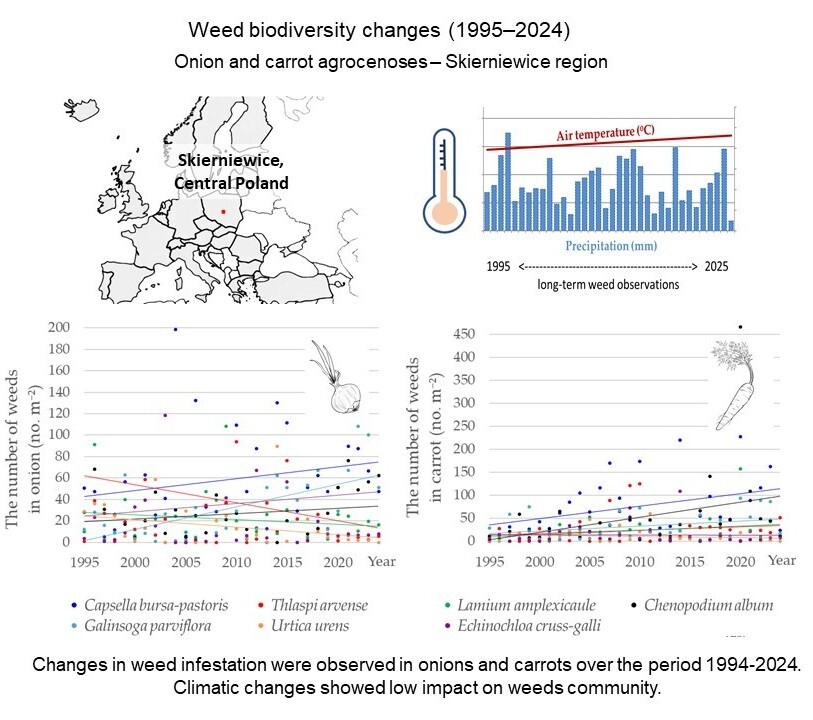
Changes in weed biodiversity in onion and carrot agrocenoses in the Skierniewice region from 1995 to 2024.
1
Weed Science Laboratory, The National Institute of Horticultural Research, Konstytucji 3 Maja 1/3, 96-100, Skierniewice, Poland
2
The Weed Science Laboratory, The National Institute of Horticultural Research, Konstytucji 3 Maja 1/3, 96-100, Skierniewice, Poland
3
Professor emeritus, The National Institute of Horticultural Research, Konstytucji 3 Maja 1/3, 96-100, Skierniewice, Poland
A - Research concept and design; B - Collection and/or assembly of data; C - Data analysis and interpretation; D - Writing the article; E - Critical revision of the article; F - Final approval of article
Submission date: 2026-03-20
Acceptance date: 2026-07-24
Online pre-proof publication date: 2026-08-12
Online publication date: 2026-08-11
Corresponding author
Joanna Golian
Weed Science Laboratory, The National Institute of Horticultural Research, Konstytucji 3 Maja 1/3, 96-100, Skierniewice, Poland
Weed Science Laboratory, The National Institute of Horticultural Research, Konstytucji 3 Maja 1/3, 96-100, Skierniewice, Poland
HIGHLIGHTS
- Long-term (1995–2024) weed monitoring in onion and carrot in central Poland
- Climatic variables explained only a small part of weed community variability
- Weed infestation in onion and carrot changed over the past 30 years
- Dominant weed species: C. bursa-pastoris, T. arvense, C. album, G. parviflora
KEYWORDS
TOPICS
ABSTRACT
Observations of weed infestation were carried out in onion and carrot crops from 1995 to 2024 in the Skierniewice region. Weed infestation was assessed on unsprayed fields based on weed numbers determined between 29 and 78 days after sowing.. Based on species composition and weed abundance, the weed community structure was determined using the Shannon-Wiener species diversity index (H) Simpson's dominance index (SI), Pearson correlation coefficients (r) and Multiple regression. Weed populations in onion and carrot exhibited substantial year-to-year variability and no long-term trends. The most abundant species in onion and carrot were Capsella bursa-pastoris, Thlaspi arvense, Chenopodium album, and Galinsoga parviflora. In onion, an increasing tendency in the number of Galinsoga parviflora Capsella bursa-pastoris, Thlaspi arvense, and Echinochloa crus-galli was observed, while the number of Chenopodium album plants showed a tendency to decrease. In carrot, an upward trend in the population of Capsella bursa-pastoris and Chenopodium album was observed, although annual fluctuations remained substantial. The climatic effects on weed communities were weak and inconsistent across crops, explaining only a small weed variation and indicating that long-term weed dynamics are shaped primarily by non-climatic factors.
CONFLICT OF INTEREST
The authors have declared that no conflict of interests exist.
Share
RELATED ARTICLE
| eISSN: | 1899-007X |
| ISSN: | 1427-4345 |

We process personal data collected when visiting the website. The function of obtaining information about users and their behavior is carried out by voluntarily entered information in forms and saving cookies in end devices. Data, including cookies, are used to provide services, improve the user experience and to analyze the traffic in accordance with the Privacy policy. Data are also collected and processed by Google Analytics tool (more).
You can change cookies settings in your browser. Restricted use of cookies in the browser configuration may affect some functionalities of the website.
You can change cookies settings in your browser. Restricted use of cookies in the browser configuration may affect some functionalities of the website.