
RAPID COMMUNICATION
A preliminary study of genetic landscape of grapevine viruses isolated from a
western Georgian vineyard: insights from initial sequencing analysis
1
School of Science and Technology, University of Georgia, Tbilisi, Georgia
2
Integrated Plant Protection Research, LEPL Scientific Research Center of Agriculture, Tbilisi, Georgia
A - Research concept and design; B - Collection and/or assembly of data; C - Data analysis and interpretation; D - Writing the article; E - Critical revision of the article; F - Final approval of article
Submission date: 2026-02-01
Acceptance date: 2026-08-11
Online pre-proof publication date: 2026-08-18
Corresponding author
HIGHLIGHTS
- Grapevine viruses being confirmed by sequencing for the first time in Georgia
- Grapevine viruses indicating limited genetic divergence
- Identified viruses are genetically related to globally distributed virus populations
KEYWORDS
TOPICS
ABSTRACT
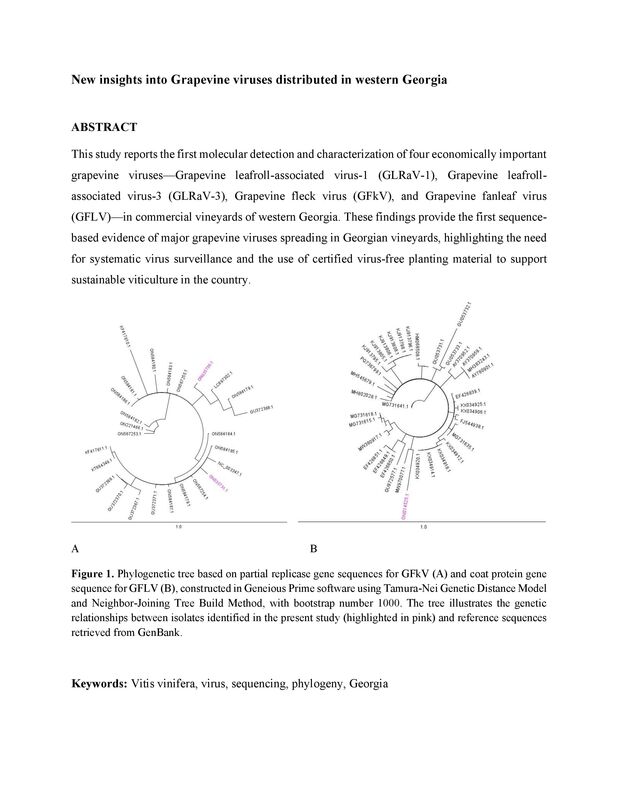
This study reports the first molecular detection and characterization of four economically important grapevine viruses—Grapevine leafroll-associated virus-1 (GLRaV-1), Grapevine leafroll-associated virus-3 (GLRaV-3), Grapevine fleck virus (GFkV), and Grapevine fanleaf virus (GFLV)—in commercial vineyards of western Georgia. Thirty grapevine samples of the widely cultivated Vitis vinifera cv. Saperavi were collected from a self-rooted vineyard in the Adjara region and analyzed using double antibody sandwich enzyme-linked immunosorbent assay (DAS-ELISA) and one-step RT-PCR. Single and mixed virus infections were detected. Viral presence was further confirmed by Sanger sequencing of partial genomic regions. Sequence analysis revealed high nucleotide identity (88–100%) with grapevine virus isolates previously reported from Europe, North America, and Asia. Phylogenetic analyses conducted in Geneious Prime software revealed that the Georgian isolates clustered among globally distributed reference strains, without forming distinct regional lineages, indicating limited genetic divergence and a conserved population structure. Typical leafroll symptoms were observed only in GLRaV-1- and GLRaV-3-infected vines, whereas GFkV- and GFLV-infected plants remained asymptomatic. These findings provide the first sequence-based evidence of major grapevine viruses spreading in Georgian vineyards, highlighting the need for systematic virus surveillance and the use of certified virus-free planting material to support sustainable viticulture in the country.
RESPONSIBLE EDITOR
Joanna Puławska
CONFLICT OF INTEREST
The authors have declared that no conflict of interests exist.
Share
RELATED ARTICLE
| eISSN: | 1899-007X |
| ISSN: | 1427-4345 |

We process personal data collected when visiting the website. The function of obtaining information about users and their behavior is carried out by voluntarily entered information in forms and saving cookies in end devices. Data, including cookies, are used to provide services, improve the user experience and to analyze the traffic in accordance with the Privacy policy. Data are also collected and processed by Google Analytics tool (more).
You can change cookies settings in your browser. Restricted use of cookies in the browser configuration may affect some functionalities of the website.
You can change cookies settings in your browser. Restricted use of cookies in the browser configuration may affect some functionalities of the website.