
ORIGINAL ARTICLE
Rhizome diameter as a driver of sprout vigor in Japanese knotweed (Reynoutria japonica Houtt.): implications for management
1
Department of Forest Utilization and Forest Techniques, Faculty of Forestry, University of Agriculture in Kraków, 29 Listopada 46, 31-425, Kraków, Poland
2
Department of Agroecology and Crop Production, Faculty of Agriculture and Economics, University of Agriculture in Krakow, Mickiewicza 21, 31-120, Kraków, Poland
3
Department of Phytomedicine, Faculty of Agrobiotechnical Sciences Osijek, Josip Juraj Strossmayer University of Osijek, Vladimira Preloga 1, 31000, Osijek, Croatia
4
Department of Production Engineering, Logistics and Applied Computer Science, Faculty of Production and Power Engineering, University of Agriculture in Krakow, Balicka 116 B, 30-149, Kraków, Poland
A - Research concept and design; B - Collection and/or assembly of data; C - Data analysis and interpretation; D - Writing the article; E - Critical revision of the article; F - Final approval of article
Submission date: 2026-06-20
Acceptance date: 2026-07-29
Online pre-proof publication date: 2026-10-23
Corresponding author
Marin Lukačević
Department of Forest Utilization and Forest Techniques, Faculty of Forestry, University of Agriculture in Kraków, 29 Listopada 46, 31-425, Kraków, Poland
Department of Forest Utilization and Forest Techniques, Faculty of Forestry, University of Agriculture in Kraków, 29 Listopada 46, 31-425, Kraków, Poland
HIGHLIGHTS
- All rhizome diameter classes retained regenerative capacity
- Small-diameter rhizome fragments can initiate new knotweed infestations
- Larger rhizome fragments produced more vigorous sprouts than smaller ones
- Mechanical control may inadvertently facilitate knotweed spread
- Integrated management strategies are needed to prevent rhizome regeneration
KEYWORDS
TOPICS
ABSTRACT
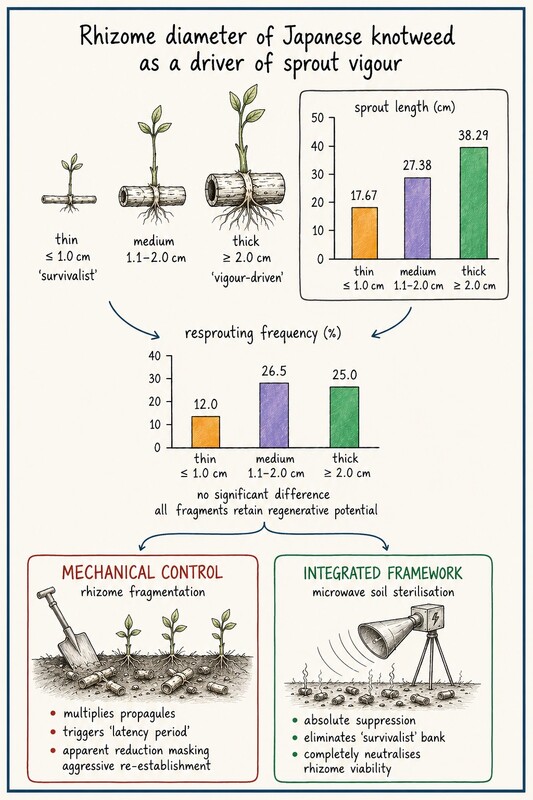
Understanding the regenerative capacity of Japanese knotweed (Reynoutria japonica Houtt.) is essential for developing effective management strategies. This study investigated how rhizome fragment diameter – classified as thin (≤ 1.0 cm), medium (1.1–2.0 cm), and thick (≥ 2.0 cm) –affects early sprouting. The one-way ANOVA and Tukey’s HSD post-hoc test revealed that sprout length increased significantly with rhizome diameter (p < 0.001), accounting for 62.40% of the variation in sprout growth. Specifically, thick fragments produced the longest sprouts (38.29 ± 1.70 cm), significantly outperforming medium (27.38 ± 1.43 cm) and thin (17.67 ± 1.76 cm) fragments. Despite these differences in vigor, resprouting frequency did not differ significantly between rhizome classes (p > 0.05), indicating that even the thinnest fragments retain regenerative potential. The hierarchical cluster analysis (HCA) further identified two functional clusters, separating thin fragments into a “survivalist” cluster characterized by reduced growth compared to medium and thick fragments, which formed a “vigor-driven” cluster with a far superior regenerative potential. Moreover, these findings highlighted a critical management loophole; that is, mechanical control alone may have contributed to rhizome fragmentation, creating the impression of reduced infestations while viable fragments persisted and regenerated following disturbance, a phenomenon termed the “latency period.” Thus, effective management must shift from strategies that merely fragment rhizomes to those that ensure the complete suppression of rhizome viability.
FUNDING
This research was funded by a subsidy of the Ministry of Education and Science for the Hugo Kołłątaj University of Agriculture in Krakow for 2026.
RESPONSIBLE EDITOR
Irena Suwara
CONFLICT OF INTEREST
The authors have declared that no conflict of interests exist.
| eISSN: | 1899-007X |
| ISSN: | 1427-4345 |

We process personal data collected when visiting the website. The function of obtaining information about users and their behavior is carried out by voluntarily entered information in forms and saving cookies in end devices. Data, including cookies, are used to provide services, improve the user experience and to analyze the traffic in accordance with the Privacy policy. Data are also collected and processed by Google Analytics tool (more).
You can change cookies settings in your browser. Restricted use of cookies in the browser configuration may affect some functionalities of the website.
You can change cookies settings in your browser. Restricted use of cookies in the browser configuration may affect some functionalities of the website.