
REVIEW
Plant defense mechanisms against insect herbivores: ecological insights for sustainable pest management
1
Department of Entomology, University of Kentucky, Research and Education Center, Princeton, KY, USA, 1500 Bull Lea Rd, Lexington, KY 40511, 40506, Lexington, Virgin Islands (U.S.)
2
Department of Entomology, International Maize and Wheat Improvement Center (CIMMYT), 47 Nairobi Crescent Johannesburg 2188, 1041-00621, Nairobi, Kenya
A - Research concept and design; B - Collection and/or assembly of data; C - Data analysis and interpretation; D - Writing the article; E - Critical revision of the article; F - Final approval of article
Submission date: 2026-05-18
Acceptance date: 2026-08-31
Online pre-proof publication date: 2026-10-08
Corresponding author
Adeshina Adewinle
Department of Entomology, University of Kentucky, Research and Education Center, Princeton, KY, USA, 1500 Bull Lea Rd, Lexington, KY 40511, 40506, Lexington, Virgin Islands (U.S.)
Department of Entomology, University of Kentucky, Research and Education Center, Princeton, KY, USA, 1500 Bull Lea Rd, Lexington, KY 40511, 40506, Lexington, Virgin Islands (U.S.)
HIGHLIGHTS
- Plant defenses shape herbivore behavior and population dynamics
- Structural and chemical defenses reduce insect feeding efficiency
- Induced defenses recruit predators and parasitoids indirectly
- Plant defenses influence coevolution and herbivore specialization
- Defense based IPM can reduce reliance on synthetic insecticides
KEYWORDS
induced plant defensesintegrated pest management (IPM)plant defense mechanismsplant-insect interactionssecondary metabolitessustainable agriculture
TOPICS
ABSTRACT
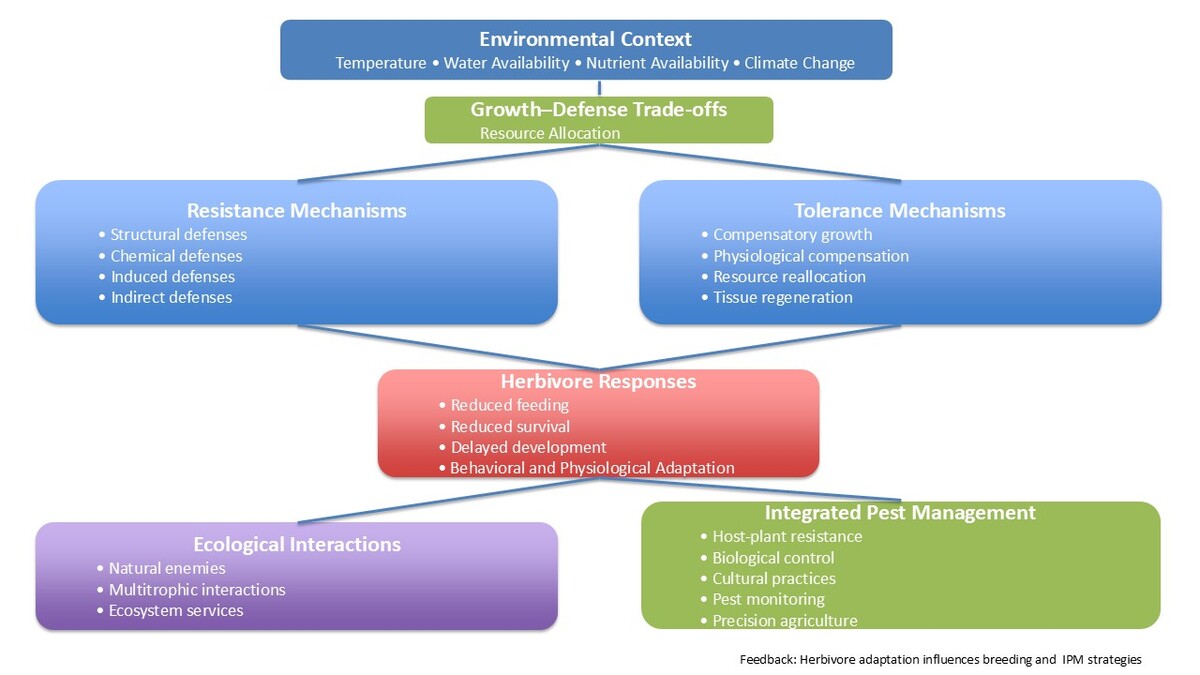
Insect herbivory remains a major constraint on agricultural productivity and ecosystem stability worldwide. Plants have evolved diverse structural, chemical, and inducible defense mechanisms that reduce herbivore damage while shaping ecological and evolutionary interactions across trophic levels. Beyond direct deterrence, plant defenses influence herbivore specialization, multitrophic interactions, and community structure, generating dynamic feedback between plants and insects. Although plant defense biology has been extensively examined from molecular and evolutionary perspective, there is potential need to explicitly connect these mechanisms to applied pest management frameworks. Here, we integrated structural barriers, secondary metabolite production, inducible signaling pathways, and herbivore-induced plant volatiles within a unified ecological context and examined how these traits influence herbivore performance, specialization, and adaptation. We further evaluated how plant defense traits can be incorporated into durable integrated pest management (IPM) strategies through selective breeding, a resistance trait pyramid, ecological intensification, and adaptive monitoring. By bridging mechanistic defense biology with ecological theory and agricultural implementation, this review summarized pathways for harnessing plant-based resistance to reduce insecticide reliance and promote resilient agroecosystems.
ACKNOWLEDGEMENTS
The authors wish to thank Dr. Nicholas M. Teets for providing thoughtful comments and constructive feedback that helped improve the clarity and focus of the manuscript.
RESPONSIBLE EDITOR
Jacek Twardowski
CONFLICT OF INTEREST
The authors have declared that no conflict of interests exist.
Share
RELATED ARTICLE
| eISSN: | 1899-007X |
| ISSN: | 1427-4345 |

We process personal data collected when visiting the website. The function of obtaining information about users and their behavior is carried out by voluntarily entered information in forms and saving cookies in end devices. Data, including cookies, are used to provide services, improve the user experience and to analyze the traffic in accordance with the Privacy policy. Data are also collected and processed by Google Analytics tool (more).
You can change cookies settings in your browser. Restricted use of cookies in the browser configuration may affect some functionalities of the website.
You can change cookies settings in your browser. Restricted use of cookies in the browser configuration may affect some functionalities of the website.