ORIGINAL ARTICLE
Spreading and evaporation behaviors of adjuvant-amended droplets on different wheat surfaces
1
Center of Agrarian Sciences, Northern Paraná State University, Bandeirantes, Brazil
2
Application Technology Research Unit, USDA ARS, United States Department of Agriculture, Wooster, Ohio, United States
These authors had equal contribution to this work
A - Research concept and design; B - Collection and/or assembly of data; C - Data analysis and interpretation; D - Writing the article; E - Critical revision of the article; F - Final approval of article
Submission date: 2026-07-10
Acceptance date: 2026-09-04
Online pre-proof publication date: 2026-10-07
Corresponding author
HIGHLIGHTS
- Adjuvant type and dose govern droplet spreading on wheat heads and stems
- Maximizing droplet spread on wheat surfaces greatly accelerates evaporation
- Textured wheat heads and stems dry much faster than flat leaves
- Adjuvant performance is strictly dose-dependent and surface-specific
- Application requires balancing wide target coverage with sufficient drying time
KEYWORDS
TOPICS
ABSTRACT
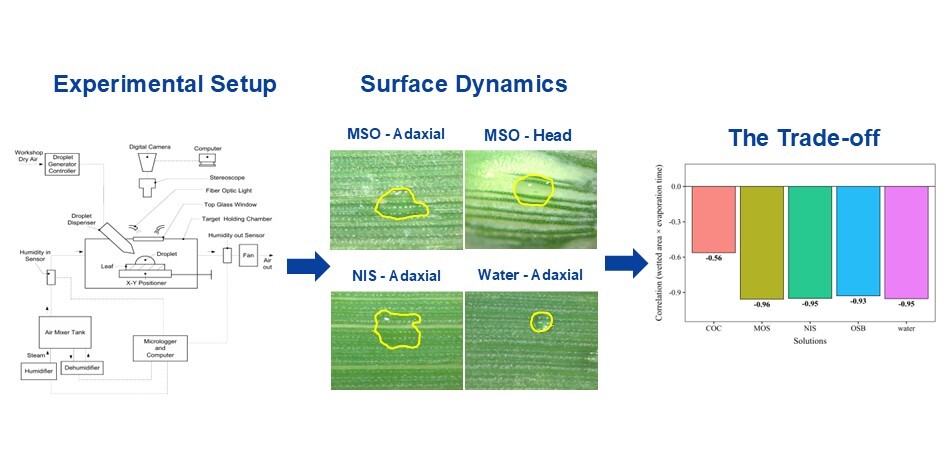
Delivering spray droplets to complex, superhydrophobic wheat (Triticum aestivum L.) structures, particularly heads and stems, remains a major challenge. Because most studies evaluate flat leaves, this research investigated droplet wetted area and evaporation time across four wheat surfaces (adaxial/abaxial leaves, stem, head) under varying concentrations of modified seed oil (MSO), non-ionic surfactant (NIS), oil surfactant blend (OSB), and crop oil concentrate (COC). All adjuvants significantly increased spreading but reduced evaporation time compared to water. MSO and NIS maximized wetted area but dried fastest, whereas COC exhibited the weakest spreading and slowest evaporation. A strong negative correlation confirmed a severe thermodynamic trade-off: extensive spreading on highly textured heads and stems created critically thin liquid films that accelerated evaporation. Consequently, maximizing spreading risks premature pesticide crystallization. Because interactions are strictly dose-dependent and surface-specific, no universal optimal concentration exists. Agronomists must balance target coverage with droplet longevity through precise adjuvant selection and dosing to ensure maximum biological efficacy.
FUNDING
The authors gratefully acknowledge the financial support provided by the Coordination for the Improvement of Higher Education Personnel (CAPES, Brazil) (process number 88887.007409/2024-00) for the scholarships granted to members of the team of authors.
RESPONSIBLE EDITOR
Agnieszka Synowiec
CONFLICT OF INTEREST
The authors have declared that no conflict of interests exist.
Share
RELATED ARTICLE
| eISSN: | 1899-007X |
| ISSN: | 1427-4345 |

We process personal data collected when visiting the website. The function of obtaining information about users and their behavior is carried out by voluntarily entered information in forms and saving cookies in end devices. Data, including cookies, are used to provide services, improve the user experience and to analyze the traffic in accordance with the Privacy policy. Data are also collected and processed by Google Analytics tool (more).
You can change cookies settings in your browser. Restricted use of cookies in the browser configuration may affect some functionalities of the website.
You can change cookies settings in your browser. Restricted use of cookies in the browser configuration may affect some functionalities of the website.