


REVIEW
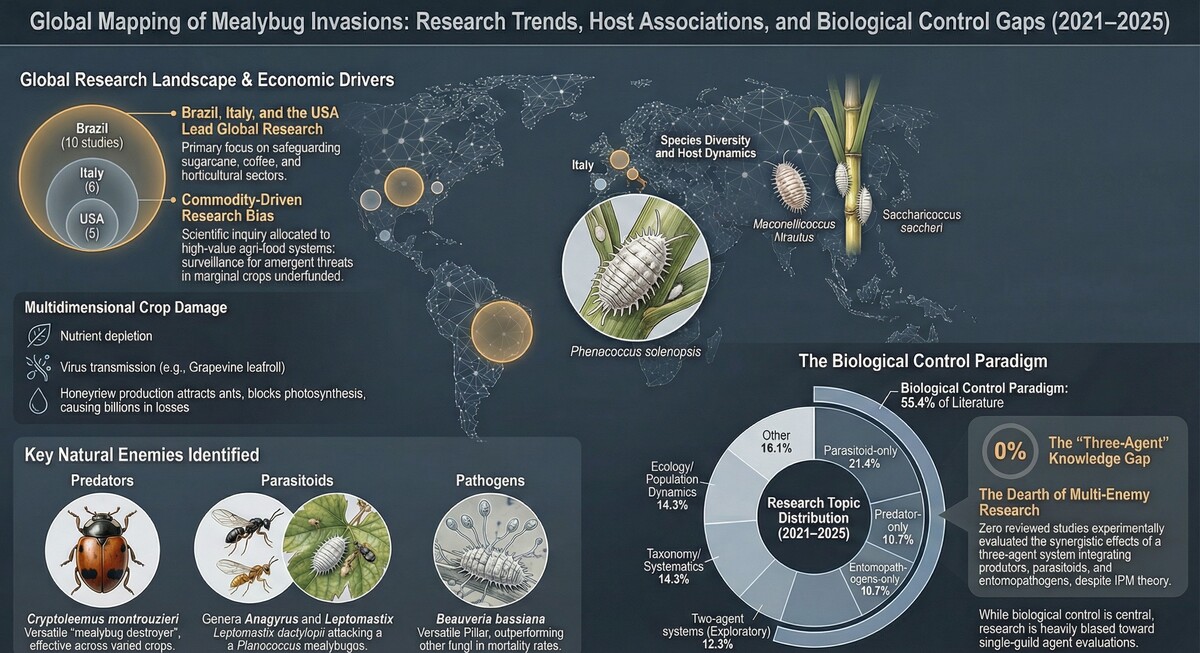
From Single Agents to Multi-Enemy Systems: A Systematic Review of Mealybug (Hemiptera: Pseudococcidae) Biological Control Research

1
Doctoral Program of Agricultural Sciences, Faculty of Agriculture, Universitas Andalas, Limau Manis, 25163, Padang, Indonesia
2
Agroteknologi, Faculty of Agriculture, Universitas Islam Riau, Jl. Khairuddin Nasution KM 11, 28284, Pekanbaru, Indonesia
3
Plant Protection, Faculty of Agriculture, Universitas Andalas, Jl. Limau Manis, 25163, Padang, Indonesia
A - Research concept and design; B - Collection and/or assembly of data; C - Data analysis and interpretation; D - Writing the article; E - Critical revision of the article; F - Final approval of article
Submission date: 2025-12-09
Acceptance date: 2026-02-19
Online publication date: 2026-03-20
Corresponding author
Trizelia Zainuddin
Plant Protection, Faculty of Agriculture, Universitas Andalas, Jl. Limau Manis, 25163, Padang, Indonesia
Plant Protection, Faculty of Agriculture, Universitas Andalas, Jl. Limau Manis, 25163, Padang, Indonesia
HIGHLIGHTS
- Geographic Bias: Brazil, Italy, USA & China led mealybug research (2021-2025)
- Top Pest & Hosts: Phenacoccus solenopsis, citrus, and grapevine most studied
- Single-Agent Bias: 21.4% were parasitoid-only studies, limiting IPM
- Critical Gap: No studies tested 3-agent (predator+parasitoid+pathogen) systems
KEYWORDS
TOPICS
ABSTRACT
Mealybugs (Hemiptera: Pseudococcidae) are major insect pests causing significant economic losses across diverse crops. This systematic review summarizes research on mealybugs, focusing on study types, species, host plants, and natural enemy groups in biological control, with emphasis on management-oriented literature to identify gaps in Integrated Pest Management (IPM). Literature searches in Scopus, PubMed, and Web of Science yielded 1,342 records, of which 56 peer-reviewed articles published between 2021 and 2025 met inclusion criteria through a PICOC-based screening. Research was geographically concentrated, with Brazil, Italy, the United States, and China as leading contributors. The 56 articles reported 35 mealybug species, highlighting a focus on biocontrol rather than global Pseudococcidae diversity. Phenacoccus solenopsis Tinsley, 1898 was the most studied species, and citrus and grapevine were the main host plants. Over half of the studies (53.6%) examined biological control, but research favored single-agent approaches: parasitoid-only studies (21.4%), predator-only and entomopathogen-only studies (10.7% each). Multi-agent systems were scarcely explored; six studies examined predator-parasitoid combinations, while only one investigated predator-entomopathogen interactions. Notably, no study examined three-agent systems. This gap is critical, as multi-agent outcomes are context-dependent, ranging from synergy to interference. The review identifies two key gaps: limited multi-agent experiments and absence of frameworks to manage their interactions. Addressing these gaps is essential to advance evidence-based, ecologically complex IPM strategies for mealybug management, emphasizing the need for research that evaluates multi-agent interactions and their practical implementation in pest management.
CONFLICT OF INTEREST
The authors have declared that no conflict of interests exist.
| eISSN: | 1899-007X |
| ISSN: | 1427-4345 |

We process personal data collected when visiting the website. The function of obtaining information about users and their behavior is carried out by voluntarily entered information in forms and saving cookies in end devices. Data, including cookies, are used to provide services, improve the user experience and to analyze the traffic in accordance with the Privacy policy. Data are also collected and processed by Google Analytics tool (more).
You can change cookies settings in your browser. Restricted use of cookies in the browser configuration may affect some functionalities of the website.
You can change cookies settings in your browser. Restricted use of cookies in the browser configuration may affect some functionalities of the website.
