

REVIEW
Regulatory differences in crop protection systems for soybean production: implications of the EU–Mercosur trade agreement
1
Department of Entomology and Agricultural Pests, Institute of Plant Protection – NRI, Poznań, Poland
2
Department of Mycology, Institute of Plant Protection – NRI, Poznań, Poland
3
Department of Weed Science and Plant Protection Technique, Institute of Plant Protection – NRI, Poznań, Poland
4
Plant Breeding and Protection Department, Ministry of Agriculture and Rural Development, Warsaw, Poland
These authors had equal contribution to this work
A - Research concept and design; B - Collection and/or assembly of data; C - Data analysis and interpretation; D - Writing the article; E - Critical revision of the article; F - Final approval of article
Submission date: 2026-02-21
Acceptance date: 2026-04-04
Online publication date: 2026-06-03
Corresponding author
Przemysław Strażyński
Department of Entomology and Agricultural Pests, Institute of Plant Protection – NRI, Poznań, Poland
Department of Entomology and Agricultural Pests, Institute of Plant Protection – NRI, Poznań, Poland
Journal of Plant Protection Research 2026;2(66):148-161
HIGHLIGHTS
- Up to 52 fold gap in soybean crop protection tools
- Around 100 active substances not approved in the EU
- Brazil pesticide use 4.7 times higher than EU average
- MRL differences reach up to 200 fold
- Regulatory asymmetry shapes trade and resistance risk
KEYWORDS
TOPICS
ABSTRACT
The political conclusion of the EU–Mercosur Partnership Agreement in December 2024
marks a significant shift in global agri-food trade and raises fundamental questions on
regulatory coherence in plant protection. This study provides a comprehensive comparative
assessment of crop protection systems in soybean (Glycine max L.) production between
the European Union (represented by Poland) and Mercosur countries. Soybean was
selected due to its strategic importance in global feed supply chains, the EU’s structural
import dependence, and the crop’s high reliance on chemical and biological plant protection
products (PPPs). The analysis reveals pronounced asymmetries in the availability of
authorized
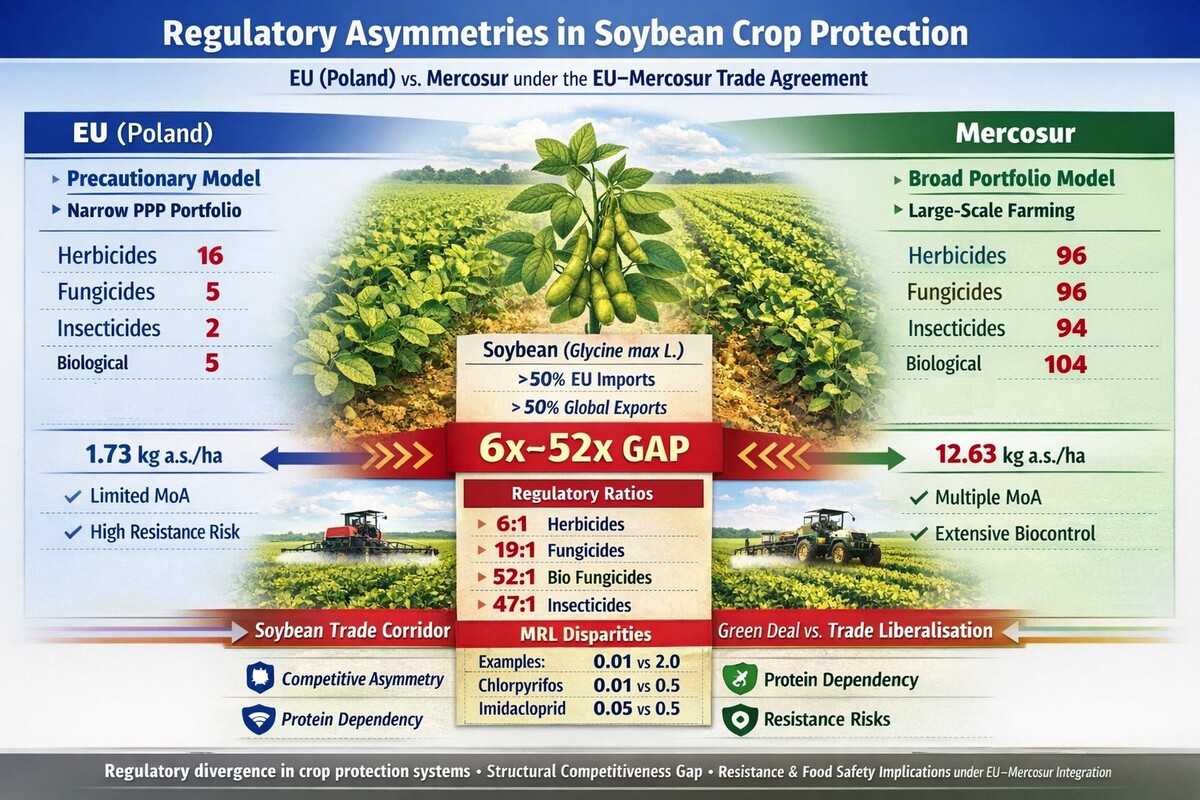
active substances. Mercosur producers have access to 96 herbicide active substances
compared to 16 in Poland (ratio 6 : 1); 96 chemical fungicide active substances
compared to 5 (19 : 1); and 94 chemical insecticide active substances compared to only 2
(47 : 1). The disparity is particularly striking for biological fungicides, where 104 microbial
strains are registered in Mercosur versus 2 in Poland (52 : 1). Even in biological insecticides,
the ratio remains 3 : 1 (9 vs. 3). Approximately 100 active substances used in Mercosur
soybean production are not approved in the EU. Pesticide application intensity in Brazil
(12.63 kg a.s./ha) is 4.7 times higher than the EU average and over seven times higher
than in Poland. In parallel, Maximum Residue Limits (MRLs) for selected substances differ
substantially, in extreme cases by up to 200-fold. These quantitative asymmetries translate
into divergent pest management capacity, resistance management flexibility, and production
resilience. While the EU regulatory framework reflects a precautionary approach with
progressive restriction of active substances, Mercosur systems operate with substantially
broader chemical and biological portfolios enabling diversified and rotation-based control
strategies. The findings demonstrate that regulatory differences – ranging from 6 : 1 to
52 : 1 depending on product category – constitute a structural factor shaping competitiveness,
resistance risk, and food safety governance under the evolving EU–Mercosur trade
framework.
RESPONSIBLE EDITOR
Arkadiusz Artyszak
CONFLICT OF INTEREST
The authors have declared that no conflict of interests exist.
REFERENCES (42)
1.
Ambroziak Ł., Bułkowska M., Szczepaniak I. 2025. Agricultural production potential in the EU and Mercosur countries: A comparative analysis. Sustainability 17: 11135. DOI: https://doi.org/10.3390/su1724....
2.
Cerdeira A.L., Gazziero D.L.P., Duke S.O., Matallo M.B. 2011. Agricultural impacts of glyphosate-resistant soybean cultivation in South America. Journal of Agricultural and Food Chemistry 59 (11): 5799–5807. DOI: 10.1021/jf102652y.
3.
Balog A., Hartel T., Loxdale H.D., Wilson K. 2017. Differences in the progress of the biopesticide revolution between the EU and other major crop-growing regions. Pest Management Science 73 (11): 2203–2208. DOI: https://doi.org/10.1002/ps.459....
4.
Bombardi L.M. 2019. A Geography of agrotoxins use in Brazil and its relations to the European Union, Universidade de São Paulo. Faculdade de Filosofia, Letras e Ciências Humanas, 266 pp. DOI: https://doi.org/10.11606/97885....
5.
Bueno A.d.F., Paula-Moraes S., Gazzoni D.L., Pomari-Fernandez A. 2013. Economic thresholds in soybean-integrated pest management: old concepts, current adoption, and adequacy. Neotropical Entomology 42 (5). DOI:10.1007/s13744-013-0167-8.
6.
Bueno A.d.F., Sutil W.P., Jahnke S.M., Carvalho G.A., Cingolani M.F., Colmenarez Y.C., Corniani N. 2023. Biological control as part of the soybean integrated pest management (IPM): Potential and Challenges. Agronomy 13 (10): 2532. DOI: https://doi.org/10.3390/agrono....
7.
Bułkowska M., Ambroziak Ł. 2025. Assessment of competitiveness and complementarity in agri-food trade between the European Union and Mercosur Countries. Agriculture 15: 2504. DOI: https://doi.org/10.3390/ agriculture15232504.
8.
de Oliveira S.E.M.C., Visentin J.C., Pavani B.F., Branco P.D., de Maria M., Loyola R. 2024. The European Union – Mercosur Free Trade Agreement as a tool for environmentally sustainable land use governance. Environmental Science & Policy 161: 103875. DOI: https://doi.org/10.1016/j.envs....
9.
European Commission 2020. Farm to fork strategy – for a fair, healthy and environmentally-friendly food system. Available on: https://eur-lex.europa.eu/lega... [Accessed: 31.01.2026].
10.
European Commission 2024. EU–Mercosur Trade Agreement: Political agreement reached; Press Release, December 2024.
11.
European Food Safety Authority (EFSA). Peer review of pesticide risk assessment of active substances under Regulation (EC) No 1107/2009. EFSA Journal (multiple years) [Accessed: 31.01.2026].
12.
FAOSTAT (Food and Agriculture Organization of the United Nations) 2024. Pesticides Use Database 2024. Rome, Italy.
13.
FRAC (Fungicide Resistance Action Committee) 2025. FRAC Code List 2025: Fungal control agents sorted by cross-resistance pattern and mode of action (including coding for FRAC Groups on product labels) [Accessed: 8.02.2026].
14.
Gohin A., Matthews A. 2025. The European Union–Mercosur Association Agreement: Implications for the EU Livestock Sector. Journal of Agricultural Economics 77 (1): 25–35. DOI: 10.1111/1477-9552.70010.
15.
Hartman G.L., Rupe J.C., Sikora E.J., Domier L.L., Davis J.A., Steffey K.L. (eds.). 2015. Compendium of Soybean Diseases and Pests. 5th ed. APS Press; St. Paul, MN, USA, 201 pp.
16.
Heap I. 2025. The International Survey of Herbicide Resistant Weeds. Online database. Available on: https://www.weedscience.org [Accessed: 31.01.2026].
17.
Hawkins N.J., Bass C., Dixon A., Neve P. 2019. The evolutionary origins of pesticide resistance. Biological Reviews 94: 135–155. DOI: https://doi.org/10.1111/brv.12....
18.
Hicks H.L., Comont D., Coutts S.R., Crook L., Hull R., Norris K., Neve P., Childs D.Z., Freckleton R.P. 2018. The factors driving evolved herbicide resistance at a national scale. Nature Ecology & Evolution 2 (3): 529–536. DOI: https://doi.org/10.1038/s41559....
19.
Hoffmans Y., Safitri R., Mol H., Bikker P. 2025. Overview of pesticides authorised in maize and soybean grown outside the EU: Authorised active substances for use in plant protection products in maize and soybean in Brazil, Ukraine and the United States. (WFSR-report; No. 2025.007). Wageningen Food Safety Research. DOI: https://doi.org/10.18174/69352....
20.
HOMOLOGA 2025. The global crop protection database. Available on: www.homologa.com [Accessed: 30.12.2025].
21.
HRAC (Herbicide Resistance Action Committee) 2026. 2026 HRAC Global Herbicide MoA Classification. Available on: https://hracglobal.com/tools/2... [Accessed: 8.02.2026].
22.
IBAMA (Instituto Brasileiro do Meio Ambiente e dos Recursos Naturais Renováveis) 2025. Relatórios de Comercialização de Agrotóxicos 2022–2024. Brasília, Brazil. https://www.gov.br/ibama/pt-br... [Accessed: 8.02.2026].
23.
IRAC (The Insecticide Resistance Action Committee) 2026. IRAC Mode of action classification scheme. Edition 11.5. Available on: IRAC-MoA_brochure_Ed11.5_4Feb26-1770200864.pdf [Accessed: 8.02.2026].
24.
Korbas M., Paradowski A., Węgorek P., Jajor E., Horoszkiewicz-Janka J., Zamojska J., Danielewicz J., Czyczewski M., Dworzańska D. 2017. Vademecum środków ochrony roślin. Wydawnictwo Agronom, Poznań, 672 pp.
25.
Lamichhane J.R. 2017. Pesticide use and risk reduction in European farming systems with IPM: An introduction to the special issue. Crop Protection. DOI: 10.1016/j.cropro.2017.01.017.
26.
Lucas J.A., Hawkins N.J., Fraaije B.A. 2014. The evolution of fungicide resistance. Advances in Applied Microbiology 90: 29–92. DOI: https://doi.org/10.1016/bs.aam....
27.
Martins M.M.V., Burnquist H.L. 2025. Maximum Residues Limits (MRLs) of pesticide and international trade dynamics to Mercosur and EU. Available on: https://www.anpec.org.br/encon... [Accessed: 31.01.2026].
28.
Norsworthy J.K., Ward S.M., Shaw D.R., Llewellyn R.S., Nichols R.L., Webster T.M., Bradley K.W., Frisvold G., Powles S.B., Burgos N.R., Witt W.W., Barrett M. 2012. Reducing the risks of herbicide resistance: best management practices and recommendations. Weed Science 60 (SP1): 31–62. DOI: 10.1614/WS-D-11-00155.1.
29.
OECD (Organisation for Economic Co-operation and Development) 2017. International regulatory co-operation and trade: Understanding the trade costs of regulatory divergence and the remedies. OECD Publishing, Paris, France. DOI: https://doi.org/10.1787/978926....
30.
OECD (Organisation for Economic Co-operation and Development) 2021. International Regulatory Co-operation, OECD Best Practice Principles for Regulatory Policy, OECD Publishing, Paris. DOI: https://doi.org/10.1787/5b28b5....
31.
Oliveira R.C., Raetano C.G., Junior J.D., Carvalho F.K. 2017. Integrated management of soybean pests: The example of Brazil. Outlooks on Pest Management 28 (4): 149–153. DOI:10.1564/v28_aug_02.
32.
Perobelli J.E. 2025. Pesticides and public health: discussing risks in Brazilian agro-industrial growth. Frontiers in Toxicology 7: 1442801. DOI: 10.3389/ftox.2025.1442801.
33.
Procópio S.d.O., Barizon R.R.M., Pazianotto R.A.A., Morandi M.A.B., Braz G.B.P. 2024. Impacts of weed resistance to glyphosate on herbicide commercialization in Brazil. Agriculture 14: 2315. DOI: https://doi.org/10.3390/agricu....
34.
Regulation (EC) No 396/2005 of the European Parliament and of the Council on maximum residue levels of pesticides in or on food and feed of plant and animal origin. Official Journal of the European Union 2005, L70: 1–16.
35.
Souza M.C.O., Cruz J.C., Cesila C.A., Gonzalez N., Rocha B.A., Adeyemi J.A., Nadal A., Nadal B., Domingo J.L., Barbosa F. 2023. Recent trends in pesticides in crops: A critical review of the duality of risks-benefits and the Brazilian legislation issue. Environmental Research 228: 115811. DOI: https://doi.org/10.1016/j.envr....
36.
Sparks T.C., Nauen R. 2015. IRAC: Mode of action classification and insecticide resistance management. Pesticide Biochemistry and Physiology 121: 122–128. DOI: https://doi.org/10.1016/j.pest....
37.
Stankiewicz-Kosyl M., Synowiec A., Haliniarz M., Wenda-Piesik A., Domaradzki K., Parylak D., Wrochna M., Pytlarz E., Gala-Czekaj D., Marczewska-Kolasa K., Marcinkowska K., Praczyk T. 2020. Herbicide resistance and management options of Papaver rhoeas L. and Centaurea cyanus L. in Europe: A Review. Agronomy 10: 874–896. DOI: 10.3390/agronomy10060874.
38.
Stankiewicz-Kosyl M., Haliniarz M., Wrochna M., Synowiec A., Wenda-Piesik A., Tendziagolska E., Sobolewska M., Domaradzki K., Skrzypczak G., Łykowski W., Krysiak M., Bednarczyk M., Marcinkowska K. 2021. Herbicide resistance of Centaurea cyanus L. in Poland in the context of its management. Agronomy 11: 1954. DOI: 10.3390/agronomy11101954.
39.
Stankiewicz-Kosyl M., Haliniarz M., Wrochna M., Obrępalska-Stęplowska A., Kuc P., Łukasz J., Wińska-Krysiak M., Wrzesińska-Krupa B, Puła J., Podsiadło C, Domaradzki K., Piekarczyk M., Bednarczyk M., Marcinkowska K. 2023. Occurrence and mechanism of Papaver rhoeas ALS inhibitors resistance in Poland. Agriculture 13 (1): 82. DOI: https://doi.org/10.3390/agricu....
40.
Strażyński P., Mrówczyński M., Kierzek R. 2025. Availability constraints of plant protection products in Polish winter cereal production – A Post–EU accession perspective. Journal of Plant Protection Research 65 (4). DOI: 10.24425/jppr.2025.156889.
41.
van Lenteren J.C., Bolckmans K., Köhl J., Ravensberg W.J., Urbaneja A. 2018. Biological control using invertebrates and microorganisms: plenty of new opportunities. BioControl 63 (1): 39–59. DOI: https://doi.org/10.1007/s10526....
42.
Yorinori J.T., Paiva W.M., Frederick R.D., Costamilan L.M., Bertagnolli P.F., Hartman G.E., Godoy C.V., Nunes J.Jr. 2005. Epidemics of soybean rust (Phakopsora pachyrhizi) in Brazil and Paraguay from 2001 to 2003. Plant Disease 89 (6): 675–677. DOI: 10.1094/PD-89-0675.
Share
RELATED ARTICLE
| eISSN: | 1899-007X |
| ISSN: | 1427-4345 |

We process personal data collected when visiting the website. The function of obtaining information about users and their behavior is carried out by voluntarily entered information in forms and saving cookies in end devices. Data, including cookies, are used to provide services, improve the user experience and to analyze the traffic in accordance with the Privacy policy. Data are also collected and processed by Google Analytics tool (more).
You can change cookies settings in your browser. Restricted use of cookies in the browser configuration may affect some functionalities of the website.
You can change cookies settings in your browser. Restricted use of cookies in the browser configuration may affect some functionalities of the website.
