
REVIEW
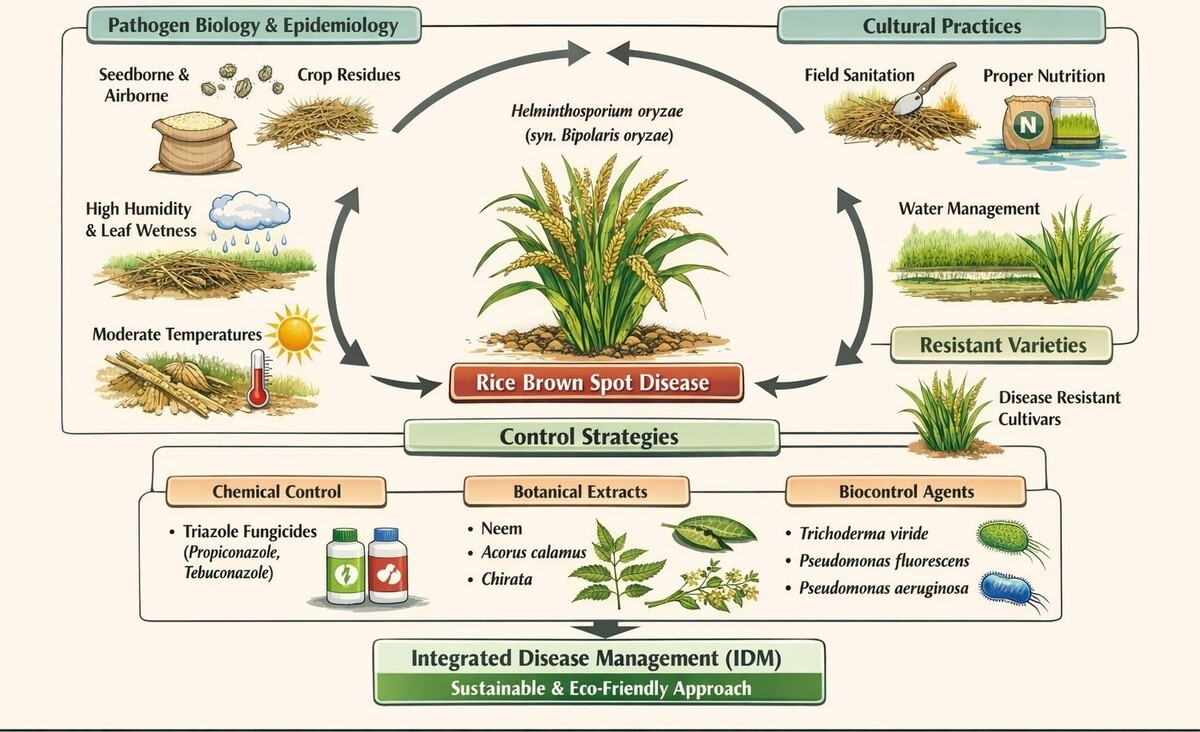
Sustainable Control of Brown Spot in Rice: A Review of Eco-Friendly In-Vitro Strategies Against Helminthosporium oryzae

1
Department of Plant Pathology, Sindh Agriculture University, Tandojam, Sindh, Tandojam, Hyderabad, Pakistan
2
Department of Entomology, Sindh Agriculture University, Tandojam, Sindh, Hyderabad, Pakistan
3
Department of Agriculture, Mir Chakar Khan Rind University, Sibi, Balochistan, Pakistan
4
Department of Plant Protection, Sindh Agriculture University, Tandojam, Sindh, Hyderabad, Pakistan
A - Research concept and design; B - Collection and/or assembly of data; C - Data analysis and interpretation; D - Writing the article; E - Critical revision of the article; F - Final approval of article
Submission date: 2025-07-16
Acceptance date: 2026-03-30
Online publication date: 2026-04-08
Corresponding author
Ghulam Hussain Jatoi
Department of Plant Pathology, Department of Plant Pathology, Sindh Agriculture University, Tandojam, Sindh, Tandojam, 70010, Hyderabad, Pakistan
Department of Plant Pathology, Department of Plant Pathology, Sindh Agriculture University, Tandojam, Sindh, Tandojam, 70010, Hyderabad, Pakistan
HIGHLIGHTS
- Helminthosporium oryzae
- fungicides
- botanical
- biocontrol
KEYWORDS
TOPICS
ABSTRACT
Brown spot of rice, caused by Helminthosporium oryzae (syn. Bipolaris oryzae), continues to pose a serious threat to rice production, particularly in resource-limited and stress-prone agroecosystems. The disease reduces yield, seed quality, and market value of rice as it has historically contributed to major food security crises. This review synthesizes research published between 2008 and 2025, aiming to critically evaluate pathogen biology, epidemiology, and sustainable management strategies for rice brown spot. H. oryzae is a highly adaptable pathogen capable of infecting rice at all of its growth stages, surviving through infected seeds, crop residues, and airborne dispersal. Disease development is strongly influenced by environmental factors, particularly high relative humidity, prolonged leaf wetness, and moderate temperatures. A clear understanding of the pathogen’s life cycle and epidemiological drivers is essential for designing effective disease management strategies. Current management strategies include the use of resistant varieties, synthetic fungicides, botanical extracts, and biocontrol agents. Among chemical options, triazole-based fungicides such as propiconazole and tebuconazole have shown effective suppression of brown spot severity and yield improvement. However, concerns over fungicide resistance, environmental toxicity, and regulatory restrictions necessitate alternative approaches. Plant-derived extracts (e.g., neem, Acorus calamus, and chirata) have demonstrated moderate antifungal activity while offering environmental safety and biodegradability. Biological control agents, including Trichoderma viride, Pseudomonas fluorescens, and Pseudomonas aeruginosa, have shown broad-spectrum inhibition of H. oryzae through antibiosis, mycoparasitism, and induced systemic resistance. This review compares and contrasts the efficacy of these management options and emphasizes the integration of resistant cultivars, biocontrol agents, and botanicals into an Integrated Disease Management framework for its better management. Such an approach promises sustainable, cost-effective, and environmentally responsible brown spot control, especially under changing climatic conditions and increasing consumer demand for residue-free rice.
CONFLICT OF INTEREST
The authors have declared that no conflict of interests exist.
Share
RELATED ARTICLE
| eISSN: | 1899-007X |
| ISSN: | 1427-4345 |

We process personal data collected when visiting the website. The function of obtaining information about users and their behavior is carried out by voluntarily entered information in forms and saving cookies in end devices. Data, including cookies, are used to provide services, improve the user experience and to analyze the traffic in accordance with the Privacy policy. Data are also collected and processed by Google Analytics tool (more).
You can change cookies settings in your browser. Restricted use of cookies in the browser configuration may affect some functionalities of the website.
You can change cookies settings in your browser. Restricted use of cookies in the browser configuration may affect some functionalities of the website.