
ORIGINAL ARTICLE
Unraveling the fungicide resistance in Alternaria alternata through integrated enzymatic, phenotypic, and colony growth analysis
1
School of Forestry, Northeast Forestry University, 150040, Harbin, China
2
Northeast Asia Biodiversity Center, Northeast Forestry University, 150040, Harbin, China
3
Key Laboratory of Forest Plant Ecology, College of Chemical Engineering and Resource Utilization. Northeast Forestry University, 150040, Harbin, China
A - Research concept and design; B - Collection and/or assembly of data; C - Data analysis and interpretation; D - Writing the article; E - Critical revision of the article; F - Final approval of article
Submission date: 2024-11-27
Acceptance date: 2025-02-10
Online publication date: 2026-06-18
Corresponding author
Journal of Plant Protection Research 2026;66(2):208-221
HIGHLIGHTS
- Investigated the activity of antioxidant enzymes of A. alternata
- Alternaria alternata growth rates on fungicide-treated media were evaluated
- Alternaria alternata's soluble protein content was measured
- Studied and contrasted the phenotypic characteristics of Alternaria alternata
- Investigated oxidative stress reactions and fungal resistance
KEYWORDS
TOPICS
ABSTRACT
Alternaria alternata causes black spots in a variety of fruits and vegetables. There are major
post-harvest losses due to a hidden fungus that develops when fruits are kept in the low
temperature and appears during the fruit marketing season. This study investigated how
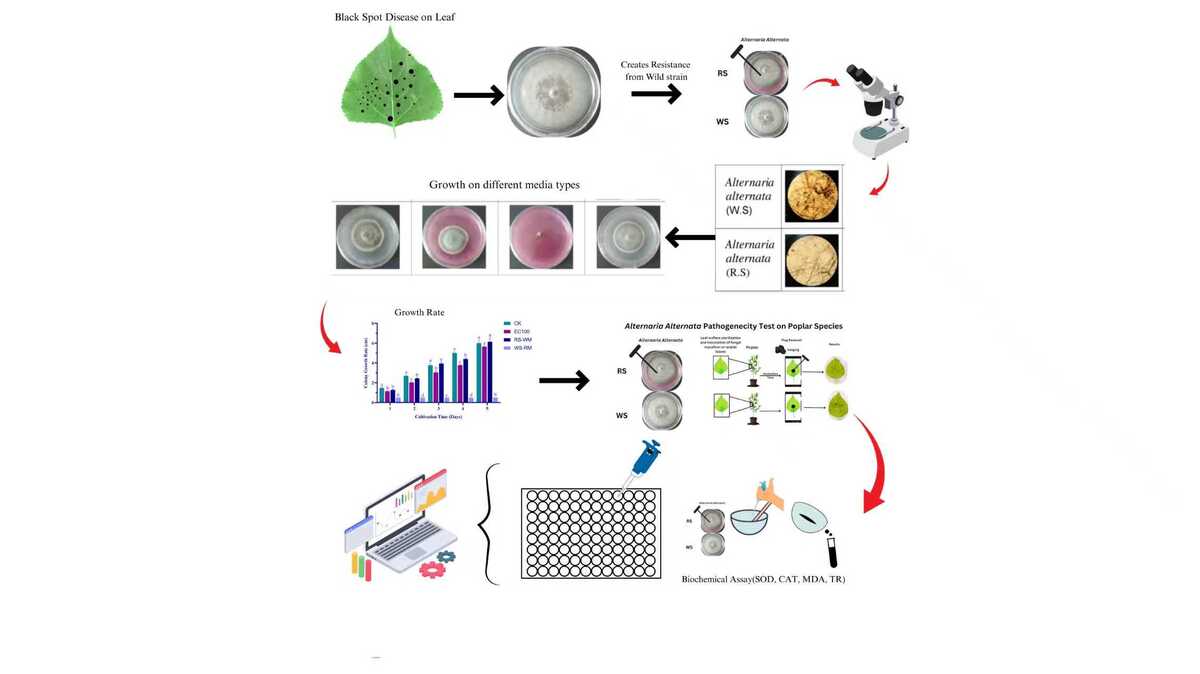
A. alternata develops resistance to fungicides and how growth rates are affected by various
growth media. According to the results, the resistant strain grew more slowly in the EC100
medium than in the control media, which showed significant differences in radial growth
across media. On the other hand, the wild strain in resistant media (WS-RM) showed less
development, whereas the resistant strain in wild media (RS-WM) showed more growth.
Wild strains multiplied, whereas resistant strains showed decreased mycelial growth.
Biochemical assays revealed significant variations between resistant and wild strains.
These distinctions are highlighted by the linear correlation (R2 = 99.38%) between protein
concentrations and absorbance variation. The wild strains’ control protein ratio
(CPr) was 0.192, whereas the resistant strains were 0.187. The mean values of MDA
(360.89 nmol · mg–1 protein), CAT (35.54 U · ml–1 protein), SOD (179.60 U · ml–1 protein),
and tyrosinase (52.18 U · ml–1 protein) in resistant strains were significantly higher than
those in wild strains (MDA: 179.19, CAT: 11.91, SOD: 161.36, tyrosinase: 23.90). Standard
deviations for all enzymes were more significant in resistant strain, indicating increased
variability. According to the pathogenicity test conducted on Populus nigra leaves, the resistant
strain’s enzymatic reactions were demonstrated by the CK leaves’ continued health,
the RS plants’ negligible symptoms, and the WS leaves’ severe necrosis. These results highlight
the necessity of further investigation into the molecular pathways underpinning interactions
between plants and pathogens to create focused defense strategies. Improving crop
tolerance to fungus infections and environmental stressors may result in more efficient
treatments, lower agricultural losses, and forest protection.
ACKNOWLEDGEMENTS
The authors would like to express their gratitude to
the School of Forestry, Northeast Forestry University,
Harbin, China, and the Chinese Scholarship Council
(CSC) for providing financial support and facilities.
We further acknowledge the constructive comments of
anonymous reviewers which improved the manuscript
substantially.
FUNDING
This study was supported by the Northeast Asia Biodiversity
Research Center Grant Number 411147021003.
RESPONSIBLE EDITOR
Piotr Iwaniuk
CONFLICT OF INTEREST
The authors have declared that no conflict of interests exist.
REFERENCES (62)
1.
Ahmad T., Xing F., Cao C., Liu Y. 2024. Characterization and toxicological potential of Alternaria alternata associated with post-harvest fruit rot of Prunus avium in China. Frontiers in Microbiology 15: 1273076. DOI: https://doi.org/10.3389/fmicb.....
2.
Alam A., Kataria P., Nethravathy V. 2021. Assessment of superoxide dismutase, catalase, and peroxidase activities in Aspergillus sp. and Cladosporium sp. Journal of Advanced Scientific Research 12 (03): 249–254. DOI: https://doi.org/10.55218/JASR.....
3.
Bagherabadi S., Zafari D. 2022. Isolation and characterization of Alternaria malorum as a causal agent of bark canker on walnut trees. Journal of Plant Protection Research: 62 (1): 102–106. DOI: https://doi.org/10.24425/jppr.....
4.
Beaumet M., Lazinski L.M., Maresca M., Haudecoeur R. 2023. Catechol-mimicking transition-state analogues as non-oxidizable inhibitors of tyrosinases. European Journal of Medicinal Chemistry: 115672. DOI: https://doi.org/10.1016/j.ejme....
5.
Biswal K.A., Das S. 2024. Unveiling the intricacies of the rice-Rhizoctonia pathosystem: a comprehensive review of host-pathogen interactions, molecular mechanisms, and strategies for sustainable management. Journal of Plant Protection Research: 64 (3): 209–233 DOI: https://doi.org/10.24425/jppr.....
6.
Budziszewska M., Bereś P.K. 2024. The box tree moth Cydalima perspectalis: a review of biology, invasiveness, management practices and future perspectives of control strategy in Europe. Journal of Plant Protection Research 64 (4): 276. DOI: https://doi.org/10.24425/jppr.....
7.
Dreischhoff S., Das I.S., Häffner F., Wolf A.M., Polle A., Kasper K.H. 2023. Fast and easy bioassay for the necrotizing fungus Botrytis cinerea on poplar leaves. Plant Methods 19 (1): 32. DOI: https://doi.org/10.1186/s13007....
8.
Duong H.T., Pham D.T., Pham V.T., Le A.H., Nguyen T.D., Nguyen N.X., Khuat C.T., Dinh H.T. 2024. Report on emerging foliar soft rot disease on ginseng Panax vietnamensis and the identification of Neocosmospora ipomoeae and Fusarium miscanthi as the causal pathogens. Journal of Plant Protection Research 64 (4): 374. DOI: https://doi.org/10.24425/jppr.....
9.
El-Beltagi H.S., Mohamed H.I. 2013. Reactive oxygen species, lipid peroxidation and antioxidative defense mechanism. Notulae Botanicae Horti Agrobotanici Cluj-Napoca 41 (1): 44–57. DOI: https://doi.org/10.15835/nbha4....
10.
El-Ganainy S.M., El-Abeid S.E., Ahmed Y., Iqbal Z. 2021. Morphological and molecular characterization of large-spored Alternaria species associated with potato and tomato early blight in Egypt. International Journal Agriculture and Biology 5: 1101–1110. DOI: https://doi.org/ 10.17957/IJAB/15.1769.
11.
El-Ghany N. 2019. Semiochemicals for controlling insect pests. Journal of Plant Protection Research 59 (1): 1–11.DOI: https://doi.org/10.24425/jppr.....
12.
Elskus A.A. 2012. Toxicity, sublethal effects, and potential modes of action of select fungicides on freshwater fish and invertebrates. U.S. Geological Survey Open-File Report 2012–1213: 42 p. DOI: https://doi.org/10.3133/ofr201....
13.
Escrivá L., Oueslati S., Font G., Manyes L. 2017. Alternaria mycotoxins in food and feed: An overview. Journal of Food Quality 2017 (1): 1569748. DOI: https://doi.org/10.1155/2017/1....
14.
Esfahani M.N. 2019. Morphological, virulence and genetic variability of Ulocladium atrum causing potato leaf blight disease in Iran. Journal of Plant Protection Research 59 (1): 41–49. DOI: https://doi.org/10.24425/jppr.....
15.
Fan X., Zhang P., Batool W., Liu C., Hu Y., Wei Y., He Z., Zhang S.-H. 2023. Contribution of the tyrosinase (MoTyr) to melanin synthesis, Conidiogenesis, Appressorium development, and pathogenicity in magnaporthe oryzae. Journal of Fungi 9 (3): 311. DOI: https://doi.org/10.3390/jof903....
16.
Feng W., Zheng X. 2007. Essential oils to control Alternaria alternata in vitro and in vivo. Food control 18 (9): 1126–1130. DOI: https://doi.org/10.1016/j.food....
17.
Golian J., Anyszka Z., Kosson R., Grzegorzewska M. 2023. The yield and postharvest quality of Chinese cabbage, depending on weed management method. Journal of Plant Protection Research: 63 (2): 113–121. DOI: https://doi.org/10.24425/jppr.....
18.
Gou Y.-N., Aung S.L.L., Htun A.A., Huang C.-X., Deng J.-X. 2022. Alternaria species in section Alternaria associated with Iris plants in China. Frontiers in Microbiology 13: 1036950. DOI: https://doi.org/10.3389/fmicb.....
19.
Gul Z., Tang Z.-H., Arif M., Ye Z. 2022. An insight into abiotic stress and influx tolerance mechanisms in plants to cope in saline environments. Biology 11 (4): 597. DOI: https://doi.org/10.3390/biolog....
20.
Haegerbaeumer A., Raschke R., Reiff N., Traunspurger W., Höss S. 2019. Comparing the effects of fludioxonil on non-target soil invertebrates using ecotoxicological methods from single-species bioassays to model ecosystems. Ecotoxicology and Environmental Safety 183: 109596. DOI: https://doi.org/10.1016/j.ecoe....
21.
Hassan F.R., Ghaffar N.M., Assaf L.H., Abdullah S.K. 2021. Pathogenicity of endogenous isolate of Paramyrothecium (= Myrothecium) roridum (Tode) L. Lombard & Crous against the squash beetle Epilachna chrysomelina (F.). Journal of Plant Protection Research: 61 (1): 110–116. DOI: https://doi.org/10.24425/jppr.....
22.
He L., He T., Farrar S., Ji L., Liu T., Ma X. 2017. Antioxidants maintain cellular redox homeostasis by elimination of reactive oxygen species. Cellular Physiology and Biochemistry 44 (2): 532–553. DOI: https://doi.org/10.1159/000485....
23.
Hernández J.A., Gullner G., Clemente-Moreno M.J., Künstler A., Juhász C., Díaz-Vivancos P., Király L. 2016. Oxidative stress and antioxidative responses in plant–virus interactions. Physiological and Molecular Plant Pathology 94: 134–148. DOI: https://doi.org/10.1016/j.pmpp....
24.
Hiner A.N., Rodríguez-López J.N., Arnao M.B., Raven E.L., García-Cánovas F., Acosta M. 2000. Kinetic study of the inactivation of ascorbate peroxidase by hydrogen peroxide. Biochemical Journal 348 (2): 321–328. DOI: https://doi.org/10.1042/bj3480....
25.
Hossain M.A., Bhattacharjee S., Armin S.-M., Qian P., Xin W., Li H.-Y., Burritt D.J., Fujita M., Tran L.-S.P. 2015. Hydrogen peroxide priming modulates abiotic oxidative stress tolerance: insights from ROS detoxification and scavenging. Frontiers in Plant Science 6: 420. DOI: https://doi.org/10.3389/fpls.2....
26.
Ihsanullah I., Khan M.T., Hossain M.F., Bilal M., Ali Shah I. 2024. Eco‐friendly solutions to emerging contaminants: unveiling the potential of bioremediation in tackling microplastic pollution in water. Advanced Sustainable Systems 8 (11): 2400172. DOI: https://doi.org/10.1002/adsu.2....
27.
Jiao L., Mao L., Zhang Y., Zhang L., Jiang H. 2018. Phytochemical changes in mango fruit in response to Alternaria alternata infection. Czech Journal of Food Sciences 36 (3): 227. DOI: https://doi.org/10.17221/328/2....
28.
Jomova K., Alomar S.Y., Alwasel S.H., Nepovimova E., Kuca K., Valko M. 2024. Several lines of antioxidant defense against oxidative stress: antioxidant enzymes, nanomaterials with multiple enzyme-mimicking activities, and low-molecular-weight antioxidants. Archives of Toxicology 98 (5): 1323–1367. DOI: https://doi.org/10.1007/s00204....
29.
Khan M.T., Ahmad L., Rashid W. 2018. Ethnobotanical documentation of traditional knowledge about medicinal plants used by indigenous people in Talash valley of Dir lower. Northern Pakistan Journal of Intercult Ethnopharmacol 7 (1): 8–24. DOI: 10.5455/jice.20171011075112.
30.
Kumar A., Bhadana N.K., Kumar G., Kumar V. 2019. Chemical and biological management of Alternaria leaf spot of Aloe vera. Think India Journal 22 (16): 1871–1893. DOI: https://thinkindiaquarterly.or....
31.
Li J.-F., Jiang H.-B., Jeewon R., Hongsanan S., Bhat D.J., Tang S.-M., Lumyong S., Mortimer P.E., Xu J.-C., Camporesi E. 2023. Alternaria: Update on species limits, evolution, multi-locus phylogeny, and classification. Studies in Fungi 8 (1): 1–61. DOI: http://doi.org/sif-0024-0001.
32.
Li S., Shao Z., Lu C., Yao J., Zhou Y., Duan D. 2021a. Glutamate dehydrogenase functions in glutamic acid metabolism and stress resistance in Pyropia haitanensis. Molecules 26 (22): 6793. DOI: https://doi.org/10.3390/molecu....
33.
Li T., Zhang N., Yan S., Jiang S., Yin H. 2021b. A novel tyrosinase from Armillaria ostoyae with comparable monophenolase and diphenolase activities suffers substrate inhibition. Applied and Environmental Microbiology 87 (12): e00275–00221. DOI: https://doi.org/10.1128/AEM.00....
34.
Łukaszewicz S., Politycka B., Borowiak-Sobkowiak B. 2021. Effect of selenium on alleviating oxidative stress in pea leaves caused by pea aphid feeding. Journal of Plant Protection Research: 61 (1): 83–94. DOI: https://doi.org/10.24425/jppr.....
35.
Maamoun H.S., Rabie G.H., Shaker I., Alaidaroos B.A., El-Sayed A.S. 2021. Biochemical properties of tyrosinase from Aspergillus terreus and Penicillium copticola; Undecanoic Acid from Aspergillus flavus, an endophyte of Moringa oleifera, is a novel potent tyrosinase inhibitor. Molecules 26 (5). DOI: https://doi.org/10.3390%2Fmole....
36.
Marsberg A., Kemler M., Jami F., Nagel J.H., Postma‐Smidt A., Naidoo S., Wingfield M.J., Crous P.W., Spatafora J.W., Hesse C.N. 2017. Botryosphaeria dothidea: a latent pathogen of global importance to woody plant health. Molecular Plant Pathology 18 (4): 477–488. DOI: https://doi.org/10.1111/mpp.12....
37.
Mmbaga M.T., Shi A., Kim M.-S. 2011. Identification of Alternaria alternata as a causal agent for leaf blight in Syringa species. DOI: https://doi.org/10.5423/PPJ.20....
38.
Morales-Urrea D., López-Córdoba A., Contreras E.M. 2023. Inactivation kinetics of horseradish peroxidase (HRP) by hydrogen peroxide. Scientific Reports 13 (1): 13363. DOI: https://doi.org/10.1038/s41598....
39.
Morales M., Munné-Bosch S. 2019. Malondialdehyde: facts and artifacts. Plant physiology 180 (3): 1246–1250. DOI: https://doi.org/10.1104/pp.19.....
40.
Muhammad S., Ali A., Mehmood K., Ahmad H., Hayat M., Khan M.T., Arbab N., Nizami M., Fahad S. 2024. Temporal variations in burn severity among various vegetation layers in subtropical Pinus Roxburghii (Chir Pine) forest of Hindu Kush mountain range. Trees, Forests and People 18: 100664. DOI: https://doi.org/10.1016/j.tfp.....
41.
Muñoz-Pérez G.A., Guillén-Chable F.A., Corzo G., Arenas-Sosa I., Sánchez-Cach L.A., Estrada G. 2024. Antibacterial activity improvement in a point mutant K45E of the pepper defensin J1-1. Journal of Plant Protection Research 64 (4): 1–8. DOI: https://doi.org/10.24425/jppr.....
42.
Nira S.T., Hossain F., Mahmud N.U., Hassan O., Islam T., Akanda A.M. 2022. Alternaria leaf spot of broccoli caused by Alternaria alternata in Bangladesh. Plant Protection Science 58 (1): 49–54. DOI: https://doi.org/10.17221/44/20....
43.
Oiki S., Yaguchi T., Urayama S.-i., Hagiwara D. 2022. Wide distribution of resistance to the fungicides fludioxonil and iprodione in Penicillium species. PLoS One 17 (1): e0262521. DOI: https://doi.org/10.1371/journa....
44.
Parada J., Tortella G., Seabra A.B., Fincheira P., Rubilar O. 2024. Potential antifungal effect of copper oxide nanoparticles combined with fungicides against Botrytis cinerea and Fusarium oxysporum. Antibiotics 13 (3): 215. DOI: https://doi.org/10.3390/antibi....
45.
Peić Tukuljac M., Danojević D., Medić-Pap S., Gvozdanović-Varga J., Prvulović D. 2023. Antioxidant response of sweet pepper fruits infected with Alternaria alternata. Journal of the Serbian Chemical Society 88 (3): 237–250. DOI: http://dx.doi.org/10.2298/JSC2....
46.
Rao A., Pimprikar P., Bendigiri C., Kumar A.R., Zinjarde S. 2011. Cloning and expression of a tyrosinase from Aspergillus oryzae in Yarrowia lipolytica: application in L-DOPA biotransformation. Applied Microbiology and Biotechnology 92: 951–959. DOI: https://doi.org/10.1007/s00253....
47.
Roy C., He X., Gahtyari N.C., Mahapatra S., Singh P.K. 2023. Managing spot blotch disease in wheat: Conventional to molecular aspects. Frontiers in Plant Science 14: 1098648. DOI: https://doi.org/10.3389/fpls.2....
48.
Saleem A., El-Shahir A.A. 2022. Morphological and molecular characterization of some Alternaria species isolated from tomato fruits concerning mycotoxin production and polyketide synthase genes. Plants 11 (9): 1168. DOI: https://doi.org/10.3390/plants....
49.
Schmey T., Small C., Einspanier S., Hoyoz L.M., Ali T., Gamboa S., Mamani B., Sepulveda G.C., Thines M., Stam R. 2023. Small‐spored Alternaria spp.(section Alternaria) are common pathogens on wild tomato species. Environmental Microbiology 25 (10): 1830–1846. DOI: https://doi.org/10.1111/1462-2....
50.
Tozlu E., Tekiner N., Kotan R., Örtücü S. 2018. Investigation on the biological control of Alternaria alternata. Indian Journal of Agricultural Sciences 88 (8): 1241–1247. DOI: https://doi.org/10.56093/ijas.....
51.
Verma S.K., Chaurasia S.K., Pankaj Y.K., Kumar R. 2020. Study on the genetic variability and pathogenicity assessment among isolates of spot blotch causing fungi (Bipolaris sorokiniana) in wheat (Triticum aestivum L.). Plant Physiology Reports 25: 255–267. DOI: https://doi.org/10.1007/s40502....
52.
Wang Y.-L., Lu Q., Decock C., Li Y.-X., Zhang X.-Y. 2015. Cytospora species from Populus and Salix in China with C. davidiana sp. nov. Fungal Biology 119 (5): 420–432. DOI: https://doi.org/10.1016/j.funb....
53.
Wang F., Saito S., Michailides T.J., Xiao C.-L. 2022. Fungicide resistance in Alternaria alternata from blueberry in California and its impact on control of Alternaria rot. Plant Disease 106 (5): 1446–1453. DOI: https://doi.org/10.1094/PDIS-0....
54.
Wang F., Saito S., Xiao C.-L. 2023. Fungicide resistance of Alternaria alternata and A. arborescens isolates from Mandarin Fruit and Its Influence on control of postharvest Alternaria rot. Plant Disease 107 (5): 1538–1543. DOI: https://doi.org/10.1094/PDIS-0....
55.
Waqas M., Prencipe S., Guarnaccia V., Spadaro D. 2023. Molecular characterization and pathogenicity of Alternaria spp. associated with black rot of sweet cherries in Italy. Journal of Fungi 9 (10): 992. https://doi.org/10.3390/jof910....
56.
Wiraswati S.M., Rusmana I., Nawangsih A.A., Wahyudi A.T. 2019. Antifungal activities of bacteria producing bioactive compounds isolated from rice phyllosphere against Pyricularia oryzae. Journal of Plant Protection Research: 59 (1): 86–94. DOI: https://doi.org/10.24425/jppr.....
57.
Woudenberg J., Groenewald J., Binder M., Crous P. 2013. Alternaria redefined. Studies in Mycology 75 (1): 171–212. https://doi.org/10.3114/sim001....
58.
Yang X., Zhu P., Gui J. 2024. Advancements of CRISPR-Mediated base editing in crops and potential applications in populus. International Journal of Molecular Sciences 25 (15): 8314. https://doi.org/10.3390/ijms25....
59.
Yuan Z., Li Y., He Y., Qian K., Zhang Y. 2023. Differential analysis of three copper-based nanomaterials with different morphologies to suppress Alternaria alternata and safety evaluation. International Journal of Molecular Sciences 24 (11): 9673. DOI: https://doi.org/10.3390/ijms24....
60.
Zenelt W., Krawczyk K., Borodynko-Filas N. 2021. Biodiversity and scope of endophytic and phytopathogenic bacterial species identified in plant samples investigated in the Plant Disease Clinic laboratory. Journal of Plant Protection Research: 61 (1): 63–82. DOI: https://doi.org/10.24425/jppr.....
61.
Zhang Z., Chen Y., Li B., Chen T., Tian S. 2020. Reactive oxygen species: A generalist in regulating development and pathogenicity of phytopathogenic fungi. Computational and Structural Biotechnology Journal 18: 3344–3349. DOI: https://doi.org/10.1016/j.csbj....
62.
Ziedan E.-S.H. 2022. A review of the efficacy of biofumigation agents in the control of soil-borne plant diseases. Journal of Plant Protection Research: 62 (1): 1–11. DOI: https://doi.org/10.24425/jppr.....
Share
RELATED ARTICLE
| eISSN: | 1899-007X |
| ISSN: | 1427-4345 |

We process personal data collected when visiting the website. The function of obtaining information about users and their behavior is carried out by voluntarily entered information in forms and saving cookies in end devices. Data, including cookies, are used to provide services, improve the user experience and to analyze the traffic in accordance with the Privacy policy. Data are also collected and processed by Google Analytics tool (more).
You can change cookies settings in your browser. Restricted use of cookies in the browser configuration may affect some functionalities of the website.
You can change cookies settings in your browser. Restricted use of cookies in the browser configuration may affect some functionalities of the website.