
ORIGINAL ARTICLE
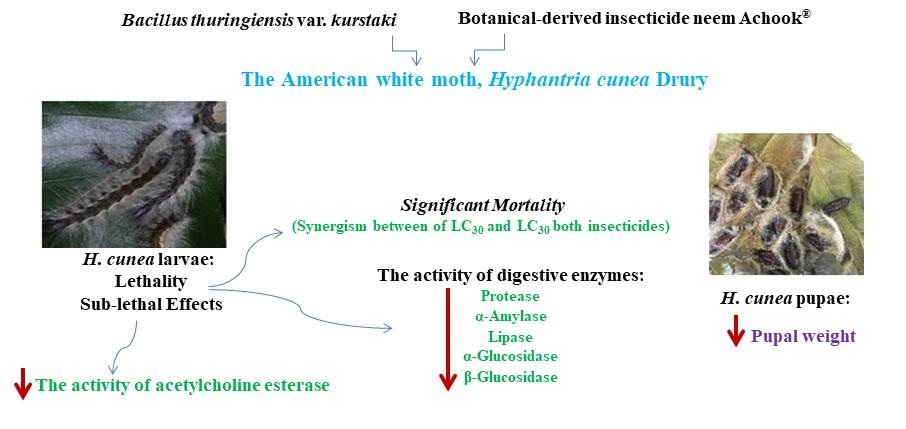
Comparative bioefficacy of Bacillus thuringiensis var. kurstaki and neem on American white moth, Hyphantria cunea Drury

1
Department of Plant Protection, University of Guilan, Rasht, Iran
2
School of Science, Engineering and Technology, Pennsylvania State University, Middletown, United States
3
Department of Plant Sciences, University of Mohaghegh Ardabili, Ardabil, Iran
A - Research concept and design; B - Collection and/or assembly of data; C - Data analysis and interpretation; D - Writing the article; E - Critical revision of the article; F - Final approval of article
Submission date: 2024-12-28
Acceptance date: 2025-03-17
Online publication date: 2026-04-28
Corresponding author
Journal of Plant Protection Research 2026;66(2):244-254
HIGHLIGHTS
- Bt and neem have a combined synergistic pesticidal effects on H. cunea
- Hyphantria cunea was susceptible to Bacillus thuringiensis var.kurstaki
- Hyphantria cunea was susceptible to botanical-derived insecticide neem Achook®
KEYWORDS
TOPICS
ABSTRACT
The American white moth, Hyphantria cunea Drury, is a polyphagous insect pest that feeds
on a wide range of fruit and forest trees. In the present study, the potential of the most commonly
used biological pesticide Bacillus thuringiensis var. kurstaki (Btk) and the botanical-
-derived insecticide neem Achook® and their combination on the mortality and physiological
disruptions of H. cunea was investigated. The LC30 (1.200 and 13.350 ppm for Bt and
neem, respectively), LC50 (3.103 and 31.753 ppm for Bt and neem, respectively), and their
combinations were considered in all biochemical assays. The combination of biopesticides
showed a synergistic phenomenon in all treatments at different concentrations. To explore
the underlying mechanisms, we assessed the main biochemical compounds, including
the activity of digestive and detoxifying enzymes of the moth larvae. Significant reductions
in the activities of protease, amylase, lipase, α-glucosidase, and β-glucosidase were
realized compared to the control (p < 0.05). The activities of detoxifying enzymes, specifically
α- and β-esterases, glutathione S-transferase, and phenol oxidase, exhibited significant
increases in the treated groups. Conversely, the activity of acetylcholine esterase was found
to be decreased across all treatment conditions. The treatments administered resulted in
a statistically significant reduction in pupal weight (p < 0.05). The lowest average pupal
weight was recorded for the combination of Bacillus thuringiensis (Bt) and neem at their
concentration (LC50) of 98.98 mg. This research demonstrated that using Bt and neem had
combined synergistic pesticidal effects that can be proposed for integrated pest management
of H. cunea.
RESPONSIBLE EDITOR
Beata Borowiak-Sobkowiak
CONFLICT OF INTEREST
The authors have declared that no conflict of interests exist.
REFERENCES (60)
1.
Abedi Z., Saber M., Vojaudi S., Mahdavi V., Parsaeyan E. 2014. Acute, sublethal, and combination effects of azadirachtin and Bacillus thuringiensis on the cotton bollworm, Helicoverpa armigera. Journal of Insect Science 14 (1): 30. DOI: https://doi.org/10.1093/jis/14....
2.
Allahvaisi S., Hassani M., Heidari B. 2021. Bioactivity of azadirachtin against Scrobipalpa ocellatella Boyd. (Lepidoptera: Gelechidae) on sugar beet. Journal of Plant Protection Research 61: 280–289. DOI: https://doi.org/10.24425/jppr.....
3.
Amizadeh M., Hejazi M.J., Niknam G., Askari-Saryazdi G. 2019. Interaction between the entomopathogenic nematode Steinernema feltiae and selected chemical insecticides for management of the tomato leafminer, Tuta absoluta. Biocontrol 64 (5): 709–721. DOI: https://doi.org/10.1007/s10526....
4.
Ayilara M.S., Adeleke B.S., Akinola S.A., Fayose C.A., Adeyemi U.T., Gbadegesin L.A., Omole R. K., Johnson R.M., Uthman Q.O., Babalola O.O. 2023. Biopesticides as a promising alternative to synthetic pesticides: A case for microbial pesticides, phytopesticides, and nanobiopesticides. Frontiers in Microbiology 14: 1040901. DOI: https://doi.org/10.3389/fmicb.....
5.
Baranek J., Jakubowska M., Gabała E. 2023. Insecticidal activity of Bacillus thuringiensis towards Agrotis exclamationis larvae – A widespread and underestimated pest of the Palearctic zone. PLoS ONE 18 (3): e0283077. DOI: https://doi.org/10.1371/journa....
6.
Basij M., Sahebzadeh N., Shahriari M., Panahandeh S. 2023. Insecticidal potential of Ajwain essential oil and its major components against Chilo suppressalis Walker. Journal of Plant Diseases and Protection 130 (4): 735–745. DOI: https://doi.org/10.1007/s41348....
7.
Bernfeld P. 1955. Amylases α and β. p. 149–151. In: “Methods in Enzymology” (S.P. Colowick and N.O. Kaplan, eds). Academic Press.
8.
Bharti K., Joshi N., Khosla S., Kaur R. 2023. Compatibility of entomopathogenic fungus Metarhizium rileyi with biorationals. Indian Journal of Entomology 85 (1): 225–228. DOI: https://doi.org/10.55446/IJE.2....
9.
Birch A.N.E., Begg G.S., Squire G.R. 2011. How agro-ecological research helps to address food security issues under new IPM and pesticide reduction policies for global crop production systems. Journal of Experimental Botany 62 (10): 3251–3261. DOI: https://doi.org/10.1093/jxb/er....
10.
Chaudhari A.K., Singh V.K., Kedia A., Das S., Dubey N.K. 2021. Essential oils and their bioactive compounds as eco-friendly novel green pesticides for management of storage insect pests: Prospects and retrospects. Environmental Science and Pollution Research 28: 18918–18940. DOI: https://doi.org/10.1007/s11356....
11.
Ebadollahi A., Rahimi‐Nasrabadi M., Batooli H., Geranmayeh J. 2013. Evaluation of the insecticidal activities of three Eucalyptus species cultivated in Iran, against Hyphantria cunea Drury (Lepidoptera: Arctiidae). Journal of Plant Protection Research 53 (4): 347–352. DOI: https://doi.org/10.2478/jppr-2....
12.
Elpidina E.N., Vinokurov K.S., Gromenko V.A., Rudenskaya Y.A., Dunaevsk Y.E., Zhuzhikov D.P. 2001. Compartmentalization of proteinases and amylases in Nauphoeta cinerea midgut. Archives of Insect Biochemistry and Physiology 48 (4): 206–216. DOI: https://doi.org/10.1002/arch.1....
13.
Ferreira C., Terra W.R. 1983. Physical and kinetic properties of a plasma-membrane-bound β-D-glucosidase (cellobiase) from midgut cells of an insect (Rhynchosciara americana larva). Biochemical Journal 213 (1): 43–51. DOI: https://doi.org/10.1042/bj2130....
15.
Gabr B., Lemmons J.M., El-Bokl M.M. 2022. Potential of neem oil extract® against palmetto weevil larvae (Rhynchophorus cruentatus Fabricius) (Coleoptera: Curculionidae) and its impact on some detoxification enzymes. Journal of Entomology and Acarology Research 54 (1). DOI: https://doi.org/10.4081/jear.2....
16.
Geedi R., Reddy G.V. 2023. Recent advances and challenges in implementing IPM programmes in the entomological context of Indian agriculture. Indian Journal of Entomology 85 (1): 277–291. DOI: https://doi.org/10.55446/IJE.2....
17.
Guerrero M.G.G. 2023. Sporulation, structure assembly, and germination in the soil bacterium Bacillus thuringiensis: Survival and success in the environment and the insect host. Microbiology Research 14 (2): 466–491. DOI: https://doi.org/10.3390/microb....
18.
Habing W.H., Pabst M.J., Jakoby W.B. 1974. Glutathione S-transferases: The first enzymatic step in mercapturic acid formation. Journal of Biological Chemistry 249 (22): 7130–7139. DOI: https://doi.org/10.1016/S0021-... (19)42083-8.
19.
Han Z., Moores G.D., Denholm I., Devonshire A.L. 1998. Association between biochemical markers and insecticide resistance in the cotton aphid (Aphis gossypii Glover). Pesticide Biochemistry and Physiology 62 (3): 164–171. DOI: https://doi.org/10.1006/pest.1....
20.
Hiremath R., Ghante V.N., Hosamani A. 2020. Compatibility of entomopathogenic fungus Beauveria bassiana (Bals.) with selected chemical insecticides. Journal of Entomology and Zoology Studies 8 (6): 1542–1548. DOI: https://doi.org/10.22271/j.ent....
21.
Horowitz A.R., Ellsworth P.C., Ishaaya I. 2009. Biorational pest control – an overview. p. 1–20. In: “Biorational Control of Arthropod Pests”. Springer Dordrecht. DOI: https://doi.org/10.1007/978-90....
22.
Kamel A.S., Abd-EL Aziz M.F., EL-Barky N.M. 2010. Biochemical effects of three commercial formulations of Bacillus thuringiensis (Agerin, Dipel 2X, and Dipel DF) on Spodoptera littoralis larvae. Egyptian Academic Journal of Biological Sciences. A, Entomology 3 (1): 21–29. DOI: https://doi.org/10.21608/eajbs....
23.
Kaur R., Choudhary D., Bali S., Bandral S.S., Singh V., Ahmad M.A., Rani N., Singh T.G., Chandrasekaran B. 2024. Pesticides: An alarming detriment to health and environment. Science of the Total Environment 170113. DOI: https://doi.org/10.1016/j.scit....
24.
Kim D.E., Kil J. 2012. A report on the occurrence of and crop damage caused by Hyphantria cunea (Drury) within Korea. Korean Journal of Applied Entomology 51 (3): 285–293. DOI: https://doi.org/10.5656/KSAE.2....
25.
Klowden M.J. 2007. Physiological Systems in Insects. 2nd ed. Academic Press, 688 pp.
26.
Luo P., Qin D., Wu H., Zheng Q., Zhao W., Ye C., Shen S., Huang S., Cheng D., Zhang Z. 2023. Azadirachtin affected the intestinal structure and microbiota of adult Harmonia axyridis (Coleoptera: Coccinellidae) while controlling Spodoptera frugiperda (Lepidoptera: Noctuidae). Journal of Pest Science 96 (3): 973–988. DOI: https://doi.org/10.1007/s10340....
27.
Mathavan S., Sudha P.M., Pechimuthu S.M. 1989. Effect of Bacillus thuringiensis israelensis on the midgut cells of Bombyx mori larvae: A histopathological and histochemical study. Journal of Invertebrate Pathology 53 (2): 217–227. DOI: https://doi.org/10.1016/0022-2....
28.
Mawcha K.T., Malinga L., Muir D., Ge J., Ndolo D. 2025. Recent advances in biopesticide research and development with a focus on microbials. F1000Research 13: 1071. DOI: https://doi.org/10.12688/f1000....
29.
Miao YG. 2002. Studies on the activity of the alkaline phosphatase in the midgut of infected silkworm, Bombyx mori L. Journal of Applied Entomology 126: 138–142. DOI: https://doi.org/10.1046/j.1439....
30.
Mohammadi D., Abad R.P., Rashidi M.R., Mohammadi S.A. 2010. Study of cotton bollworm, Helicoverpa armigera Hübner (Lepidoptera: Noctuidae) using Dyar’s rule. Munis Entomology & Zoology 5 (1): 216–224.
31.
Murugesan P., Krishanan A., Ramasamy P., Chandrasekaran K., Rajendran J., Paramasivam S., Chinnaiyan U., Panneerselvam C., Aziz A.T., Alasmari A. 2023. Biorational methods for effective pest control management in stored products for agricultural sustainability. Entomological Research 54 (1): e12697. DOI: https://doi.org/10.1111/1748-5....
32.
Mordue(Luntz) A.J., Nisbet A.J. 2000. Azadirachtin from the neem tree Azadirachta indica: its action against insects. Anais da Sociedade Entomológica do Brasil 29 (4): 615–632. DOI: https://doi.org/10.1590/S0301-....
33.
Navya R.N., Balasubramani V., Raveendran M., Murugan M., Lakshmanan A. 2022. Characterization of indigenous Bacillus thuringiensis isolate RM11 toxic to the diamondback moth, Plutella xylostella (L.) (Lepidoptera: Plutellidae). Egyptian Journal of Biological Pest Control 32 (1): 1–10. DOI: https://doi.org/10.1186/s41938....
34.
Nouri-Ganbalani G., Borzoui E., Abdolmaleki A., Abedi Z., Kamita S.G. 2016. Individual and combined effects of Bacillus thuringiensis and azadirachtin on Plodia interpunctella Hübner (Lepidoptera: Pyralidae). Journal of Insect Science 16 (1): 95. DOI: https://doi.org/10.1093/jisesa....
35.
Oftadeh M., Sendi J.J., Ebadollahi A. 2020. Toxicity and deleterious effects of Artemisia annua essential oil extracts on mulberry pyralid (Glyphodes pyloalis). Pesticide Biochemistry and Physiology 170: 104702. DOI: https://doi.org/10.1016/j.pest....
36.
Oftadeh M., Sendi J.J., Ebadollahi A., Setzer W.N., Krutmuang P. 2021. Mulberry protection through flowering-stage essential oil of Artemisia annua against the lesser mulberry pyralid (Glyphodes pyloalis Walker). Foods 10 (2): 210. DOI: https://doi.org/10.3390/foods1....
37.
Palma L., Muñoz D., Berry C., Murillo J., Caballero P. 2014. Bacillus thuringiensis toxins: An overview of their biocidal activity. Toxins 6 (12): 3296–3325. DOI: https://doi.org/10.3390/toxins....
38.
Pinheiro D.H., Valicente F.H. 2021. Noxious components of venom from the pupa-specific parasitoid Pimpla hypochondriaca. Journal of Invertebrate Pathology 73 (1): 74–83. DOI: https://doi.org/10.1006/jipa.1....
39.
Quintero H.A., Serrão J.E., Martínez L.C. 2020. Insecticidal activity of Bacillus thuringiensis strains on the nettle caterpillar, Euprosterna elaeasa (Lepidoptera: Limacodidae). Insects 11 (5): 310. DOI: https://doi.org/10.3390/insect....
40.
Rezaei V., Jaafari Y., Moharramipour S., Talebi A.A. 2004. Biological study of American white webworm Hyphantria cunea Drury (Lep.: Arctiidae) in Guilan province. In: Proceeding of the 16th Iranian Plant Protection Congress. Vol. 1.
41.
Rezaei V., Moharamipour S., FathipourY., Talebi A.A. 2006. Some biological characteristics of American white webworm, Hyphantria cunea Drury (Lepidoptera: Arctiidae) in the Guilan province. Journal of the Entomological Society of Iran 26 (1): 33–43.
42.
Sabbahi R., Hock V., Azzaoui K., Saoiabi S., Hammouti B. 2022. A global perspective of entomopathogens as microbial biocontrol agents of insect pests. Journal of Agricultural and Food Chemistry 10: 100376. DOI: https://doi.org/10.1016/j.jafr....
43.
Sabbour M.M., E-Abd-El-Aziz S. 2010. Efficacy of some bioinsecticides against Bruchidius Incarnatus (Boh.) (Coleoptera: Bruchidae) infestation during storage. Journal of Plant Protection Research 50: 28–34. DOI: https://doi.org/10.2478/v10045....
44.
SAS Institute. (1997). SAS/STAT User’s Guide for Personal Computers. Cary, NC, USA.
45.
Senthil-Nathan S., Chunga P.G., Murugan K. 2006. Combined effect of biopesticides on the digestive enzymatic profiles of Cnaphalocrocis medinalis (Gueneé) (the rice leaf folder) (Insecta: Lepidoptera: Pyralidae). Journal of Ecology and Environment Safety 64: 382–389. DOI: https://doi.org/10.1016/j.ecoe....
46.
Senthil-Nathan S., Choi M.Y., Paik C.H., Seo H.Y., Kalaivani K. 2009. Toxicity and physiological effects of neem pesticides applied to rice on the brown planthopper, Nilaparvata lugens Stål. Ecotoxicology and Environmental Safety 72 (6): 1707–1713. DOI: https://doi.org/10.1016/j.ecoe....
47.
Shannag H.K., Capinera J.L., Freihat N.M. 2015. Effects of neem-based insecticides on consumption and utilization of food in larvae of Spodoptera eridania (Lepidoptera: Noctuidae). Journal of Insect Science 15 (1): 152. DOI: https://doi.org/10.1093/jisesa....
48.
Singh G., Rup P.J., Koul O. 2007. Acute, sublethal and combination effects of azadirachtin and Bacillus thuringiensis toxins on Helicoverpa armigera (Lepidoptera: Noctuidae) larvae. Bulletin of Entomological Research 97 (4): 351–357. DOI: https://doi.org/10.1017/S00074....
49.
Su M.W., Fang Y.L., Tao W.Q., Yan G.Z., Ma W.E. 2008. Identification and field evaluation of the sex pheromone of an invasive pest, Hyphantria cunea, in China. Chinese Science Bulletin 53 (4): 555–560. DOI: https://doi.org/10.1007/s11434....
50.
Trajković A., ŽikićV. 2023. Stuck in the caterpillars’ web: A half-century of biocontrol research and application on gregarious Lepidopteran pests in Europe. Sustainability 15 (4): 2881. DOI: https://doi.org/10.3390/su1504....
51.
Trisyono A., Whalon M.E. 1999. Toxicity of neem applied alone and in combinations with Bacillus thuringiensis to Colorado potato beetle (Coleoptera: Chrysomelidae). Journal of Economic Entomology 92 (6): 1281–1288. DOI: https://doi.org/10.1093/jee/92....
52.
Tsujita T., Ninomiya H., Okuda H. 1989. p-Nitrophenyl butyrate hydrolyzing activity of hormone-sensitive lipase from bovine adipose tissue. Journal of Lipid Research 30 (7): 997–1004. DOI: https://doi.org/10.1016/S0022-....
53.
Valizadeh B., Sendi J. J., Zibaee A., Oftadeh M. 2013. Effect of neem-based insecticide Achook® on mortality, biological and biochemical parameters of elm leaf beetle Xanthogaleruca luteola Müll (Col.: Chrysomelidae). Journal of Crop Protection 2 (3): 319–330. DOI: http://jcp.modares.ac.ir/artic....
54.
Wang D., Gong P., Li M., Qiu X., Wang K. 2009. Sublethal effects of spinosad on survival, growth and reproduction of Helicoverpa armigera (Lepidoptera: Noctuidae). Pest Management Science 65 (2): 223–227. DOI: https://doi.org/10.1002/ps.167....
55.
War A.R., Paulraj M.G., Hussain B., Ahmad T., War M.Y., Ignacimuthu S. 2014. Efficacy of a combined treatment of neem oil formulation and endosulfan against Helicoverpa armigera (Hűb.) (Lepidoptera: Noctuidae). International Journal of Insect Science 6 (1). DOI: https://doi.org/10.1177/IJIS.S....
56.
Yanar O., Topkara E.F., Solmaz F.G., Mercan S. 2021. Effects of plant phenolic compounds and Bacillus thuringiensis subsp. kurstaki on immune responses and antioxidant enzyme activities of Hyphantria cunea (Drury, 1773) (Lepidoptera: Arctiidae) larvae. Acta Zoologica Bulgarica 73 (4): 535–542.
57.
Yao P.H., Mobarak S.H., Yang M.F., Hu C.X. 2025. Differential detoxification enzyme profiles in C-corn strain and R-rice strain of Spodoptera frugiperda by comparative genomic analysis: insights into host adaptation. BMC Genomics 26 (1): 14. DOI: https://doi.org/10.1186/s12864....
58.
Zibaee A., Bandani A.R. 2010. Study on the toxicity of the medicinal plant, Artemisia annua L. (Astracea) extracts the sunn pest, Eurygaster integriceps Puton (Heteroptera: Scutelleridae). Journal of Plant Protection Research 50 (1): 79–85.
59.
Zibaee A., Bandani A.R., Ramzi S. 2009. Lipase and invertase activities in midgut and salivary glands of Chilo suppressalis (Walker) (Lepidoptera: Pyralidae), rice striped stem borer. Invertebrate Survey Journal 5 (2): 180–189.
60.
Zou C., Wang Y., Zou H., Ding N., Geng N., Cao C., Zhang G. 2019. Sanguinarine in Chelidonium majus induced antifeeding and larval lethality by suppressing food intake and digestive enzymes in Lymantria dispar. Pesticide Biochemistry and Physiology 153: 9–16. DOI: https://doi.org/10.1016/j.pest....
Share
RELATED ARTICLE
| eISSN: | 1899-007X |
| ISSN: | 1427-4345 |

We process personal data collected when visiting the website. The function of obtaining information about users and their behavior is carried out by voluntarily entered information in forms and saving cookies in end devices. Data, including cookies, are used to provide services, improve the user experience and to analyze the traffic in accordance with the Privacy policy. Data are also collected and processed by Google Analytics tool (more).
You can change cookies settings in your browser. Restricted use of cookies in the browser configuration may affect some functionalities of the website.
You can change cookies settings in your browser. Restricted use of cookies in the browser configuration may affect some functionalities of the website.