
RAPID COMMUNICATION
Endophytic potential of Beauveria bassiana (Bals.-Criv.) Vuill against sap-sucking insect pests in kiwi trees and cotton plants

1
Department of Agriculture, University of Loannina, Arta, Greece
2
Institute of Mediterranean Forest Ecosystems, Terma Alkmanos Ilisia, Athina, Greece
A - Research concept and design; B - Collection and/or assembly of data; C - Data analysis and interpretation; D - Writing the article; E - Critical revision of the article; F - Final approval of article
Submission date: 2025-08-24
Acceptance date: 2025-12-19
Online publication date: 2026-03-17
Corresponding author
Journal of Plant Protection Research 2026;66(1):121-127
HIGHLIGHTS
- Evaluation of the entomopathogenic action of B. bassiana on BMSB and cotton aphid
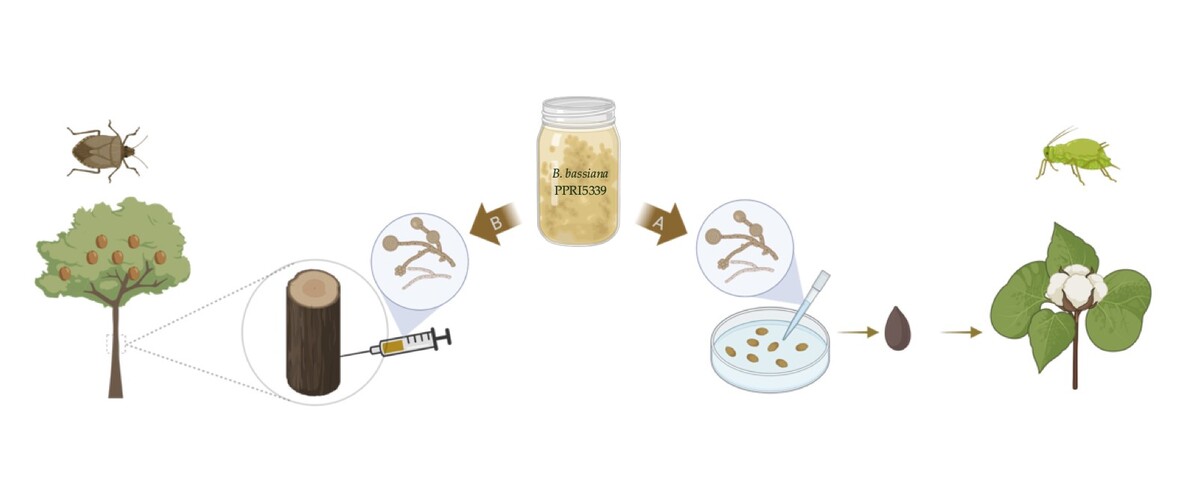
- Innoculation on kiwi tree trunk
- Application as seed coating on cotton seed
- Monitoring of total chlorophyll content and leaf area for both cases
KEYWORDS
TOPICS
ABSTRACT
Beauveria bassiana has proven to be an efficient crop colonizer due to its highly entomopathogenic
activity against a wide range of sap-sucking pests. In this work, two different
application methods of B. bassiana (Bals.-Criv.) strain PPRI 5339 were studied over
two consecutive years: (A) seed coating on cotton and (B) trunk inoculation to kiwi trees.
Untreated plants served as controls for both methods. The sucking insects, Aphis gossypii
(Glover) on cotton plants, and Halyomorpha halys (Stål) on kiwi trees, were counted, and
the total chlorophyll content and leaf area were measured as indicators of plant performance.
The presence of B. bassiana slightly reduced the population of sucking pests but
also enhanced the total chlorophyll content and the leaf area in both crops. These results
demonstrate the dual role of strain PPRI 5339 as both a biocontrol agent and a growth promoter,
highlighting its potential as an environmentally friendly alternative for managing
sap-sucking pests that severely affect agricultural production in Greece.
ACKNOWLEDGEMENTS
The author, Vasileios Papantzikos, was granted a scholarship
award from the Hellenic Entomological Society.
The authors gratefully acknowledge the Hellenic Entomological
Society for the doctoral grant and the Koliou
Group Co., S.A., Arta, Greece, for providing an
experimental kiwifruit orchard to conduct part of the
experiment.
RESPONSIBLE EDITOR
Danuta Sosnowska
CONFLICT OF INTEREST
The authors have declared that no conflict of interests exist.
Share
RELATED ARTICLE
| eISSN: | 1899-007X |
| ISSN: | 1427-4345 |

We process personal data collected when visiting the website. The function of obtaining information about users and their behavior is carried out by voluntarily entered information in forms and saving cookies in end devices. Data, including cookies, are used to provide services, improve the user experience and to analyze the traffic in accordance with the Privacy policy. Data are also collected and processed by Google Analytics tool (more).
You can change cookies settings in your browser. Restricted use of cookies in the browser configuration may affect some functionalities of the website.
You can change cookies settings in your browser. Restricted use of cookies in the browser configuration may affect some functionalities of the website.