
REVIEW
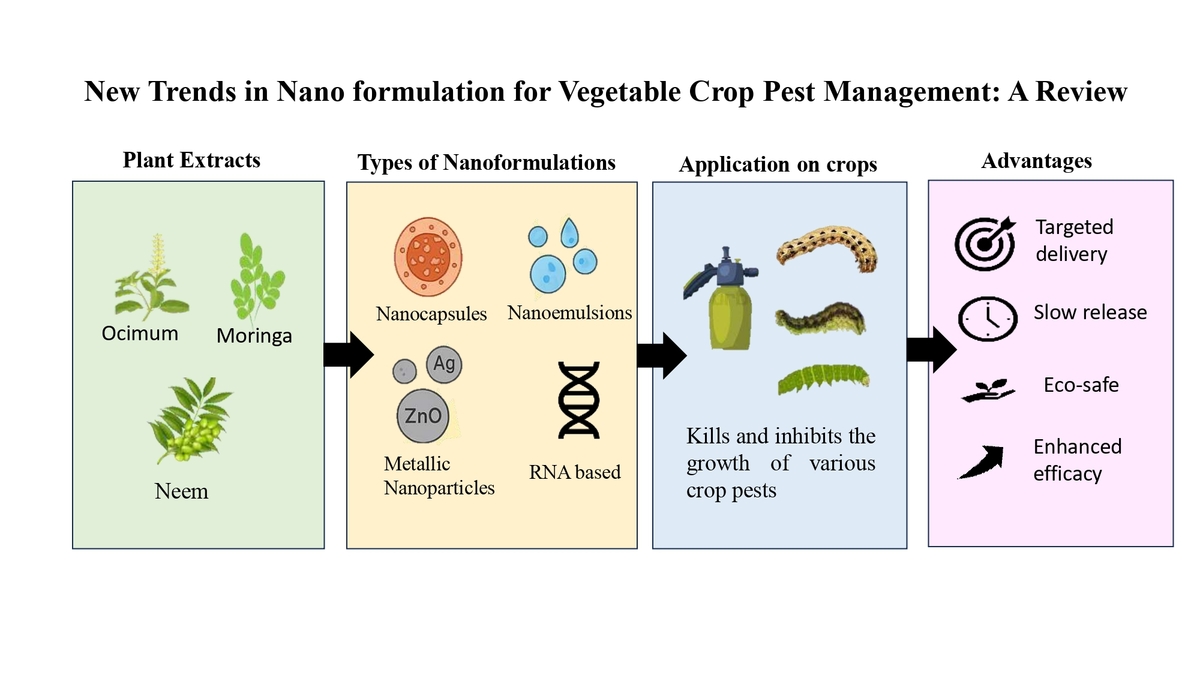
New Trends in Nano formulation for Vegetable Crop Pest Management: A Review
1
Department of zoology, University of Rajasthan, JLN marg, 302004, Jaipur, India
A - Research concept and design; B - Collection and/or assembly of data; C - Data analysis and interpretation; D - Writing the article; E - Critical revision of the article; F - Final approval of article
Submission date: 2025-07-29
Acceptance date: 2025-10-14
Online publication date: 2025-12-03
Corresponding author
HIGHLIGHTS
- Nanoformulations offer eco-friendly solutions for vegetable pest management
- Biodegradable nanocarriers enhance pesticide safety and effectiveness
- Review discusses recent advances and challenges in nano-based pest control
KEYWORDS
TOPICS
ABSTRACT
The use of Insecticides remains one of the primary methods for controlling species harmful to crops. However, insecticides used for pest control pose hazards to human health and cause environmental damage. Nanotechnology has been used in the agriculture sector to address these problems and increase crop yield. Numerous formulations with various modes of action and applications have been developed, including solid-based nano-pesticides, controlled-release formulations, nanoemulsions and nanosuspensions. Nano-pesticides provide effective and environment friendly substitutes for controlling insect pests in fields and storage. Nanoparticles can be used to target particular pests, thereby minimizing off target impacts and increasing pest control effectiveness. Nano formulations enhance the stability and solubility of active ingredients, leading to better absorption and prolonged action, and also allow for the slow and controlled release of pesticides. Recently, green nanotechnology-based nanoparticles and nanoparticle-based RNA pesticides have been used as a recent trend to control vegetable crop pests. This review presents information about recently used nano formulations for vegetable crop pest management and their challenges.
CONFLICT OF INTEREST
The authors have declared that no conflict of interests exist.
Share
| eISSN: | 1899-007X |
| ISSN: | 1427-4345 |

We process personal data collected when visiting the website. The function of obtaining information about users and their behavior is carried out by voluntarily entered information in forms and saving cookies in end devices. Data, including cookies, are used to provide services, improve the user experience and to analyze the traffic in accordance with the Privacy policy. Data are also collected and processed by Google Analytics tool (more).
You can change cookies settings in your browser. Restricted use of cookies in the browser configuration may affect some functionalities of the website.
You can change cookies settings in your browser. Restricted use of cookies in the browser configuration may affect some functionalities of the website.