
ORIGINAL ARTICLE
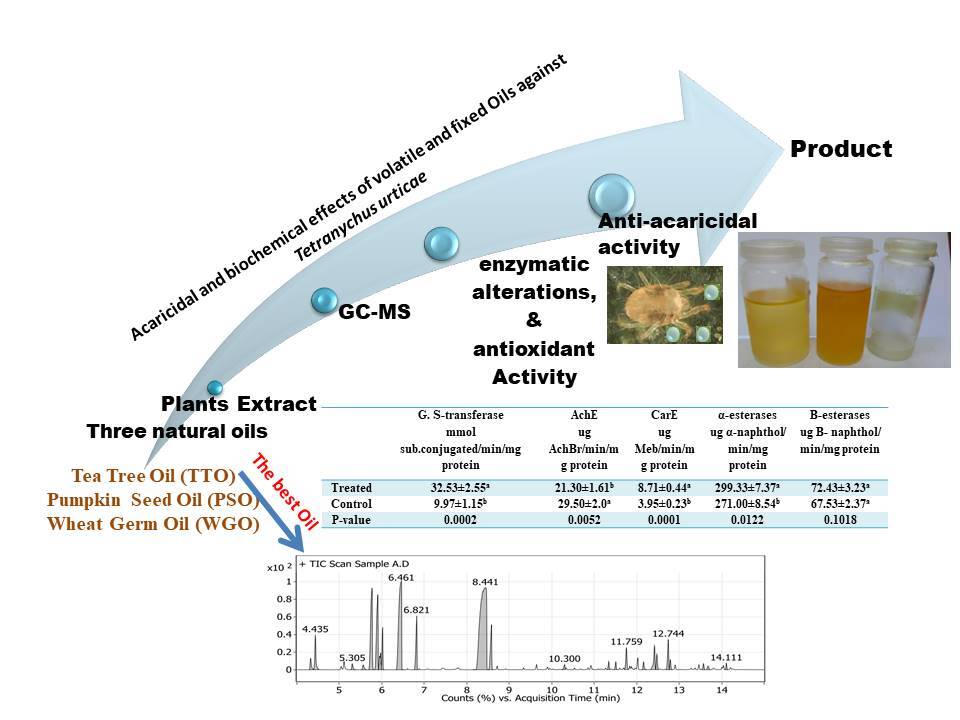
Natural oils as botanical acaricides: linking chemical composition, enzymatic disruption, and antioxidant capacity in the control of Tetranychus urticae

1
Medicinal and Aromatic Plants Research Department, National Research Centre, Dokki, Egypt
2
Vegetable and Ornamental Plant Mites Department, Plant Protection Research Institute, Agricultural Research Center, Cairo, Egypt
These authors had equal contribution to this work
A - Research concept and design; B - Collection and/or assembly of data; C - Data analysis and interpretation; D - Writing the article; E - Critical revision of the article; F - Final approval of article
Submission date: 2025-05-11
Acceptance date: 2025-09-17
Online publication date: 2026-05-28
Corresponding author
Mona A. Mohammed
Medicinal and Aromatic Plants Research Department, National Research Centre, Dokki, Egypt
Medicinal and Aromatic Plants Research Department, National Research Centre, Dokki, Egypt
Journal of Plant Protection Research 2026;66(2):234-243
HIGHLIGHTS
- Tea tree oil showed strongest acaricidal activity against Tetranychus urticae
- Pumpkin seed and wheat germ oils showed moderate acaricidal effects
- Tea tree oil significantly increased GST, CarE, and α-esterase levels in mites
- Acetylcholinesterase activity decreased after exposure to tea tree oil
- Natural oils offer eco-friendly alternatives for managing spider mite infestations
KEYWORDS
TOPICS
ABSTRACT
The two-spotted spider mite (Tetranychus urticae Koch) is a major agricultural pest, with
increasing resistance to synthetic pesticides thereby, driving the search for natural alternatives.
This study evaluated the acaricidal and antioxidant activities of tea tree oil (TTO,
Melaleuca alternifolia (Maiden and Betch) Cheel), pumpkin seed oil (PSO, Cucurbita pepo
L.), and wheat germ oil (WGO, Triticum aestivum L.) against T. urticae. Laboratory trials
determined LC50 and LC90 values for adults and eggs. Biochemical effects on mites surviving
TTO exposure were assessed by analyzing glutathione S-transferase (GST), acetylcholinesterase
(AchE), carboxylesterase (CarE), and α-esterases activities. Antioxidant activity
was evaluated via DPPH and ABTS assays. Gas chromatography-mass spectrometry
(GC-MS) identified 24 compounds in TTO, with 4-terpineol (36.65%) and γ-terpinene
(17.66%) as major components. TTO showed the highest acaricidal activity (LC50 of 0.3%
for adults and 1.8% for eggs), outperforming PSO and WGO. TTO exposure significantly
disrupted key enzymatic activities, impairing mite survival. Among the oils, TTO
exhibited the strongest antioxidant activity. The antioxidant assays revealed that while all
three oils demonstrated dose-dependent antioxidant effects, TTO was markedly more effective
than PSO and WGO, although less potent than vitamin C and Trolox. Additionally,
TTO exposure resulted in significant reductions in detoxification enzyme activity, particularly
GST and AchE, highlighting a biochemical mechanism underlying its acaricidal
action. The lipophilic properties of TTO likely enhance its penetration through the mite
cuticle, increasing its efficacy. These findings support the use of plant-derived oils as ecofriendly
alternatives for sustainable pest management and suggest potential for further development
into natural pesticide formulations.
ACKNOWLEDGEMENTS
The authors would like to express their sincere gratitude
to the National Research Center, for their valuable
support and technical assistance throughout this work.
Special thanks are also extended to the Agricultural Research
Center, for providing the necessary facilities and
resources that made this research possible.
RESPONSIBLE EDITOR
Piotr Iwaniuk
CONFLICT OF INTEREST
The authors have declared that no conflict of interests exist.
REFERENCES (42)
1.
Abbott W.S. 1925. A method of computing the effectiveness of an insecticide. Journal of Economy Entomology 18 (2): 265–267. DOI: https://doi.org/10.1093/jee/18....
2.
Abdelgaleil S.A., Badawy M.E., Mahmoud N.F., Marei A.E.-S.M. 2019. Acaricidal activity, biochemical effects and molecular docking of some monoterpenes against two-spotted spider mite (Tetranychus urticae Koch). Pesticide Biochemistry and Physiology 156: 105–115. DOI: https://doi.org/10.1016/j.pest....
3.
Adesanya A.W., Lavine M.D., Moural T.W., Lavine L.C., Zhu F., Walsh D.B. 2021. Mechanisms and management of acaricide resistance for Tetranychus urticae in agroecosystems. Journal of Pest Science 94: 639–663. DOI: https://doi.org/10.1007/s10340....
4.
Adly D., Bakr E. 2016. The toxic effect of camphor vapour against Aphis craccivora Koch (Hemiptera: Aphididae) and some of its natural enemies. Journal of Crop Protection 5 (1): 149–156. DOI: https://doi.org/10.18869/modar....
5.
Afify A.E.-M.M., Ali F.S., Turky A. 2012. Control of Tetranychus urticae Koch by extracts of three essential oils of chamomile, marjoram and Eucalyptus. Asian Pacific Journal of Tropical Biomedicine 2 (1): 24–30. DOI: https://doi.org/10.1016/S2221-....
6.
Anholeto L.A., Blanchard S., Wang H.V., de Souza Chagas A.C., Hillier N.K., Faraone N. 2024. In vitro acaricidal activity of essential oils and their binary mixtures against Ixodes scapularis (Acari: Ixodidae). Ticks and Tick-borne Diseases 15 (2): 102309. DOI: https://doi.org/10.1016/j.ttbd....
7.
Brun P., Bernabè G., Filippini R., Piovan A. 2019. In vitro antimicrobial activities of commercially available tea tree (Melaleuca alternifolia) essential oils. Current Microbiology 76: 108–116. DOI: https://doi.org/10.1007/s00284....
8.
Buteler M., Alma A.M., Herrera M.L., Gorosito N.B., Fernández P.C. 2021. Novel organic repellent for leaf-cutting ants: tea tree oil and its potential use as a management tool. International Journal of Pest Management 67 (1): 1–9. DOI: https://doi.org/10.1080/096708....
9.
Chaves N., Santiago A., Alías J.C. 2020. Quantification of the antioxidant activity of plant extracts: Analysis of sensitivity and hierarchization based on the method used. Antioxidants 9 (1): 76. DOI: https://doi.org/10.3390/antiox....
10.
Dib N., Abdel Rahman T., Ashour A., Badawy H. 2017. In vitro evaluation of certain fungicides against Botrytis cinerea isolates the causal pathogen of gray mold disease on tomato. Journal of Plant Protection and Pathology 8 (5): 195–200. DOI: https://doi.org/10.21608/jppp.....
11.
Dinkova-Kostova A., Cheah J., Samouilov A., Zweier J., Bozak R., Hicks R., Talalay P. 2007. Phenolic Michael reaction acceptors: combined direct and indirect antioxidant defenses against electrophiles and oxidants. Medicinal Chemistry 3 (3): 261–268. DOI: https://doi.org/10.2174/157340....
12.
Dunford N.T., Zhang M. 2003. Pressurized solvent extraction of wheat germ oil. Food Research International 36 (9–10): 905–909. DOI: https://doi.org/10.1016/S0963-....
13.
Ellaithy A., Abdel-khalek A., Mohammed M. 2022. The potency of ricinine biopesticide from Ricinus communis leaves as an alternative host for mass rearing process of Tetranychus urticae and two predatory phytoseiid mites. Egyptian Journal of Chemistry 65 (6): 535–549. DOI: https://doi.org/10.21608/ejche....
14.
Finney D. 1971. Statistical logic in the monitoring of reactions to therapeutic drugs. Methods of Information in Medicine 10 (04): 237–245. DOI: https://doi.org/10.1016/s0140-....
15.
Habashy M.G., Abou El Atta D.A., Saleh F.M. 2023. Efficacy of selected plant-derived oils against Tetranychid Mite (Tetranychus urticae) (Acari: Tetranychidae), in laboratory and semi field conditions. International Journal of Zoology Studies 8: 47–52. DOI: https://doi.org/10.21608/ajesa....
16.
Habig W.H., Pabst M.J., Jakoby W.B. 1974. Glutathione S-transferases: the first enzymatic step in mercapturic acid formation. Journal of Biological Chemistry 249 (22): 7130–7139. DOI: https://doi.org/10.1016/S0021-....
17.
Homer L.E., Leach D.N., Lea D., Lee L.S., Henry R.J., Baverstock P.R. 2000. Natural variation in the essential oil content of Melaleuca alternifolia Cheel (Myrtaceae). Biochemical Systematics and Ecology 28 (4): 367–382. DOI: https://doi.org/10.1016/s0305-....
18.
Hussein H., Reda A., Momen F. 2013. Repellent, antifeedent and toxic effects of three essential oils on the two spotted spider mite, Tetranychus urticae Koch (Acari: Tetranychidae). Acta Phytopathologica et Entomologica Hungarica 48 (1): 177–186. DOI: https://doi.org/10.1556/APhyt.....
19.
Kan A. 2012. Chemical and elemental characterization of wheat germ oil (Triticum spp. L.) cultivated in Turkey. African Journal of Agricultural Research 7: 4979–4982. DOI: https://doi.org/10.5897/AJAR12....
20.
Kumral M. 2010. Robust stochastic mine production scheduling. Engineering Optimization 42 (6): 567–579. DOI: https://doi.org/10.1080/030521....
21.
Mohammed M.A., Elzefzafy N., El-Khadragy M.F., Alzahrani A., Yehia H.M., Kachlicki P. 2024. Comprehensive tools of alkaloid/volatile compounds–metabolomics and DNA profiles: Bioassay-role-guided differentiation process of six Annona sp. grown in Egypt as anticancer therapy. Pharmaceuticals 17 (1): 103. DOI: https://doi.org/10.3390/ph1701....
22.
Mohammed M.A., Hamed M.A., El-Gengaihi S.E., Enein A.M.A., Kachlicki P., Hassan E.M. 2022a. Profiling of secondary metabolites and DNA typing of three different Annona cultivars grown in Egypt. Metabolomics 18 (7): 49. DOI: https://doi.org/10.1007/s11306....
23.
Mohammed M.A., Ibrahim B.M., Abdel-Latif Y., Hassan A.H., El Raey M.A., Hassan E.M., El-Gengaihi S.E. 2022b. Pharmacological and metabolomic profiles of Musa acuminata wastes as a new potential source of anti-ulcerative colitis agents. Scientific Reports 12 (1): 10595. DOI: https://doi.org/10.1038/s41598....
24.
Mwangi J.W., Kiragu D., Chaka B. 2024. Phytochemical screening, FTIR and GCMS analysis of Cucurbita pepo seeds cultivated in Kiambu county, Kenya. Heliyon 10 (9): e30237. DOI: https://doi.org/10.1016/j.heli....
25.
Neamah G.A.K., Alkhfaji M.A.S., Shaheed H.S. 2023. The antioxidant role of pumpkin (Cucurbita pepo) seed extract against acute reproductive toxicity by uranyl acetate in male rats. Journal of Advanced Veterinary and Animal Research 10 (4): 647. DOI: https://doi.org/10.5455/javar.....
26.
Olubomehin O.O., Atoyebi Y.O., Babarinde N.A. 2020. Chemical analysis of the seed oil of Canavalia ensiformis Linn. for nutritional and industrial qualities. African Journal of Science and Nature 6: 66–72. DOI: https://doi.org/10.46881/ajsn.....
27.
Payumo J., Bello-Bravo J., Chennuru V., Mercene S.A., Yim C., Duynslager L., Kanamarlapudi B., Posos-Parra O., Payumo S., Mota-Sanchez D. 2024. An assessment model for agricultural databases: the arthropod pesticide resistance database as a case study. Insects 15 (10): 747.
28.
Rakhmanov A. 2024. Tetranychus urticae Koch biology on apple trees. Бюллетень науки и практики 10 (10): 239–243. DOI: https://doi.org/10.33619/2414-....
29.
Rott A., Ponsonby D. 2000. Improving the control of Tetranychus urticae on edible glasshouse crops using a specialist coccinellid (Stethorus punctillum Weise) and a generalist mite (Amblyseius californicus McGregor) as biocontrol agents. Biocontrol Science and Technology 10 (4): 487–498. DOI: https://doi.org/10.1080/095831....
30.
Šamec D., Loizzo M.R., Gortzi O., Çankaya İ.T., Tundis R., Suntar İ., Shirooie S., Zengin G., Devkota H.P., Reboredo‐Rodríguez P. 2022. The potential of pumpkin seed oil as a functional food – A comprehensive review of chemical composition, health benefits, and safety. Comprehensive Reviews in Food Science and Food Safety 21 (5): 4422–4446. DOI: https://doi.org/10.1111/1541-4....
31.
Scott I.M., McDowell T., Renaud J.B., Krolikowski S.W., Chen L., Dhaubhadel S. 2021. Soybean (Glycine max L. Merr) host-plant defenses and resistance to the two-spotted spider mite (Tetranychus urticae Koch). Plos One 16 (10): e0258198. DOI: https://doi.org/10.1371/journa....
32.
Sharma R.K., Bhullar M.B., Kaur P. 2020. Current status of acaricide resistance in two spotted spider mite, Tetranychus urticae Koch and its underlying mechanism. Pesticide Research Journal 32 (2): 201–220. DOI: https://doi.org/10.5958/2249-5....
33.
Shelenga T.V., Piskunova T.M., Malyshev L.L., Taipakova A.A., Solovyeva A.E. 2020. Seed oil biochemical composition of cultivated Cucurbita L. species from the VIR Collections Grown in the Astrakhan Province of the Russian Federation. Agronomy 10 (10): 1491. DOI: https://doi.org/10.3390/agrono....
34.
Simpson R.B. 1964. Association constants of methylmercuric and mercuric ions with nucleosides. Journal of the American Chemical Society 86 (10): 2059–2065. DOI: https://doi.org/10.1021/ja0106....
35.
Singh A., Kumar V. 2024. Pumpkin seeds as nutraceutical and functional food ingredient for future: A review. Grain & Oil Science and Technology 7 (1): 12–29. DOI: https://doi.org/10.1016/j.gaos....
36.
Siraj N. 2022. Wheat germ oil: a comprehensive review. Food Science and Technology 42: e113721. DOI: https://doi.org/10.1590/fst.11....
37.
Topuz E., Madanlar N., Erler F. 2018. Chemical composition, toxic and development-and reproduction-inhibiting effects of some essential oils against Tetranychus urticae Koch (Acarina: Tetranychidae) as fumigants. Journal of Plant Diseases and Protection 125: 377–387. DOI: https://doi.org/10.1007/s41348....
38.
Van Asperen K. 1962. A study of housefly esterases by means of a sensitive colorimetric method. Journal of Insect Physiology 8 (4): 401–416. DOI: https://doi.org/10.1016/0022-1....
39.
Wang T., Johnson L.A. 2001. Refining high-free fatty acid wheat germ oil. Journal of the American Oil Chemists' Society 78: 71–76. DOI: https://doi.org/10.1007/s11746....
40.
Younis Y., Ghirmay S., Al-Shihry S. 2000. African Cucurbita pepo L.: properties of seed and variability in fatty acid composition of seed oil. Phytochemistry 54 (1): 71–75. DOI: https://doi.org/10.1016/s0031-....
41.
Zargar S., Wani T.A., Rizwan Ahamad S. 2023. An insight into wheat germ oil nutrition, identification of its bioactive constituents and computer-aided multidimensional data analysis of its potential anti-inflammatory effect via molecular connections. Life 13 (2): 526. DOI: https://doi.org/10.3390/life13....
42.
Zieliński M., Zalewski A., Łaba S. 2025. Sustainability conditions of Polish agriculture in the context of the use of plant protection products, as compared to other European Union countries. Economic aspects. Journal of Plant Protection Research: 45–60. DOI: https://doi.org/10.24425/jppr.....
Share
RELATED ARTICLE
| eISSN: | 1899-007X |
| ISSN: | 1427-4345 |

We process personal data collected when visiting the website. The function of obtaining information about users and their behavior is carried out by voluntarily entered information in forms and saving cookies in end devices. Data, including cookies, are used to provide services, improve the user experience and to analyze the traffic in accordance with the Privacy policy. Data are also collected and processed by Google Analytics tool (more).
You can change cookies settings in your browser. Restricted use of cookies in the browser configuration may affect some functionalities of the website.
You can change cookies settings in your browser. Restricted use of cookies in the browser configuration may affect some functionalities of the website.