
REVIEW
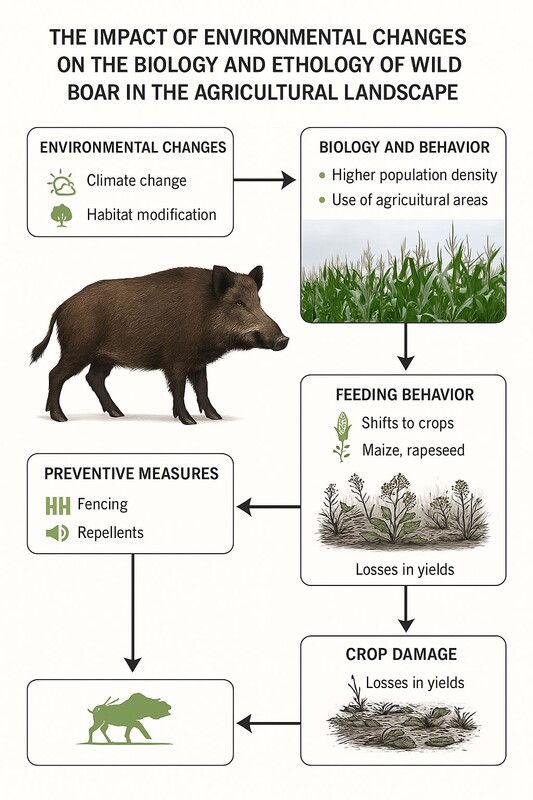
The impact of environmental changes on the biology and ethology of wild boar in the agricultural landscape
1
Entomology and Animal Agrophagues, Institute of Plant Protection – NRI, Poznań, Poland
2
Plant Health Surveillance Department, Provincial Inspectorate of Plant Health and Seed Inspection in Poznań, Środa Wielkopolska, Poland
3
Plant Health Surveillance Department, Provincial Inspectorate of Plant Health and Seed Inspection in Poznań, Poznań, Poland
A - Research concept and design; B - Collection and/or assembly of data; C - Data analysis and interpretation; D - Writing the article; E - Critical revision of the article; F - Final approval of article
Submission date: 2025-03-17
Acceptance date: 2025-05-16
Online publication date: 2025-12-19
Corresponding author
Paweł Węgorek
Entomology and Animal Agrophagues, Institute of Plant Protection – NRI, Poznań, Poland
Entomology and Animal Agrophagues, Institute of Plant Protection – NRI, Poznań, Poland
Journal of Plant Protection Research 2025;65(4):455-464
HIGHLIGHTS
- Damages caused by wild boar in the most important crops
- Wild boar as one of the main agricultural pests
- Crop protection against wild boar
KEYWORDS
TOPICS
ABSTRACT
Environmental changes significantly impact the populations of various game mammal species,
altering their biology, behavior, feeding preferences, and the extent of damage they
cause to agricultural crops. This study focused on the current status of the wild boar (Sus
scrofa L.) — a species that has become a major agricultural pest in certain agricultural
crops. In Greater Poland, which is an agricultural region of Poland, wild boars cause the
greatest damage to rapeseed and maize crops. Both plant species are mainly damaged
during the spring and summer growing seasons, as wild boars not only forage in these
fields but also create shelter areas within them, which leads to significant yield losses. This
analysis considered both the negative consequences of its presence and the positive role it
plays in the ecosystem. A substantial part of the presented information is based on research
and observations conducted at the Game Breeding Center of the Institute of Plant Protection
– National Research Institute in Poznań (GBC OPP-NRI), within hunting district
no. 311 (Jarocin Forest District) near Winna Góra.
RESPONSIBLE EDITOR
Jacek Twardowski
CONFLICT OF INTEREST
The authors have declared that no conflict of interests exist.
REFERENCES (43)
1.
Alves E.C., Ovilo M., Rodriguez C., Silio L. 2003. Mitochondrial DNA sequence variation and phylogenetic relationships among Iberian pigs and other domestic and wild pigs populations. Animal Genetics 34 (5): 319–324. DOI: 10.1046/j.1365-2052.2003.01010.x.
2.
Aplin M.L., Farine D.R., Morand-Ferron J., Cockburn A., Thornton A., Sheldon B.C. 2015. Experimentally induced innovations lead to persistent culture via conformity in wild birds. Nature 518 (7540): 538¬–541. DOI: 10.1038/nature13998.
3.
Bartal I.B.A., Decety J., Mason P. 2011. Emphaty and pro-social behawior in rats. Science 334 (6061): 1427–1430. DOI: 10.1126/science.1210789.
4.
Bear M.F., Connors B.W., Paradiso M.A. (eds.). 2007. Neuroscience: Exploring the Brain. Williams and Wilkins, 857 pp.
5.
Bodenchuk M.J. 2008. Feral hog management: Tying performance measures to resources protected. In: “National Conference on feral hogs” (Vantassel S.M. ed.), St. Louis, Missouri. DOI: http://digitalcommons.unl.edu/....
6.
Briffa M., Weiss A. 2010. Animal Personality. Current Biology 20: 912–914. DOI: 10.1016/j.cub.2010.09.019.
7.
Cooper Jr. W., Burghardt G.M.. 1990. Vomerolfaction and vomodor. Journal of Chemical Ecology 16 (1): 103–105. DOI: 10.1007/BF01021271.
8.
Diegemanse N.J., Reale D. 2005. Natural selection and animal personality. Behaviour 142 (9–10): 1159-1168.
9.
Ditchkoff S.S., Mayer J.J. 2009. Wild pig food habits. p. 105–143. In: “Wild Pigs. Biology, Damage, Control Techniques and Management” (Mayer and Brisbin, eds.). Savannah River National Laboratory Aiken, South Carolina, 400 pp.
10.
Erdtmann D., Keuling O. 2020. Behavioural patterns of free roaming wild boar in a spatiotemporal context. PeerJ. DOI: 10.7717/peerj.10409.
11.
Fernández-Llario P., Mateos-Quesada P. 1998. Body size and reproductive parameters in the wild boar. Acta Theriologica 43: 439–444.
12.
Fernández-Llario P., Carranza J., Mateos-Quesada P. 1999. Sex allocation in a polygynous mammal with large litters: the wild boar. Animal Behaviour 58: 1079–1084.
13.
Fernández-Llario P., Carranza J. 2000. Reproductive performance of the wild boar in a Mediterranean ecosystem under drought conditions. Ethology, Ecology and Evolution 12: 335–343.
14.
Fernández-Llario P., Mateos-Quesada P., Silverio A., Santod P. 2003. Habitat effects and shooting techniques on two Wild boar (Sus scrofa) populations in Spain and Portugal. Zeitschrift für Jagdwissenschaft 49: 120–129.
15.
Ganges L., Crooke H. R., Postel A., Sakoda Y., Becher P., Ruggli N. 2020. Classical swine fever virus: the past, present and future. Virus Research: 289. DOI: doi.org/10.1016/j.virusres.2020.198151.
16.
Garcia M., Gingras B., Bowling D.L., Herbst C.T., Boeckle M., Locatelli Y., Fitch W.T. 2016. Structural Classification of Wild Boar (Sus scrofa) Vocalizations. Ethology 122 (4): 329–342. DOI: 10.1111/eth.12472.
18.
Jerina K., Pokorny B., Stergar M. 2014. First evidence of long-distance dispersal of adult female wild boar (Sus scrofa) with piglets. European Journal of Wildlife Research 60: 367–370. DOI: https://doi.org/10.1007/s10344....
19.
Klingholz F., Siegert C., Meynhardt H. 1979. Die Akutische Kommunukation des Europaeischen Wildschweines (Sus scrofa L.). Der Zoologische Garten 49 (4–5): 277–303.
20.
Korbas M., Węgorek P., Zamojska J., Danielewicz J., Jajor E., Dworzańska D., Bandyk A., Horoszkiewicz-Janka J. 2016. Influence of Capreolus capreolus L. and Cervus elaphus L. feeding simulation on disease incidence rate and maize yielding. Fresenius Environmental Bullettin 25 (10): 4269–4277. DOI: 10.1515/chem-2021-0074.
21.
Linhart P., Ratcliffe V.F., Reby D., Špinka M. 2015. Expression of Emotional Arousal in Two Different Piglet Call Types. Plos One 10 (8): 0135414. DOI: 10.1371/journal.pone.0135414.
22.
Research Centre for Cultivar Testing. Lista odmian roślin rolniczych COBORU. https://www.coboru.gov.pl (in Polish).
23.
Maigrot A. L., Hillmann E., Briefer E.F. 2018. Encoding of Emotional Valence in Wild Boar (Sus scrofa) Calls. Animals 8: 85. DOI: https://doi.org/10.3390/ani806....
24.
Mayer J.J. 2009. Wild pig behaviour. p. 77–105. In: “Wild Pigs. Biology, Damage, Control Techniques and Management” (Mayer and Brisbin, eds.). Savannah River National Laboratory Aiken, South Carolina.
25.
Palinski R.M., Mitra N., Hause B.M. 2016. Discovery of a novel Parvovirinae virus, porcine parvovirus 7, by metagenomic sequencing of porcine rectal swabs. Virus Genes 52: 564-567. DOI: 10.1007/s11262-016-1322-1.
26.
Pałubicki J. 2016. The impact of mycotoxins contained in maize on the reproduction of wild boar (Sus scrofa L.). Doctoral Dissertation, Poznań University of Life Sciences, Faculty of Forestry. (Wpływ mikotoksyn zawartych w kukurydzy na rozrodczość dzików (Sus scrofa L.). Praca Doktorska, Uniwersytet Przyrodniczy w Poznaniu, Wydział Leśny.
27.
Ruiz-Fons F., Segales J., Gortazar Ch. 2008. A review of viral diseases of the European wild boar: Effects of population dynamics and reservoir role. The Veterinary Journal 176 (2): 158–169. DOI: 10.1016/j.tvjl.2007.02.017.
28.
Saha G.K., Mazumdar S. 2017. Wildlife Biology: An Indian Perspective. PHI Learning, 328 pp.
29.
Schley L., Roper T. J. 2003. Diet of wild boar Sus scrofa in Western Europe, with particular reference to consumption of agricultural crops. Mammal Review 33 (1): 43–56. DOI: 10.1046/j.1365-2907.2003.00010.x.
30.
Singer F.J., Ackerman B.B. 1981. Food availability, reproduction and condition of European wild board in Great Smoky Mountains National Park. Research, Resource Management, and Reports 43: 1–52.
31.
Snethlage K. 1982. Das Schwarzwild. 7th Edition. Verlag Paul Parey, Hamburg and Berlin, West Germany, 105 pp.
32.
Spinka M., Syrova M., Policht R., Linhart P. 2019. Early vocal ontogeny in a polytocous mammal: no evidence of social learning among sibling piglets, Sus scrofa. Animal Behaviour 151: 9–19. https://doi.org/10.1016/j.anbe....
33.
Sweeney J.R., Sweeney J.M., Sweeney S.W. 2003. Feral hog, Sus scrofa. p. 1164–1180. In: “Wild Mammals od North America: Biology, Management and Conservation” (Feldhammed G.A., Thompson B.C., Chapman J.A., eds.). The Johns Hopkins University Press, Baltimore, Maryland, 385 pp.
34.
Syrová M., Policht R., Linhart P., Špinka M. 2017. Ontogeny of individual and litter identity signaling in grunts of piglets. The Journal of the Acoustical Society of America 142 (5): 3116. DOI: 10.1121/1.5010330.
35.
Tallet C., Linhart P., Policht R., Hammerschmidt K., Šimeček P. 2013. Encoding of Situations in the Vocal Repertoire of Piglets (Sus scrofa): A Comparison of Discrete and Graded Classifications. Plos One 8 (8): 71841. DOI: https://doi.org/10.1371/journa....
36.
Verhulst C.E., Mateman A.C., Zwier M.V., Caro S.P., Verhoeven K.J.F., van Oers K. 2016. Evidence from pyrosequencing indicates that natural variation in animal personality is associated with DRD4 DNA methylation. Molecular Ecology 25: 1801–1811. DOI: 10.1111/mec.13519.
37.
Węgorek P., Zamojska J., Dworzańska D. 2009-2024. Game (wildlife) damage. [In:] Integrated Pest Management Methodologies and Signalman’s Guides of the Institute of Plant Protection – National Research Institute (IOR–PIB). (Szkody łowieckie. [W]: Metodyki Integrowanej Ochrony Roślin i Poradniki Sygnalizatora IOR – PIB).
38.
Węgorek P., Korbas M., Zamojska J., Bandyk A. 2011. Wpływ wielkości i rodzaju uszkodzeń rzepaku ozimego przez zwierzęta łowne na plonowanie roślin. Progress in Plant Protection/Postępy w Ochronie Roślin 51 (1): 227–231.
39.
Węgorek P., Zamojska J., Bandyk A., Olejarski P. 2014. Results of the monitoring of the effectiveness of repellents against wild boar in the fields. Progress in Plant Protection 54 (2). DOI: http://dx.doi.org/10.14199/ppp....
40.
Węgorek – personal observations at Game Breeding Center, Institute of Plant Protection – National Research Institute (GBC IPP – NRI).
41.
Wu G.S., Yao Y.G., Qu K.X., Ding Z.L., Li H., Palanichamy M.G., Duan Z.Y., Li N., Chen Y.S., Zhang Y.P. 2007. Population phylogenomic analysis of mitochondrial DNA in wild boars and domestic pigs revealed multiple domestication events in East Asia. Genome Biology 8: 245. DOI: https://doi.org/10.1186/gb-200....
Share
RELATED ARTICLE
| eISSN: | 1899-007X |
| ISSN: | 1427-4345 |

We process personal data collected when visiting the website. The function of obtaining information about users and their behavior is carried out by voluntarily entered information in forms and saving cookies in end devices. Data, including cookies, are used to provide services, improve the user experience and to analyze the traffic in accordance with the Privacy policy. Data are also collected and processed by Google Analytics tool (more).
You can change cookies settings in your browser. Restricted use of cookies in the browser configuration may affect some functionalities of the website.
You can change cookies settings in your browser. Restricted use of cookies in the browser configuration may affect some functionalities of the website.