ORIGINAL ARTICLE
The effect of yeast application on spike wheat pathogens

1
Department of Entomology and Phytopathology, University of Warmia and Mazury in Olsztyn, Prawocheńskiego 17, Olsztyn, 10-720, Olsztyn, Poland
A - Research concept and design; B - Collection and/or assembly of data; C - Data analysis and interpretation; D - Writing the article; E - Critical revision of the article; F - Final approval of article
Submission date: 2025-10-17
Acceptance date: 2026-10-19
Online pre-proof publication date: 2026-11-12
Corresponding author
Urszula Wachowska
Department of Entomology and Phytopathology, University of Warmia and Mazury in Olsztyn, Prawocheńskiego 17, Olsztyn, 10-720, Olsztyn, Poland
HIGHLIGHTS
- Biological treatments reduced the severity of Fusarium head blight
- Debaryomyces hansenii application reduced Fusarium and Alternaria pathogens
- Biological treatments application increased dominant yeast species on grain
KEYWORDS
TOPICS
ABSTRACT
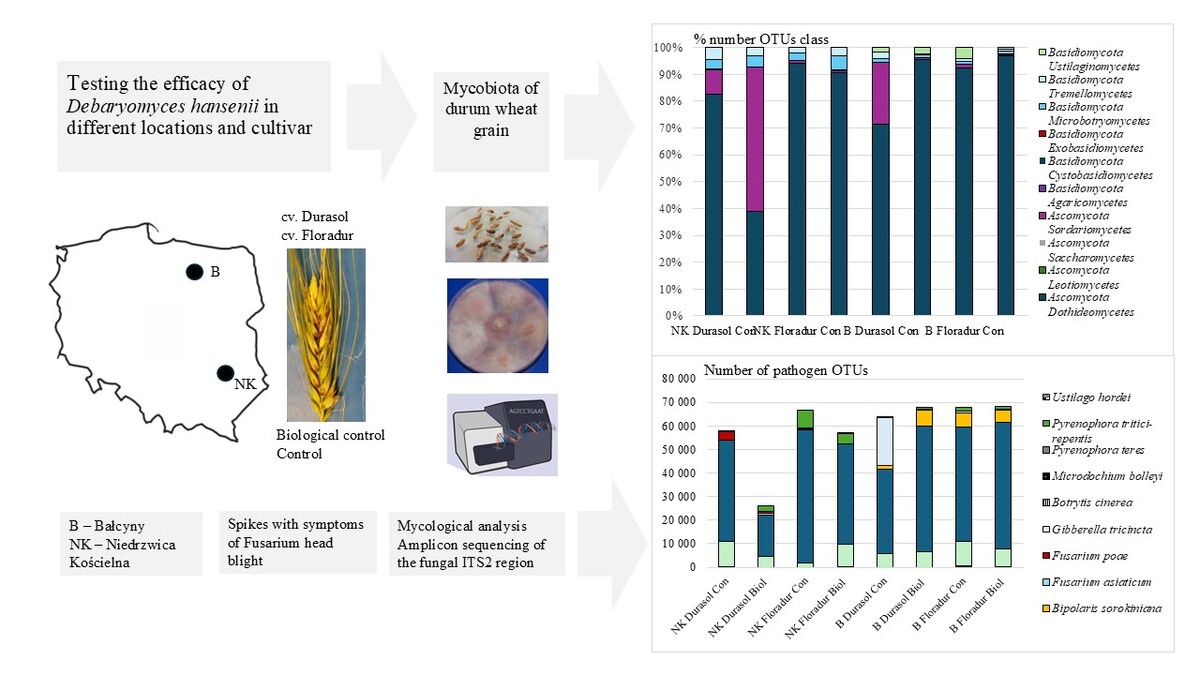
Fusarium head blight (FHB) and black sooty mold (BSM) are among the most dangerous and difficult to control diseases of wheat. Biological spike protection with selected yeast strains limits the spread of these pathogens with variable efficacy. The aim of this study was to select yeast strains Aureobasidium pullulans, Debaryomyces hansenii, and Rhodotorula glutinis that effectively inhibit Fusarium spp. and Alternaria spp. under field conditions and to determine their influence on the pathogens of wheat grain. Fungal DNA was extracted from wheat grain, and amplicon sequencing of the ITS2 region was performed to determine the composition of the wheat grain mycobiome. Biological treatments reduced the severity of FHB in common wheat and durum wheat. Biological protection clearly reduced the number of operational taxonomic units (OTUs) of Fusarium and Alternaria pathogens. This treatment also increased the number of OTUs associated with D. hansenii and other dominant yeast species on grain. To effectively protect spikes against pathogens, biocontrol agents optimal for specific wheat cultivars and locations should be selected based on grain mycobiome monitoring.
RESPONSIBLE EDITOR
Ewa Moliszewska
CONFLICT OF INTEREST
The authors have declared that no conflict of interests exist.
Share
RELATED ARTICLE
| eISSN: | 1899-007X |
| ISSN: | 1427-4345 |

We process personal data collected when visiting the website. The function of obtaining information about users and their behavior is carried out by voluntarily entered information in forms and saving cookies in end devices. Data, including cookies, are used to provide services, improve the user experience and to analyze the traffic in accordance with the Privacy policy. Data are also collected and processed by Google Analytics tool (more).
You can change cookies settings in your browser. Restricted use of cookies in the browser configuration may affect some functionalities of the website.